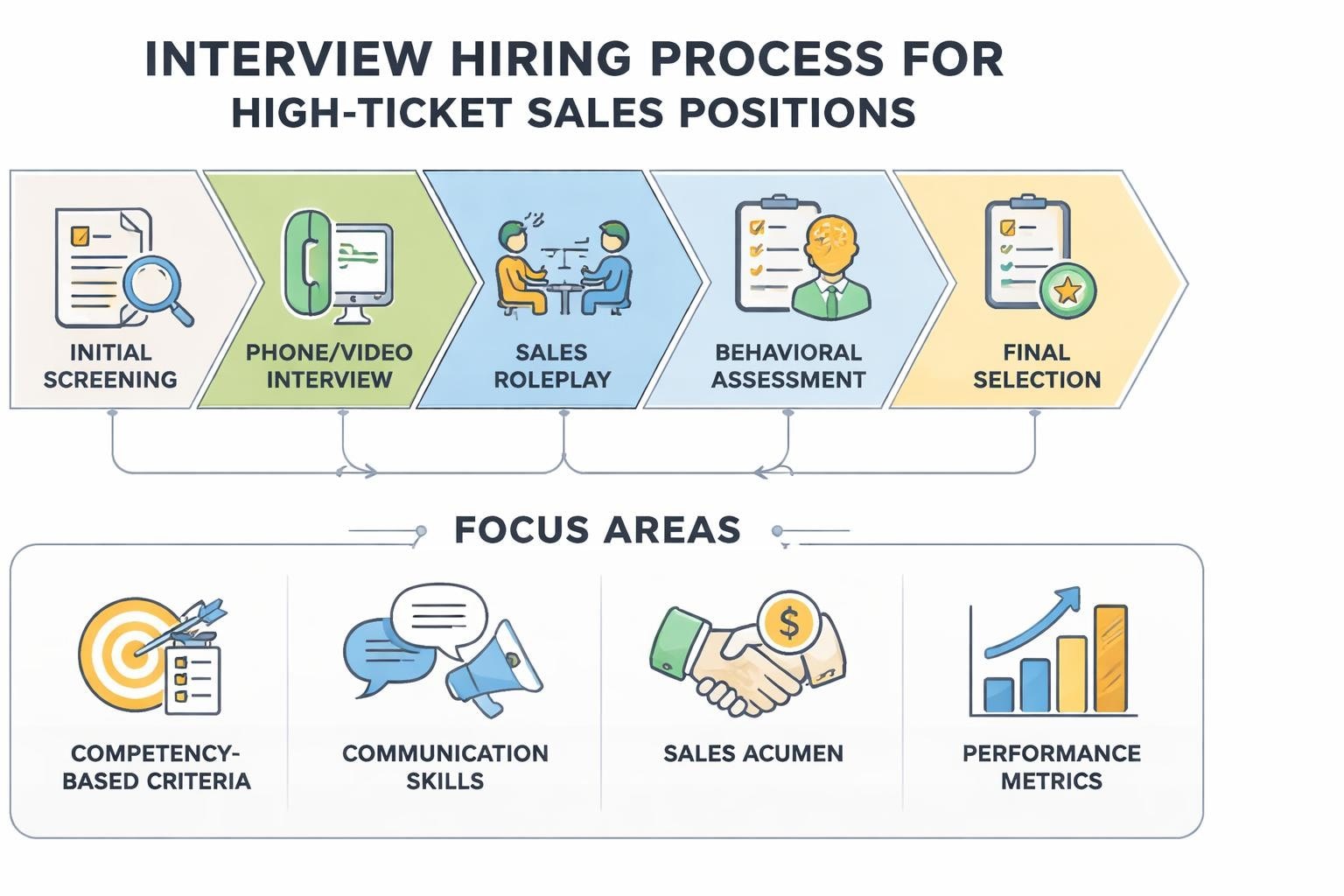
Interview Hiring: Building Elite Sales Teams in 2026
Master interview hiring for high-ticket sales roles. Learn structured techniques, competency-based assessment, and efficient processes to build winning teams.
published
The quality of your sales team directly determines your revenue trajectory, especially in high-ticket businesses where individual contributors can make or break quarterly targets. Interview hiring represents the critical gateway between your talent pool and your actual team composition, yet most businesses approach this crucial process with outdated techniques and inconsistent methodologies. For companies selling premium services over $2,500 through virtual channels, the stakes are even higher because remote sales professionals must demonstrate exceptional communication skills, technical proficiency, and self-motivation before they ever join your team. The difference between a methodical interview hiring approach and a haphazard one can mean the distinction between building a revenue-generating machine and constantly cycling through underperformers.
The Foundation of Effective Interview Hiring
Structured interview processes consistently outperform unstructured conversations by reducing bias and increasing predictive validity for job performance. Research published in the comprehensive review on employment interviews demonstrates that structured interviews can increase reliability coefficients significantly compared to casual interview approaches.
When building your interview hiring framework, start by defining exact competencies required for success in your specific sales environment. High-ticket sales roles demand different skill sets than transactional positions, particularly when deals close over Zoom or Google Meet rather than in-person meetings.
Competency-Based Assessment Criteria
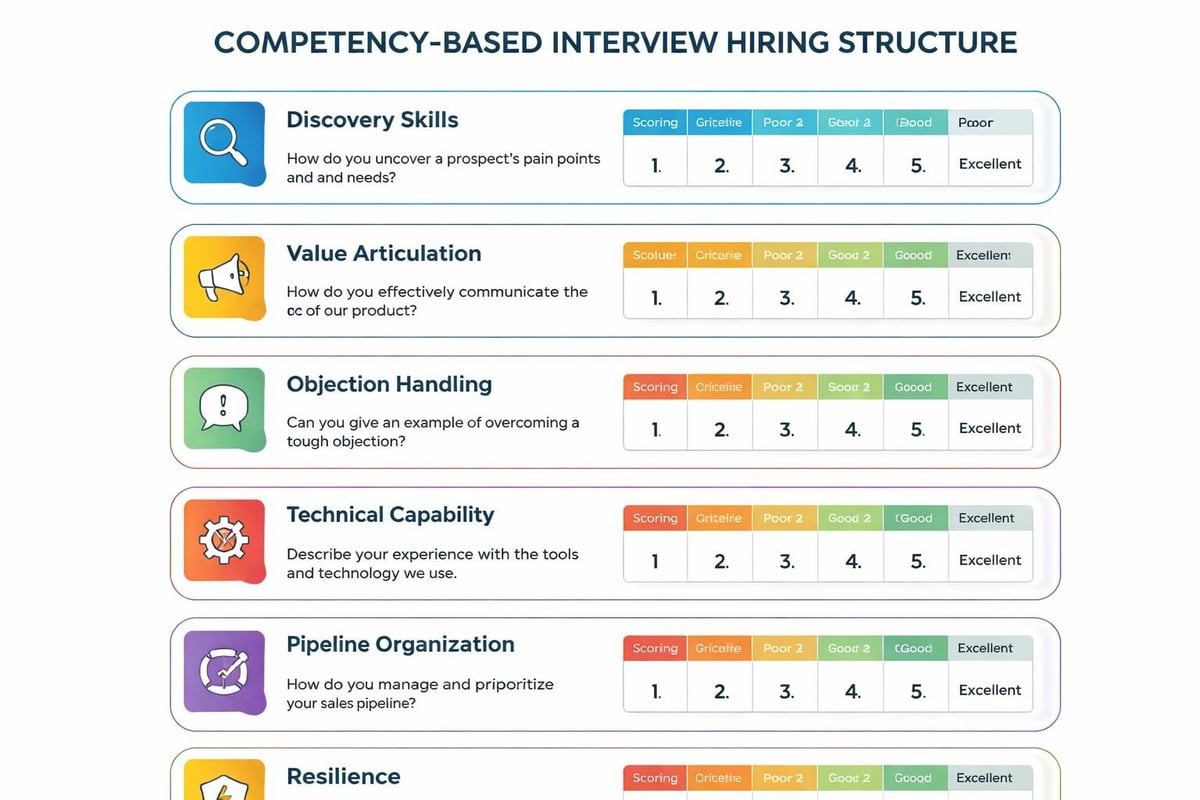
Competency-based recruitment focuses on candidates demonstrating specific abilities rather than simply discussing their experience. For sales positions in coaching, consulting, and service businesses, these competencies typically include:
Consultative discovery: Ability to uncover pain points through strategic questioning
Value articulation: Translating features into benefits relevant to specific buyer situations
Objection navigation: Addressing concerns without becoming defensive or dismissive
Technical proficiency: Managing CRM systems, video platforms, and communication tools
Pipeline management: Organizing opportunities and following systematic processes
Resilience and recovery: Maintaining performance after rejection or setbacks
Each competency should connect to specific interview questions and evaluation rubrics. Rather than asking candidates to describe their sales philosophy generally, present scenario-based challenges that require them to demonstrate these capabilities in real-time.
Creating Your Interview Hiring Framework
Your framework should outline exactly who interviews candidates, what each interviewer evaluates, and how decisions get made. This systematic approach prevents redundant questioning and ensures comprehensive assessment across all critical dimensions.
Interview Stage | Evaluator | Focus Areas | Duration |
|---|---|---|---|
Initial Screening | Recruiting Specialist | Basic qualifications, communication clarity, availability | 15-20 min |
Skills Assessment | Sales Manager | Sales methodology, discovery process, objection handling | 45-60 min |
Role-Play Scenario | Senior Closer | Live demonstration of sales conversation | 30-45 min |
Cultural Alignment | Team Lead | Values fit, collaboration style, growth mindset | 30 min |
Final Discussion | Leadership | Compensation expectations, long-term goals, logistics | 20-30 min |
This multi-stage approach allows different evaluators to focus on specific dimensions while preventing interview fatigue. According to best practices from the U.S. Office of Personnel Management, structured interviews with multiple assessors significantly reduce individual bias and improve hiring outcomes.
Technology-Mediated Interview Considerations
Remote sales positions require remote interview hiring processes, which introduces unique dynamics compared to traditional in-person assessments. A meta-analysis on technology-mediated interviews reveals important differences in how candidates present themselves and how interviewers evaluate performance through digital channels.
Video-based interviews eliminate geographical constraints but require careful attention to technical setup and candidate comfort levels. When your entire sales process happens through video conferencing, the interview itself becomes a preview of how candidates will perform in their actual role.
Optimizing Virtual Interview Hiring Sessions
Ensure candidates receive clear technical instructions at least 24 hours before their scheduled interview. This preparation time allows them to test equipment, adjust lighting, and familiarize themselves with the platform. Nothing derails an interview hiring process faster than spending the first ten minutes troubleshooting audio issues.
Consider these virtual interview best practices:
Send a detailed agenda outlining what candidates should prepare and who they'll meet
Test your own setup to ensure professional video quality and clear audio
Use the same platform your sales team uses daily to assess technical comfort
Record sessions (with permission) for review by additional stakeholders
Build in buffer time between interviews to prevent cascading delays
The interview scheduling best practices resource emphasizes how thoughtful scheduling and clear communication improve candidate experience while maintaining process efficiency.
Behavioral and Situational Questions That Reveal Truth
Generic interview questions produce generic responses that candidates have rehearsed dozens of times. Effective interview hiring requires questions that force candidates to demonstrate thinking processes and reveal authentic behavioral patterns.
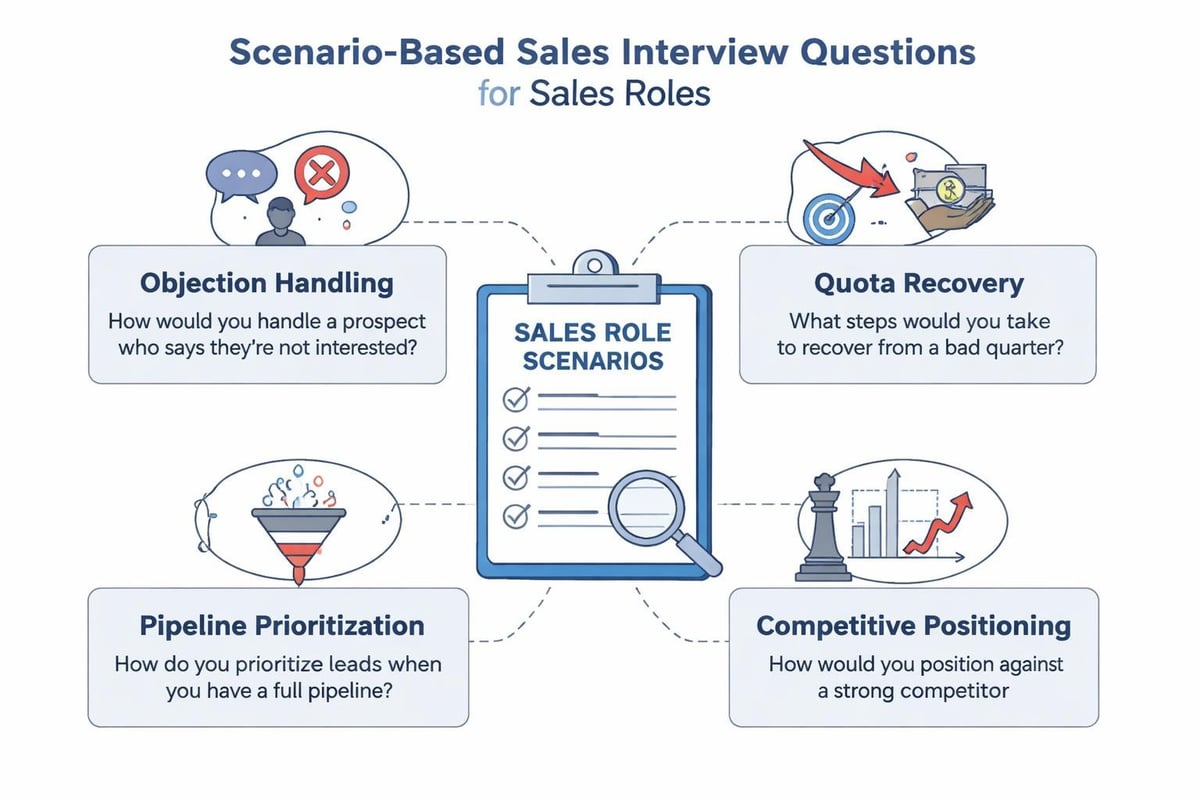
Situational questions present hypothetical scenarios specific to your business model, while behavioral questions ask candidates to describe past experiences with concrete examples. Both approaches provide valuable insights when structured properly.
High-Impact Questions for Sales Interview Hiring
Instead of asking "What's your greatest strength?", try these targeted alternatives:
"Walk me through your last sales conversation that didn't result in a close. What specifically happened, and what would you change?"
"A prospect says your price is 40% higher than a competitor they're considering. Take me through your exact response, word for word."
"Describe the last time you missed quota. What factors contributed, and how did you adjust your approach?"
"You have five opportunities in your pipeline, all at different stages. How do you decide where to focus your time today?"
These questions require specific answers that reveal actual experience rather than theoretical knowledge. Candidates who have genuinely succeeded in similar roles can provide detailed responses with specific numbers, timelines, and outcomes.
The Topgrading Chronological Interview Approach
The Topgrading methodology includes a comprehensive chronological interview that examines each position in a candidate's work history. This deep-dive approach takes significant time but uncovers patterns of success, challenges with authority, reasons for leaving positions, and consistency in performance claims.
When implementing elements of this approach in your interview hiring process, focus particularly on:
Specific metrics achieved in each sales role
Names and contact information for references at each company
Detailed reasons for leaving each position
Patterns in role duration and progression
Candidates who fabricate experience struggle with this level of detail and consistency across multiple conversations. Top performers appreciate the thoroughness because it allows them to fully demonstrate their track record.
Efficiency Without Sacrificing Quality
High-ticket businesses cannot afford lengthy hiring processes that allow top candidates to accept other offers while you deliberate. However, rushing interview hiring decisions to save time often results in expensive mistakes that cost far more than the days saved.
Research on group interviews as an efficient hiring method demonstrates how certain interview formats can reduce time and financial costs without compromising assessment quality. While group interviews work better for some positions than others, the underlying principle applies universally: design processes that evaluate multiple dimensions simultaneously.
Streamlining Your Interview Hiring Timeline
The 12 best practices for hiring efficiency include leveraging employee referrals, proactive sourcing, and self-scheduling tools. For sales-specific roles, consider these timeline optimizations:
Traditional Approach | Optimized Approach | Time Saved |
|---|---|---|
Sequential interviews over 3-4 weeks | Condensed interview day with multiple evaluators | 2-3 weeks |
Manual scheduling via email chains | Self-scheduling through calendar tools | 3-5 days |
Separate role-play assessment | Integrated role-play within main interview | 1 week |
Reference checks after verbal offer | Reference checks before final interview | 3-7 days |
Multiple decision-making meetings | Single collaborative debrief session | 2-4 days |
These adjustments can compress your interview hiring timeline from 4-6 weeks to 7-10 days without sacrificing assessment depth. Speed matters particularly for sales roles because top performers rarely remain available long in competitive markets.
When working with pre-vetted sales talent, much of the initial screening work has already been completed, allowing you to focus your interview hiring efforts on culture fit and role-specific assessment rather than basic qualification verification.
Assessment Beyond the Conversation
Words reveal intentions, but actions demonstrate capabilities. The most predictive interview hiring processes include practical assessments that simulate actual job responsibilities rather than relying solely on conversational interviews.
For high-ticket sales positions, practical assessments might include:
Mock discovery call: Provide a prospect profile and have candidates conduct a 15-minute discovery conversation
Email sequence creation: Ask candidates to write a three-touch email sequence for a specific prospect scenario
Objection response recording: Present common objections via email and request video responses
CRM navigation exercise: Have candidates demonstrate their ability to manage opportunities in your specific system
Competitive analysis presentation: Request a brief analysis of how your offer compares to a specific competitor
These assessments reveal competencies that conversational interviews cannot accurately measure. A candidate may discuss their discovery process eloquently but struggle to execute it under realistic conditions.
Scoring and Decision-Making Frameworks
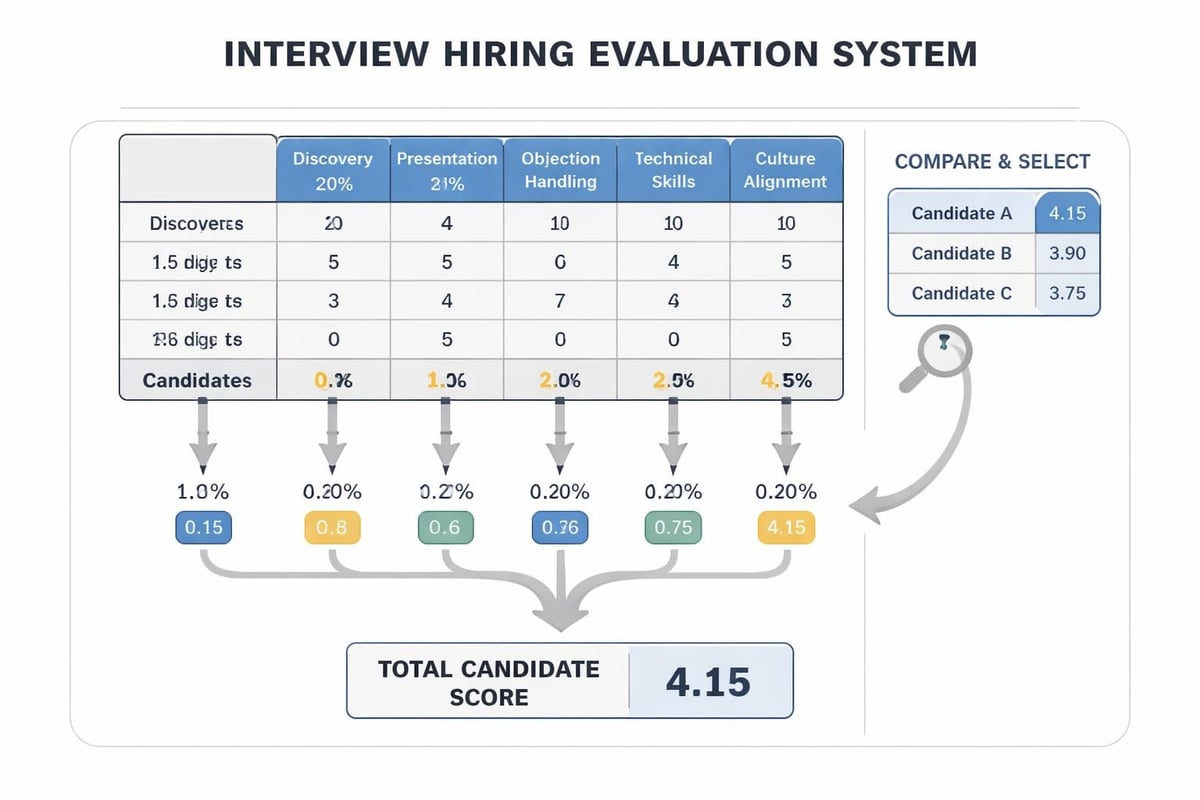
Subjective impressions create inconsistent interview hiring outcomes where charismatic candidates advance despite lacking core competencies. Implement numerical scoring rubrics for each assessment dimension:
Does not meet requirements: 1-2 points
Meets basic requirements: 3-4 points
Exceeds requirements: 5-6 points
Exceptional demonstration: 7-8 points
Calculate weighted scores based on competency importance. Discovery skills and objection handling might carry 20% weight each, while technical proficiency carries 10% for experienced sellers who can learn systems quickly.
Document specific evidence supporting each score rather than general impressions. "Candidate demonstrated consultative discovery by asking seven qualifying questions before presenting any solutions" provides actionable feedback and defensible decision rationale.
Building Interview Hiring Consistency Across Evaluators
Multiple interviewers provide comprehensive perspectives but also introduce variability in assessment standards. One evaluator might prioritize aggressive closing while another values relationship building, leading to conflicting evaluations of the same candidate.
Calibrate your interview hiring team through regular norming sessions where evaluators review recorded interviews together and discuss scoring rationale. This practice aligns standards and reduces individual bias over time.
Training Your Interview Team
Effective interviewers require specific training, particularly for sales-specific assessments. Consider these development areas:
Recognizing competency demonstrations versus rehearsed responses
Avoiding leading questions that telegraph desired answers
Managing conversation flow to ensure comprehensive coverage
Taking structured notes that support objective evaluation
Identifying red flags specific to high-ticket sales environments
Sales managers often conduct interviews without formal training in assessment techniques, relying on intuition developed through years of team management. While experience provides valuable context, systematic training in interview hiring methodology produces more reliable outcomes.
The Role of Cultural Alignment in Sales Interview Hiring
Technical skills and sales methodology matter enormously, but cultural misalignment creates friction that undermines even exceptional performers. Your interview hiring process must assess whether candidates will thrive within your specific team dynamics, communication norms, and operational philosophy.
Cultural fit does not mean hiring people who think identically. Diversity in perspective and background strengthens teams by introducing different approaches to problem-solving and customer engagement. Cultural alignment means sharing core values around work ethic, customer service philosophy, integrity, and collaboration.
Recent research on cultural biases in hiring evaluations emphasizes the importance of culturally sensitive assessment practices. This consideration applies whether you're evaluating candidates from different geographical regions or simply ensuring your standards don't inadvertently favor particular communication styles over others.
Questions That Reveal Cultural Compatibility
Rather than asking candidates to describe their ideal culture (which prompts them to mirror your description), present scenarios that reveal actual preferences:
"Describe a time when you disagreed with your manager's strategy. How did you handle it?"
"What type of recognition motivates you most: public acknowledgment, private appreciation, monetary bonuses, or increased responsibility?"
"When you're struggling with a deal, do you prefer to work through it independently or discuss it with teammates? Why?"
"How do you prefer to receive feedback: in the moment, during scheduled reviews, or through written communication?"
These questions don't have universally correct answers, but responses should align with your actual team culture. A candidate who thrives on constant collaboration will struggle in an environment emphasizing individual autonomy.
Avoiding Common Interview Hiring Pitfalls
Even structured processes fall victim to predictable mistakes that compromise hiring quality. Awareness of these pitfalls allows you to design safeguards into your interview hiring framework.
The recency bias causes interviewers to weight the most recent candidate more heavily than earlier ones, particularly when conducting multiple interviews in succession. Combat this by reviewing all candidate materials before making final decisions rather than evaluating immediately after each interview.
The similarity bias leads interviewers to favor candidates with backgrounds, communication styles, or experiences similar to their own. This creates homogeneous teams that lack diverse perspectives. Including multiple evaluators with different backgrounds in your interview hiring process provides natural protection against this tendency.
Red Flags in Sales Candidate Interviews
Certain warning signs should trigger additional scrutiny during interview hiring:
Vague responses without specific metrics or timelines
Consistent blaming of external factors for missed targets
Inability to articulate a clear sales methodology
Lack of curiosity about your product, market, or customers
Resistance to role-play or practical assessments
Unrealistic compensation expectations disconnected from performance history
Frequent job changes without clear progression
None of these automatically disqualifies a candidate, but each warrants deeper exploration. A single red flag might have a reasonable explanation, while multiple concerns suggest fundamental misalignment.
When considering replacement policies in your hiring decisions, recognize that even thorough interview hiring processes occasionally result in mismatches. Building safeguards into your employment arrangements protects your business while you continue refining your assessment methodology.
Making the Final Interview Hiring Decision
Data-informed decisions outperform gut instinct when supported by comprehensive evaluation frameworks. Compile all interview scores, practical assessment results, reference feedback, and documented observations before making final selections.
Conduct a collaborative decision meeting with all evaluators present. Each person shares their assessment based on specific evidence rather than general impressions. Discuss discrepancies in scoring to understand different perspectives and ensure all relevant information surfaces.
Consider creating a decision matrix that weighs multiple factors:
Candidate | Technical Score (40%) | Culture Score (25%) | Growth Potential (20%) | References (15%) | Total |
|---|---|---|---|---|---|
Candidate A | 7.2 | 8.0 | 6.5 | 7.8 | 7.3 |
Candidate B | 8.1 | 6.8 | 7.2 | 8.0 | 7.6 |
Candidate C | 6.8 | 7.5 | 8.0 | 7.0 | 7.2 |
This framework prevents single exceptional attributes from overshadowing significant weaknesses in other areas. The highest total score might not always win if certain minimum thresholds aren't met, but quantification forces explicit trade-off discussions.
Continuous Improvement of Interview Hiring Systems
Your interview hiring process should evolve based on hiring outcomes and team performance data. Track which interview indicators correlate with actual job success by comparing interview scores against 90-day performance metrics.
Candidates who scored highly on discovery assessments should demonstrate strong discovery execution in actual sales calls. If this correlation doesn't appear in your data, your discovery assessment may not accurately predict real-world capability.
Conduct regular retrospectives with your hiring team to identify process improvements. Which questions generated the most useful candidate information? Where did assessments fail to predict performance? What factors distinguished top performers from adequate ones?
Document these insights and update your interview hiring framework quarterly. This continuous refinement ensures your process adapts to changing market conditions, evolving role requirements, and lessons learned from previous hiring cycles.
Building a complete sales team requires systematic interview hiring processes that identify not just qualified candidates, but exceptional performers who will drive sustainable revenue growth. The investment in developing robust assessment frameworks pays dividends through improved hiring quality, reduced turnover, and stronger team performance.
Effective interview hiring transforms from a necessary administrative burden into a strategic advantage when you implement structured, competency-based assessment processes tailored to high-ticket sales environments. By combining behavioral interviews, practical assessments, multiple evaluator perspectives, and data-driven decision frameworks, you significantly increase the probability of identifying sales professionals who will thrive in your specific business context. When you need access to pre-vetted sales talent without the extensive time investment of building these systems yourself, Sales Match provides thoroughly assessed candidates ready to contribute immediately, backed by replacement guarantees that eliminate the risk of hiring decisions while you focus on scaling your business.