
Sales Appointment Setter: Build Your High-Ticket Pipeline
Discover how a sales appointment setter fills your calendar with qualified prospects. Learn strategies, best practices, and hiring tips for 2026.
published
The difference between a thriving sales operation and one that struggles often comes down to a single factor: consistent, qualified appointments. For high-ticket businesses selling complex products and services over the internet, the challenge isn't just finding prospects, but getting them on calls where real conversations can happen. This is where a sales appointment setter becomes invaluable. These specialized professionals focus exclusively on one mission: filling your sales team's calendar with qualified prospects who are ready to engage. Unlike traditional salespeople who handle the entire sales cycle, appointment setters excel at the critical top-of-funnel work that determines whether your closers have opportunities to work with or empty calendars to stare at.
What Is a Sales Appointment Setter
A sales appointment setter serves as the bridge between marketing efforts and actual sales conversations. This role focuses specifically on contacting leads, qualifying their interest and fit, and scheduling meetings with sales closers or account executives. Rather than trying to close deals themselves, these professionals specialize in the art of engagement and calendar management.
The responsibilities extend beyond simply dialing numbers. Appointment setters must effectively communicate value propositions, handle initial objections, and determine whether a prospect matches your ideal customer profile before booking time on anyone's calendar. For businesses selling products or services above $2,500, this qualification step prevents wasted time and ensures sales professionals focus their energy on prospects with genuine potential.
Core Responsibilities and Daily Activities
The daily workflow of a sales appointment setter involves multiple touchpoints across various channels. Email outreach, phone calls, LinkedIn messages, and follow-up sequences all play a role in moving prospects toward scheduled meetings.
Key daily activities include:
Reviewing and prioritizing lead lists from marketing campaigns
Making outbound calls to cold and warm prospects
Responding to inbound inquiries within minutes of receipt
Sending personalized follow-up messages across multiple channels
Updating CRM systems with detailed notes on each interaction
Coordinating schedules between prospects and sales closers
Confirming appointments 24 hours before scheduled time

The most effective appointment setters understand they're not just booking meetings, they're protecting the time of high-value sales professionals. A poorly qualified appointment wastes everyone's time and damages credibility with prospects. This is why thorough qualification matters more than simply hitting appointment quotas.
Why High-Ticket Businesses Need Dedicated Appointment Setters
For companies selling coaching programs, consulting services, marketing agencies, or other high-value offerings, the sales process requires significant time investment. Closing a $10,000 or $50,000 deal often demands multiple touchpoints, detailed discovery, and personalized presentations.
When your top closers spend hours each day prospecting and booking their own appointments, they're not doing what they do best. The economics simply don't work. A closer who can generate $500,000 in annual revenue shouldn't spend 40% of their time on activities that could be handled by a specialized appointment setter.
The Economics of Specialization
Consider the math behind role specialization. A highly skilled closer might command compensation of $150,000 to $250,000 annually when you factor in base salary and commission. A dedicated sales appointment setter typically earns between $40,000 and $70,000 depending on experience and market.
Role | Annual Cost | Hours on Appointments | Effective Hourly Cost |
|---|---|---|---|
Closer doing own setting | $200,000 | 800 hours | $250/hour |
Dedicated appointment setter | $55,000 | 1,600 hours | $34/hour |
Combined team efficiency | $255,000 | Optimized allocation | Maximum ROI |
The numbers reveal why building a specialized sales team delivers superior results. Your closers focus exclusively on closing, your setters focus exclusively on booking qualified appointments, and your overall conversion rates improve because each person operates within their zone of genius.
Essential Skills for Effective Appointment Setting
Not everyone has the temperament or skill set to excel as a sales appointment setter. The role demands a unique combination of persistence, empathy, communication ability, and organizational discipline. Understanding these requirements helps businesses identify the right candidates when building their teams.
Communication and Persuasion
The ability to build rapport quickly over the phone or through written communication separates mediocre appointment setters from exceptional ones. These professionals must convey confidence, knowledge, and value within the first 30 seconds of any interaction.
Effective appointment setters master the art of asking questions rather than delivering pitches. They understand that prospects care about solving their own problems, not hearing about product features. Following proven appointment-setting best practices means focusing conversations on prospect pain points and desired outcomes.
Critical communication skills include:
Active listening to understand unstated objections
Tone modulation to match prospect energy and communication style
Clear articulation of next steps and meeting value
Ability to handle rejection without taking it personally
Empathy to connect with prospects facing business challenges
Organization and Follow-Through
The difference between an appointment booked and an appointment that actually happens often comes down to follow-through. Prospects have busy schedules, competing priorities, and short attention spans. Without systematic confirmation and reminder processes, no-show rates can exceed 30% or even 40%.
Top-performing appointment setters maintain detailed CRM records, set multiple follow-up tasks, and use automated sequences to stay in front of prospects without overwhelming them. They understand the balance between persistence and pestering.
Building a Systematic Appointment Setting Process
Random activity produces random results. The most successful high-ticket businesses develop repeatable, measurable systems for appointment setting that can be taught, refined, and scaled. This systematic approach transforms appointment setting from an art into a science.
Lead Qualification Framework
Before any appointment hits the calendar, effective setters apply a consistent qualification framework. The classic BANT model (Budget, Authority, Need, Timeline) still provides a solid foundation, though modern approaches often expand these criteria.
Modern qualification criteria for high-ticket sales:
Budget availability: Can they afford your offering within the next 90 days?
Decision-making authority: Who else needs to approve this purchase?
Current pain level: How urgent is solving this problem?
Previous solutions tried: What have they already attempted?
Expected outcomes: What specific results are they seeking?
Timeline pressure: What happens if they don't solve this soon?
Thoroughly vetting candidates and prospects ensures that only qualified opportunities consume your sales team's valuable time. This discipline protects margins and maintains high close rates.

Multi-Channel Outreach Strategy
Relying on a single communication channel limits your appointment-setting effectiveness. Modern prospects expect engagement across the platforms where they spend their time. Email, phone, LinkedIn, text messaging, and even video messages all play roles in comprehensive outreach strategies.
Channel | Best Use Case | Response Rate | Speed to Response |
|---|---|---|---|
Phone | Warm leads, urgent follow-ups | 8-12% | Immediate |
Initial outreach, detailed info | 15-20% | 24-48 hours | |
Professional services, B2B | 25-30% | 2-5 days | |
Text/SMS | Appointment confirmations | 40-50% | Minutes |
The key is sequencing these channels strategically. A typical sequence might begin with a personalized email, follow with a LinkedIn connection request, attempt phone contact on day three, send a value-focused email on day five, and make a final phone attempt on day seven. Understanding how to secure appointments through systematic approaches improves consistency and predictability.
Training and Developing Appointment Setting Talent
Even naturally talented communicators require structured training to excel at appointment setting for high-ticket offers. The skills needed to book meetings for $50,000 consulting engagements differ significantly from those required for $99 software subscriptions.
Your training program should cover product knowledge, ideal customer profiles, common objections, qualification criteria, CRM usage, and communication scripts. However, the most effective programs go beyond rote memorization to develop genuine understanding.
Objection Handling Frameworks
Every sales appointment setter encounters predictable objections dozens of times per week. "I'm too busy," "Send me some information," "I need to talk to my partner," and "Call me back in a few months" top the list. Without effective frameworks for handling these responses, appointment setters waste opportunities.
The most effective objection handling doesn't involve clever tricks or manipulative tactics. Instead, it acknowledges the prospect's concern, asks clarifying questions, and redirects the conversation toward outcomes rather than logistics.
Sample objection handling sequence:
Acknowledge: "I completely understand you're busy right now."
Clarify: "What's taking up most of your time these days?"
Connect: "Is [pain point] one of the things consuming your bandwidth?"
Redirect: "That's exactly why a 20-minute conversation makes sense. We've helped others in similar situations reduce [pain point] by [outcome]. Would Thursday at 2 PM or Friday at 10 AM work better?"
This approach feels consultative rather than pushy, positioning the appointment setter as a problem-solver rather than a calendar-filler. Remote appointment setters who master these frameworks can perform at the same level as in-office teams while providing businesses with greater flexibility and access to wider talent pools.
Technology Stack for Modern Appointment Setting
The right tools multiply the effectiveness of every sales appointment setter on your team. CRM systems, dialers, email automation platforms, and scheduling software eliminate friction and enable setters to focus on conversations rather than administrative tasks.
Essential Tools and Platforms
Your technology stack should prioritize integration and ease of use. Tools that don't communicate with each other create data silos and force appointment setters to manually transfer information between systems, which introduces errors and wastes time.
Core technology components:
CRM platform: Centralized database for all prospect interactions and appointment history
Auto-dialer: Increases call volume by eliminating manual dialing and connecting only when prospects answer
Email sequencing: Automates follow-up messages while maintaining personalization
Calendar scheduling: Allows prospects to self-book while respecting setter and closer availability
Call recording: Enables coaching and quality assurance review
Analytics dashboard: Tracks key metrics like contacts made, appointments set, and show rates
The investment in proper tooling pays dividends through increased productivity. An appointment setter with effective tools can handle 2-3 times the volume of one working with outdated systems or manual processes.
Metrics That Matter for Appointment Setting Success
What gets measured gets managed. Tracking the right metrics enables you to identify bottlenecks, coach effectively, and continuously improve your appointment-setting operation. However, focusing on the wrong metrics creates perverse incentives that damage long-term results.
Key Performance Indicators
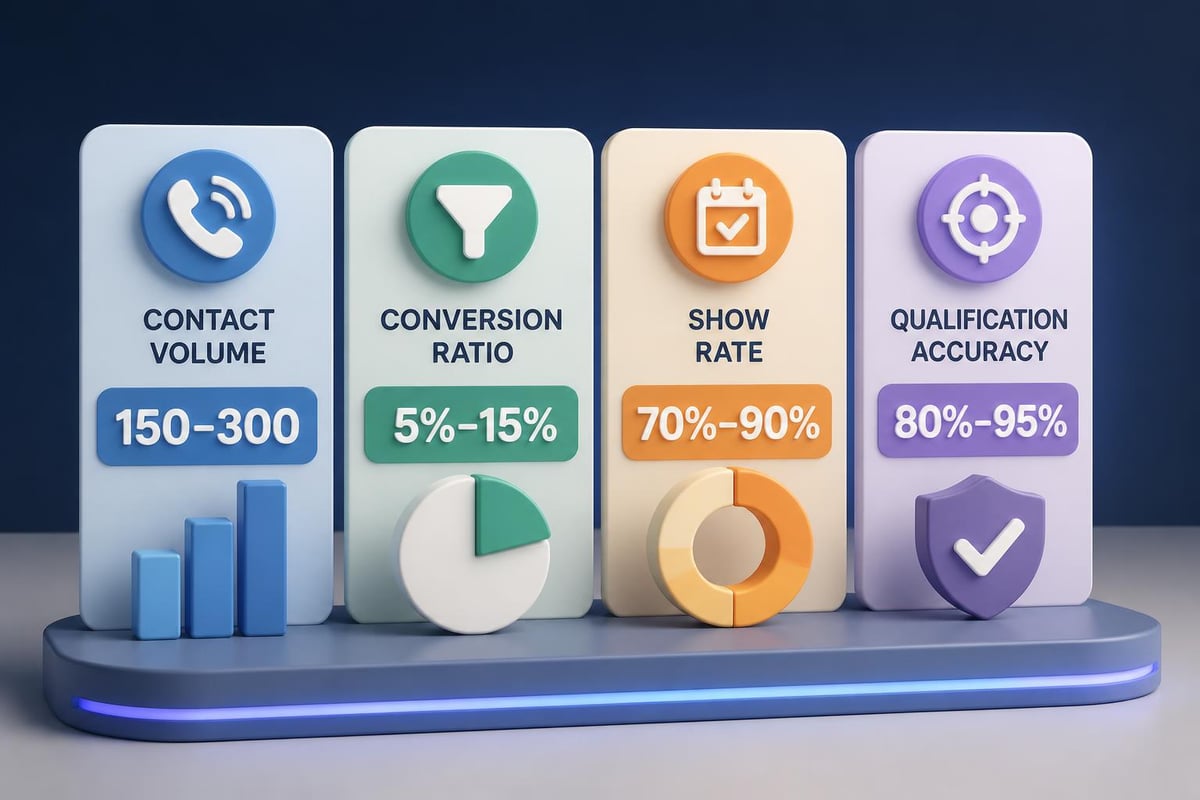
Raw appointment volume matters less than appointment quality and show rates. An appointment setter who books 50 meetings per month but sees 30% no-shows and 20% unqualified prospects delivers less value than one who books 35 meetings with 10% no-shows and 95% qualification accuracy.
Metric | Target Range | What It Reveals |
|---|---|---|
Daily contacts made | 60-100 | Activity level and time management |
Contact-to-appointment ratio | 8-15% | Communication effectiveness |
Appointment show rate | 70-85% | Qualification accuracy and confirmation process |
Show-to-qualified ratio | 85-95% | Understanding of ideal customer profile |
Appointments per setter per week | 8-15 | Overall productivity and efficiency |
These benchmarks assume high-ticket B2B sales with complex buying processes. Businesses with shorter sales cycles or lower price points might see different ranges, but the relationships between metrics remain consistent.
Leading vs. Lagging Indicators
Smart managers track both leading indicators (activities that drive results) and lagging indicators (the results themselves). Appointments booked is a lagging indicator, it tells you what happened. Calls made, emails sent, and follow-ups completed are leading indicators, they predict what will happen.
When appointments decline, examine the leading indicators first. Did activity levels drop? Has the quality of conversations decreased? Are follow-up sequences being executed consistently? Best practices for appointment setting in complex sales cycles emphasize this systematic approach to performance management.
Common Mistakes That Sabotage Appointment Setting Results
Even experienced teams fall into predictable traps that undermine their appointment-setting effectiveness. Recognizing these patterns allows you to proactively address them before they damage your pipeline.
Prioritizing Quantity Over Quality
The temptation to maximize appointment numbers often leads setters to lower their qualification standards. They know that booking more meetings makes their metrics look better in the short term, even if those appointments waste the sales team's time.
This creates a vicious cycle. Sales closers become frustrated with unqualified appointments, lose trust in the setting team, and begin doing their own prospecting again. The entire purpose of role specialization gets defeated.
Clear consequences for poor qualification help maintain standards. Some organizations implement a "quality score" where closers rate each appointment's qualification level. Setters with consistently low scores require additional training or coaching.
Inadequate Follow-Up Systems
Research consistently shows that most deals require multiple touchpoints before prospects agree to meetings. Yet many appointment setters give up after one or two attempts. The fortune truly is in the follow-up, but only when executed systematically.
Effective follow-up requires:
Predetermined sequence of at least 7-10 touchpoints
Varied messaging that provides value rather than just asking for meetings
Multiple channels (phone, email, LinkedIn, video) to match prospect preferences
Specific notes about previous conversations to demonstrate attention and care
Automated reminders so no prospect falls through the cracks
Hiring the Right Sales Appointment Setters
The foundation of any successful appointment-setting operation is talent. Hiring the wrong people, no matter how good your training and systems, produces mediocre results at best. The question becomes: what separates strong candidates from weak ones?
Essential Qualifications and Experience
While prior appointment-setting experience helps, it's not always necessary or even desirable. Sometimes candidates from related backgrounds (customer service, retail sales, recruiting) bring transferable skills without the bad habits picked up at other organizations.
A detailed appointment setter job description should emphasize the specific requirements for your industry and sales process. What works for scheduling HVAC maintenance appointments differs dramatically from what's needed for booking discovery calls with Fortune 500 executives.
Critical evaluation criteria:
Communication clarity: Can they articulate complex ideas simply?
Resilience: How do they respond to rejection and setbacks?
Coachability: Do they accept feedback and implement changes?
Organization: Can they manage multiple priorities without dropping details?
Goal orientation: Are they motivated by targets and metrics?
Phone screen interviews reveal communication skills immediately. Role-playing exercises during the interview process show how candidates handle objections and pressure. Reference checks from previous supervisors provide insight into work ethic and reliability.
The Pre-Vetted Talent Advantage
Building an appointment-setting team from scratch requires significant time and resources. Posting job descriptions, reviewing resumes, conducting interviews, checking references, and onboarding new hires consumes weeks or months. Even after this investment, you won't know if someone can actually perform until they've been on the job for 30-60 days.
Working with vetted candidates who have demonstrated sales capabilities accelerates this timeline dramatically. Pre-screened professionals with verified track records can begin producing results within days rather than months. This becomes especially valuable when you need to scale quickly or replace underperforming team members without disrupting pipeline flow.
For high-ticket businesses, every week without sufficient qualified appointments represents significant lost revenue. The speed advantage of accessing pre-vetted talent often justifies any premium over traditional hiring approaches. Understanding your company's replacement policy ensures continuity even when individual team members don't work out.
Compensation Structures That Drive Performance
How you pay appointment setters directly influences their behavior and results. The right compensation structure aligns their incentives with your business objectives, while poorly designed plans create conflicts and perverse incentives.
Base Salary vs. Commission Mix
Pure commission structures attract highly motivated performers but also create income instability that drives turnover. Pure salary arrangements provide stability but often fail to reward top performers adequately or motivate consistent effort.
Most successful high-ticket businesses use a hybrid approach with base salary covering 50-70% of total target compensation and performance bonuses or commissions making up the remainder. This provides stability while still rewarding excellence.
Sample compensation structure:
Base salary: $45,000 annually
Commission: $100 per qualified appointment that shows
Bonus: $500 per appointment that results in a closed deal
Total target compensation: $65,000-$75,000 for meeting goals
This structure incentivizes both appointment quantity (volume commission) and quality (bonus for closes), while the base salary ensures financial stability. Understanding commission structures helps you design plans that attract and retain top talent.
Non-Monetary Motivation Factors
Money matters, but it's not the only factor that drives performance. Recognition, career advancement opportunities, skill development, and work environment all influence retention and effort levels.
Regular coaching sessions, performance leaderboards, monthly recognition for top performers, and clear paths to advancement into closing roles create a culture where appointment setters feel valued and see a future. Many successful sales professionals began their careers in appointment setting roles and appreciate when organizations invest in their development.
Scaling Your Appointment Setting Operation
As your business grows, your appointment-setting needs expand proportionally. However, scaling this function isn't as simple as hiring more people. Systems, training, management capacity, and technology infrastructure must scale alongside headcount.
When to Add Capacity
The decision to expand your appointment-setting team should be driven by specific indicators rather than arbitrary growth targets. Adding capacity before you're ready creates unnecessary costs; waiting too long creates pipeline gaps that damage revenue.
Signals that indicate it's time to scale:
Your current setters consistently exceed capacity with quality maintained
Lead volume from marketing exceeds setter capacity to contact within 24 hours
Sales closers have open calendar slots due to insufficient appointments
No-show rates remain low, indicating demand for more appointments
Average time-to-contact for new leads extends beyond acceptable thresholds
Starting with one or two new hires allows you to refine processes and training before massive expansion. Building the right sales department structure ensures each new team member integrates smoothly and contributes quickly.
Remote vs. In-Office Considerations
The shift toward remote work has opened access to talent pools previously unavailable to many businesses. Location no longer constrains hiring decisions, allowing you to recruit the best appointment setters regardless of where they live.
However, remote teams require different management approaches. Clear communication protocols, regular video check-ins, robust performance tracking, and strong onboarding processes become even more critical when team members work from distributed locations.
Many high-ticket businesses find that remote sales professionals perform at or above the level of in-office teams when properly supported. The key is creating systems that work regardless of physical location and hiring self-motivated professionals who thrive with autonomy.
A skilled sales appointment setter transforms your sales operation from reactive and inconsistent to proactive and predictable, filling your pipeline with qualified prospects who match your ideal customer profile. The systematic approaches, proven best practices, and talent strategies outlined above provide the foundation for building an appointment-setting function that drives sustainable revenue growth. Whether you're ready to hire your first setter or scale an existing team, Sales Match provides access to pre-vetted sales talent specifically trained for high-ticket appointment setting, complete with replacement guarantees that eliminate hiring risk and ensure your calendar stays full with qualified opportunities.
FAQs
How much should I pay a sales appointment setter?
Sales Match recommends a minimum total comp of $65K+/year to attract A-players. Structure it as commission-only, base plus commission, or salary. Higher-ticket offers justify bigger per-appointment bonuses.
How fast can I hire a vetted appointment setter, and what if they don't perform?
First shortlisted candidates land in 7–10 days, after an 8-step vetting process with a live call test. You pay $0 upfront, backed by the longest replacement guarantee in the industry. A bad hire isn't your risk.
Should my closer book their own appointments instead of hiring a setter?
No. A closer's time is too expensive to spend prospecting. Splitting setters (who book qualified calls) from closers (who close) lifts conversion and protects margins. Sales Match places setters directly onto your team as your employees.
