
Working for Sales: Career Paths & Growth in 2026
Discover what working for sales really means in 2026. Explore career paths, essential skills, compensation models, and growth strategies.
published
TL;DR: Working for sales in 2026 means more than cold calling and closing deals. This comprehensive guide explores the diverse career paths available, essential skills for success, compensation structures, and strategies for long-term growth in sales roles ranging from appointment setters to senior closers and managers.
The sales profession has transformed dramatically over the past few years, yet misconceptions persist about what it means to spend your career working for sales organizations. Many people view sales as a temporary stepping stone or assume every role follows the same pattern. The reality is far more nuanced. Modern sales careers offer diverse specializations, competitive compensation models, and clear advancement pathways that can lead to six-figure opportunities without requiring advanced degrees or extensive corporate experience.
For professionals considering a transition into sales or businesses looking to understand what motivates top sales talent, grasping the full landscape of sales careers has never been more important. The online service economy has created unprecedented demand for skilled salespeople who can navigate virtual selling environments, build trust through video calls, and close high-ticket transactions remotely.
What Does Working for Sales Actually Mean in 2026?
Working for sales encompasses a broad spectrum of roles, responsibilities, and career trajectories. At its core, it means being responsible for revenue generation through customer acquisition, relationship building, and deal closure.
The evolving landscape of sales in 2026 shows significant shifts in how sales professionals approach their work. Remote selling has become the standard rather than the exception, particularly for businesses selling high-value services and consulting packages. Sales teams now operate across time zones, conduct entire sales cycles via Zoom or Google Meet, and leverage technology to manage pipelines that previous generations would have handled face-to-face.
The Main Sales Role Categories
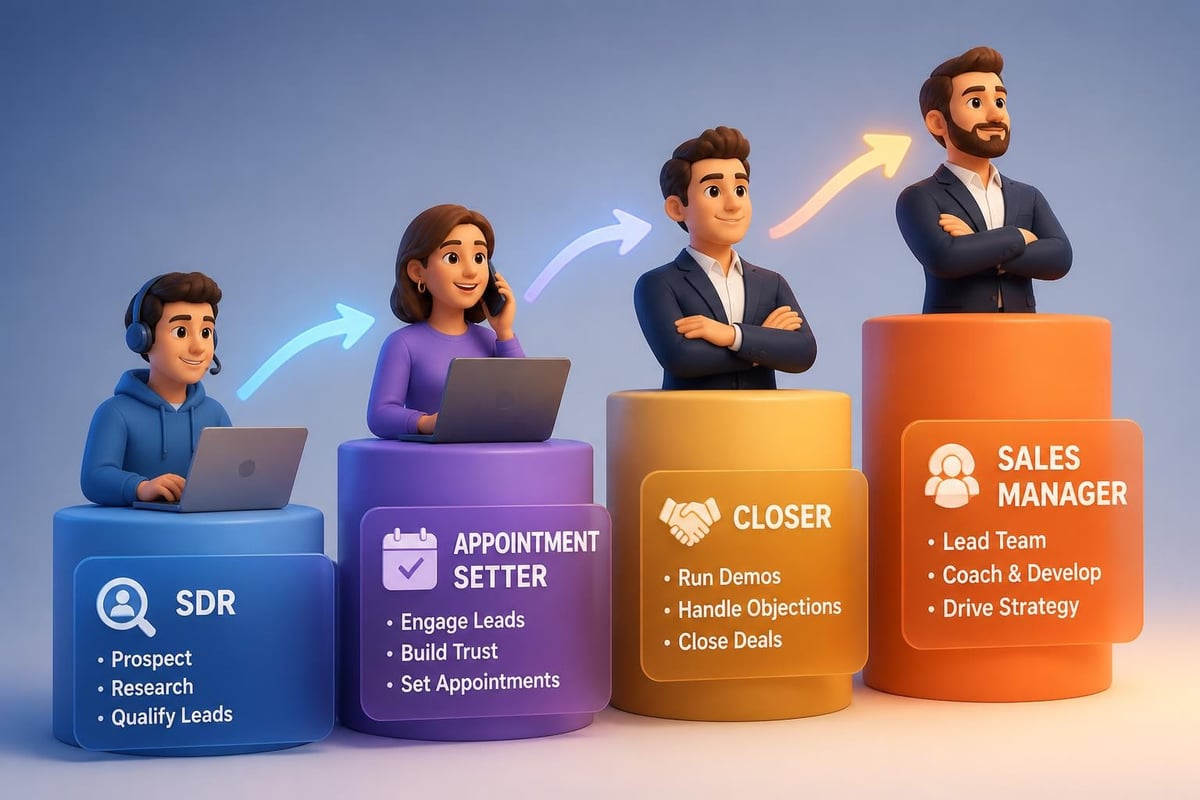
Sales careers typically fall into several distinct categories, each requiring different skill sets and offering unique growth opportunities:
Sales Development Representatives (SDRs): Focus on prospecting, lead qualification, and booking appointments
Appointment Setters: Specialize in converting inbound or outbound leads into qualified sales calls
Closers: Handle the final stages of the sales process, negotiating terms and securing commitments
Account Executives: Manage the full sales cycle from prospecting through closure
Sales Managers: Oversee teams, develop strategies, and drive organizational revenue targets
Each category serves a critical function within the revenue generation ecosystem. Companies selling products or services above $2,500 typically require specialized talent in multiple categories to maintain a healthy pipeline and conversion rate.
What Skills Are Essential When Working for Sales?
Success in sales demands a combination of hard and soft skills that can be developed through training and experience. The most effective sales professionals master both technical competencies and interpersonal abilities.
Communication stands as the foundation of all sales work. This extends beyond articulating product benefits to include active listening, emotional intelligence, and the ability to adapt messaging based on prospect responses. Working for sales requires reading verbal and non-verbal cues in virtual environments where traditional body language signals may be limited.
Core Competencies for Sales Success
Skill Category | Specific Abilities | Application in High-Ticket Sales |
|---|---|---|
Communication | Active listening, clarity, persuasion | Building trust during discovery calls |
Technical | CRM proficiency, sales automation tools | Managing pipeline efficiently |
Emotional Intelligence | Empathy, self-awareness, resilience | Handling objections and rejection |
Process Management | Organization, follow-up discipline | Maintaining consistent conversion rates |
Resilience deserves special attention when working for sales. The challenges of working in sales roles include frequent rejection, missed quotas, and the pressure of performance-based compensation. Top performers develop mechanisms to process rejection without internalizing it, viewing each "no" as progress toward the next "yes."
According to research from Bridge Group published in their 2025 SDR Metrics Report, the average SDR makes 52 dials per day but only connects with prospects on 6-8 of those attempts. This reality underscores why mental fortitude matters as much as sales technique.
Industry Knowledge and Adaptability
Sales professionals must also develop deep knowledge of their industry and ideal customer profile. Those working for sales organizations serving marketing agencies need to understand agency economics, common pain points, and the buying process for professional services. Similarly, individuals selling to B2B service businesses must grasp operational challenges and ROI expectations.
The ability to learn continuously sets exceptional sales professionals apart from average performers. Markets shift, buyer preferences evolve, and new technologies emerge. Commitment to ongoing skill development through courses, mentorship, and practice separates those who build lasting careers from those who cycle through jobs.
How Is Compensation Structured When Working for Sales?
Compensation models in sales vary significantly based on role, industry, and company stage. Understanding these structures helps both professionals evaluating opportunities and businesses designing attractive packages.
Performance-based compensation aligns sales professional incentives with company revenue goals. This typically combines a base salary or retainer with commissions tied to closed deals or appointments set. The specific ratio between base and variable compensation depends on role complexity and sales cycle length.
Common Compensation Models
Commission-Only (Performance-Based)
This model offers the highest earning potential with the greatest variability. Closers working on commission-only arrangements typically receive 10-20% of the deal value for high-ticket sales. For a $10,000 service package, a closer might earn $1,000-$2,000 per sale. Top performers can generate substantial income, while those struggling to close deals may earn little or nothing during slow periods.
Base Plus Commission
This hybrid approach provides financial stability through a guaranteed base salary while maintaining performance incentives through commissions. SDRs and appointment setters often receive this structure, with bases ranging from $3,000-$5,000 monthly plus bonuses for meetings booked or deals influenced.
Retainer Model
Commonly used for appointment setters and customer success representatives, retainer models offer predictable monthly compensation in exchange for consistent activity and results. A setter might receive $3,500-$6,000 monthly with clear expectations around call volume, appointment booking rates, and show-up percentages.
Compensation Type | Typical Roles | Stability Level | Upside Potential | Best For |
|---|---|---|---|---|
Commission-Only | Closers | Low | Very High | Experienced, proven performers |
Base + Commission | Account Executives, SDRs | Medium | High | Most sales professionals |
Retainer | Setters, CSRs | High | Medium | Consistency-focused individuals |
The guide to different types of sales roles and compensation emphasizes that no single model suits everyone. Personal risk tolerance, financial obligations, and skill level should inform which structure you pursue.

What Career Progression Looks Like When Working for Sales?
Sales offers clearer advancement pathways than many professions. Performance metrics provide objective evidence of capability, allowing talented individuals to progress rapidly regardless of educational background or previous experience.
Entry-level positions typically start with appointment setting or SDR work. These roles build foundational skills in prospecting, qualification, and pipeline management. Professionals in these positions learn to handle objections, maintain activity discipline, and operate CRM systems effectively.
Typical Career Advancement Path
Appointment Setter/SDR (0-18 months): Master prospecting, learn qualification frameworks, develop communication skills
Junior Closer/Account Executive (18-36 months): Handle smaller deals, refine closing techniques, build track record
Senior Closer (3-5 years): Manage high-ticket sales, mentor junior team members, contribute to process improvement
Sales Manager (5+ years): Lead teams, develop strategies, own revenue targets across multiple sellers
Director of Sales/VP of Sales (7+ years): Set organizational sales vision, build department infrastructure, align sales with company objectives
This progression isn't strictly linear. Some individuals move from setter to closer within six months if they demonstrate exceptional closing ability. Others may specialize in a particular role, becoming expert appointment setters who generate more value in that capacity than they would as average closers.
The comprehensive sales career path guide notes that progression speed depends primarily on results rather than tenure. A closer who consistently exceeds quota may advance to management within two years, while someone barely meeting targets might remain in the same role indefinitely.
What Challenges Should You Expect Working for Sales?
Understanding realistic challenges helps professionals prepare mentally and develop coping strategies before difficulties arise. Sales demands more psychological resilience than most corporate positions.
Rejection occurs daily when working for sales. Even top performers hear "no" far more often than "yes." In high-ticket B2B sales, conversion rates of 20-30% from qualified appointment to close are considered excellent. This means seven or eight rejections for every three deals closed. Developing the ability to separate personal worth from sales outcomes determines who thrives long-term.
Common Pain Points and Solutions
Inconsistent Income Fluctuations
Commission-based compensation creates income variability that causes stress, particularly for those supporting families or carrying fixed expenses. Sales cycles, seasonal demand patterns, and economic conditions all impact monthly earnings.
Solution approach: Build a financial buffer covering 3-6 months of expenses. During high-earning months, save aggressively rather than inflating lifestyle. Consider roles offering higher base-to-commission ratios early in your sales career.
Performance Pressure and Quota Stress
Monthly or quarterly quotas create constant pressure. Missing targets can result in reduced commissions, management scrutiny, or job loss. This pressure intensifies in performance-based roles where compensation directly ties to results.
Solution approach: Develop consistent daily habits around activity metrics (calls made, emails sent, follow-ups completed). Focus on controllable actions rather than outcomes. Maintain detailed pipeline tracking to forecast performance and address shortfalls proactively.
Work-Life Boundaries in Remote Roles
Remote sales positions offer flexibility but blur boundaries between work and personal time. The temptation to check email constantly or make one more call can lead to burnout when working for sales organizations that operate across time zones.
Solution approach: Establish clear working hours and communicate them to prospects and team members. Create physical separation between work and living spaces when possible. Use time-blocking to protect personal time.
How Do You Determine If Working for Sales Suits You?
Not everyone thrives in sales environments. Honest self-assessment saves time and frustration by helping individuals evaluate fit before committing to this career path.
The resource on assessing sales career suitability suggests evaluating your relationship with competition, feedback, and autonomy. Sales rewards self-starters who take initiative without constant supervision. If you require detailed direction and clearly defined daily tasks, traditional sales roles may feel uncomfortable.
Self-Assessment Questions
Do you recover quickly from setbacks and criticism?
Can you maintain motivation without external accountability?
Are you comfortable with income variability?
Do you enjoy solving problems for others?
Can you persist through extended periods without visible progress?
Are you willing to continuously learn and adapt techniques?
Honest "no" answers to several questions don't necessarily disqualify you from sales success, but they indicate areas requiring development before you'll excel in this field.
Money motivation alone rarely sustains sales professionals through difficult periods. The most successful individuals working for sales find genuine satisfaction in helping clients solve problems, enjoy the competitive aspects of the role, and appreciate the meritocratic nature of compensation.

What Support Systems Drive Sales Success?
Individual talent matters tremendously in sales, but environmental factors significantly impact results. The best sales professionals seek out organizations that provide proper support, training, and resources.
Quality training programs accelerate skill development and reduce the trial-and-error period. Organizations that invest in onboarding, provide script frameworks, and offer ongoing coaching produce better results than those expecting salespeople to figure everything out independently. The step-by-step guide to building a sales career emphasizes that structured learning environments benefit professionals at all experience levels.
Critical Support Elements
Comprehensive Onboarding
Effective onboarding covers product knowledge, ideal customer profiles, sales processes, objection handling frameworks, and CRM systems. Organizations that rush this process set new hires up for failure.
Ongoing Coaching and Feedback
Regular call reviews, role-play sessions, and constructive feedback help salespeople refine techniques. The best sales managers invest time listening to calls, identifying improvement opportunities, and modeling effective approaches.
Clear Processes and Playbooks
Documented processes reduce decision fatigue and provide frameworks for handling common scenarios. Sales playbooks covering discovery questions, presentation structures, and closing sequences allow professionals to focus on execution rather than inventing approaches from scratch.
Technology and Tools
Modern CRM systems, dialers, email automation platforms, and analytics dashboards enable productivity that manual methods cannot match. Working for sales organizations that provide proper technology stack prevents administrative tasks from consuming selling time.
Where Are the Best Opportunities Working for Sales?
Opportunity quality varies dramatically across industries, company stages, and business models. Strategic role selection accelerates career growth and maximizes earning potential.
High-ticket service businesses offer particularly attractive opportunities for sales professionals. Companies selling coaching programs, consulting services, agency retainers, and B2B solutions priced above $2,500 typically pay higher commissions than those selling low-ticket products. A closer earning 15% commission on $10,000 packages generates far more per sale than someone earning 20% on $500 products.
High-Opportunity Environments
Organizations serving established markets with proven products reduce the burden on salespeople to educate prospects about problem existence. Selling marketing services to agencies already investing in marketing proves easier than convincing businesses they need marketing at all.
Remote-first companies provide flexibility and access to broader opportunity pools. Geographic limitations no longer restrict career options when entire sales processes occur virtually. Sales professionals can work for organizations anywhere while maintaining location independence.
Businesses offering performance-based arrangements with unlimited replacement guarantees demonstrate confidence in their hiring processes and vetting standards. This structure protects both the company and the sales professional from prolonged poor fits.
How Do You Get Started Working for Sales?
Entry into sales careers requires less formal credentialing than most professions. Action and results matter more than degrees or certifications.
Identify Your Target Role
Determine which sales position aligns with your current skills and desired compensation structure. If you lack sales experience, appointment setter or SDR roles provide accessible entry points. Those with relevant industry knowledge or transferable skills might qualify for closer positions immediately.
Develop Core Skills
Invest time in communication development, active listening practice, and objection handling frameworks. Free resources, online courses, and books provide foundations without significant financial investment.
Research Target Industries
Focus on sectors that interest you and offer favorable economics. Higher-margin businesses typically compensate sales teams better than low-margin operations. B2B service companies, consulting firms, agencies, and coaching businesses often provide stronger opportunities than product-based retail.
Seek Quality Organizations
Priority should go to companies with structured training, proven products, reasonable quotas, and fair compensation. Sales recruitment specialists can connect candidates with pre-vetted opportunities matching specific criteria and compensation preferences.
Start Building a Track Record
Results speak louder than resumes in sales. Even if your first role isn't ideal, focus on achieving measurable outcomes. Documented success in one position creates leverage when negotiating future opportunities.
The path forward in sales rewards those who combine continuous learning with consistent execution. Working for sales organizations that invest in their people, provide clear advancement paths, and maintain performance-based meritocracy positions professionals for long-term success in this dynamic field.
Working for sales in 2026 offers diverse career paths, competitive compensation, and growth potential for professionals willing to develop the necessary skills and resilience. Whether you're considering a transition into sales or building a team of high-performing closers, understanding the landscape helps you make informed decisions. Sales Match specializes in connecting online service businesses with pre-vetted, high-ticket sales professionals who are ready to perform from day one, eliminating lengthy hiring timelines and reducing placement risk through our rigorous multi-step vetting process.
