
Agencies Business: Building Elite Sales Teams in 2026
Discover how the agencies business landscape is evolving in 2026 and why building elite sales teams is critical for high-ticket agencies.
published
The agencies business landscape has undergone dramatic transformation over the past few years, with 2026 bringing unprecedented challenges and opportunities for marketing agencies, consultants, and service providers selling high-ticket offerings over the internet. As client expectations evolve and competition intensifies, the ability to maintain a world-class sales team has become the defining factor between thriving agencies and those struggling to maintain momentum. For businesses selling services valued at $2,500 or more through virtual channels, the quality of sales talent directly determines revenue stability and growth potential.
The Current State of Agencies Business Operations
According to recent Digiday research analyzing the agency business landscape, agencies are seeing renewed optimism after challenging periods of economic uncertainty. Revenue trends indicate that agencies who invested in sales infrastructure during downturns emerged stronger, while those who cut sales resources struggled to capture rebounding demand.

The agencies business model has always depended on consistent new client acquisition combined with long-term retention. However, the margin for error has shrunk considerably. Service-based businesses can no longer afford prolonged sales hiring mistakes or extended periods with underperforming closers on their team.
Revenue Dynamics in High-Ticket Service Delivery
High-ticket agencies face unique sales challenges compared to product-based businesses. Each sale represents significant investment from the client's perspective, requiring sales professionals who can build trust, handle sophisticated objections, and navigate longer decision-making cycles.
Critical sales competencies for agencies business include:
Consultative selling abilities that position services as strategic investments
Technical fluency with virtual selling platforms like Zoom and Google Meet
Strong relationship-building skills for complex B2B transactions
Resilience during extended sales cycles spanning weeks or months
Deep understanding of client pain points and business challenges
The stakes are particularly high because every missed opportunity represents thousands of dollars in lost revenue. When selling services priced at $2,500 to $50,000 or more, even a small percentage improvement in close rates translates to massive revenue differences.
Sales Team Challenges Unique to Agencies Business
Marketing agencies, consulting firms, and high-ticket service providers encounter distinctive hiring obstacles that don't affect traditional businesses. The specialized nature of selling intangible services requires sales talent with specific experience and mindset.
Challenge Category | Impact on Agencies | Traditional Solutions | Modern Approach |
|---|---|---|---|
Extended hiring timelines | 3-6 months lost revenue per open position | Internal recruitment teams | Pre-vetted talent pools |
High turnover rates | Constant rebuilding, lost momentum | Better compensation packages | Replacement guarantees |
Service complexity | Difficulty finding industry-savvy sellers | Extensive training programs | Specialists with relevant background |
Virtual selling skills | Poor conversion on remote calls | Hope for on-the-job learning |
Research from CallRail examining agency marketing trends reveals that client lifecycles are shortening, putting additional pressure on agencies to continuously feed their pipelines with new opportunities. This reality makes sales team consistency even more critical.
The Cost of Sales Team Instability
When a top performer leaves an agencies business, the impact extends far beyond the immediate gap in closings. Existing pipeline opportunities may stall or die completely. New lead flow generates no revenue. Marketing spend continues without corresponding return.
The cascading effects include:
Immediate revenue drop from lost closings
Pipeline deterioration as prospects lose their point of contact
Increased burden on remaining team members
Rushed hiring decisions leading to poor fits
Extended training periods for replacements
Potential damage to brand reputation
For agencies operating on tight margins, a single quarter with sales team disruption can jeopardize the entire year's performance. The traditional approach of posting job listings, screening hundreds of resumes, conducting multiple interview rounds, and hoping the hire works out has become untenable.
Building Resilient Sales Infrastructure
Forward-thinking agencies business leaders recognize that sales team stability requires systematic approaches rather than reactive hiring when problems emerge. The most successful agencies treat sales talent acquisition as ongoing strategic priority.
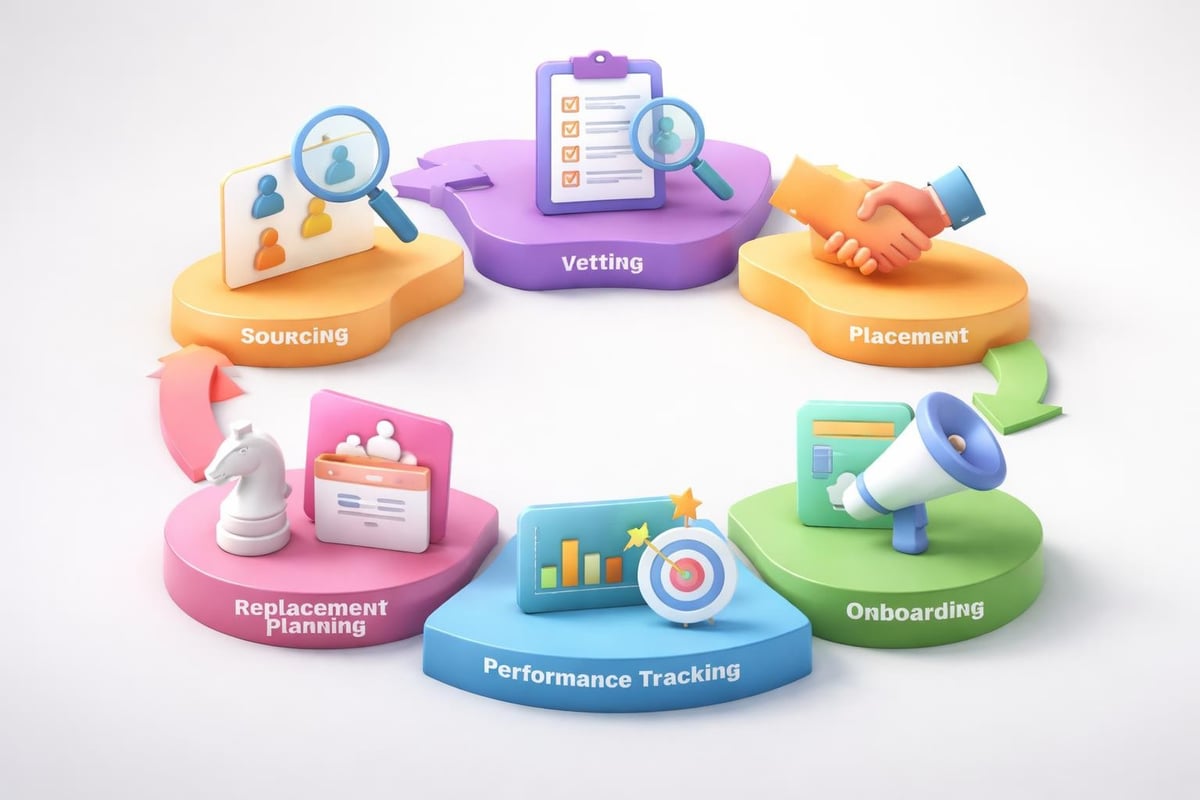
Pre-Vetted Talent vs Traditional Hiring
The difference between accessing pre-vetted sales professionals and conducting traditional hiring processes is substantial. Traditional recruitment for agencies business positions typically involves:
Traditional hiring timeline:
Week 1-2: Job posting creation and distribution
Week 3-6: Resume screening and initial phone screens
Week 7-8: First-round interviews with multiple candidates
Week 9-10: Second-round interviews and reference checks
Week 11-12: Offer negotiation and acceptance
Week 13-16: Notice period at candidate's current employer
Week 17-20: Onboarding and initial training
This four to five-month process assumes everything goes smoothly. In reality, chosen candidates often decline offers, accept counteroffers, or prove unsuitable during onboarding, forcing the entire cycle to restart.
Pre-vetted approaches compress this timeline dramatically by maintaining ready-to-deploy talent pools of candidates who have already cleared comprehensive screening processes. According to data on agency growth statistics, agencies that reduced time-to-hire by 60% or more saw corresponding improvements in revenue consistency and team morale.
Quality Indicators for High-Ticket Sales Talent
Not all sales experience translates to agencies business success. The most valuable sales professionals for high-ticket service providers demonstrate specific background elements and competencies.
Essential quality markers include:
Proven track record in consultative, complex sales: Experience selling services rather than simple products
Virtual selling proficiency: Demonstrated success closing deals entirely through remote communication
Industry relevance: Background in marketing, consulting, or related professional services
Deal size experience: History closing transactions in similar price ranges ($2,500+)
Self-motivation: Ability to prospect, manage pipeline, and close without constant supervision
Communication excellence: Clear, professional written and verbal communication skills
The vetting process that separates elite performers from average candidates must evaluate these factors rigorously. Superficial screening based solely on resume keywords or years of experience fails to identify top talent.
Strategic Workforce Planning for Agency Growth
The agencies business model requires different workforce strategies than traditional businesses because revenue generation depends almost entirely on human capital. Manufacturing companies can scale through automation and equipment. Agencies scale through talented people, particularly in sales roles.
Right-Sizing Your Sales Team
Determining optimal sales team size involves balancing several factors specific to your agencies business model:
Factor | Consideration | Calculation Approach |
|---|---|---|
Average deal size | Higher prices = fewer closings needed | Annual revenue target ÷ average contract value |
Sales cycle length | Longer cycles = more pipeline capacity needed | Average cycle days ÷ 30 × target monthly closings |
Close rate | Lower rates = more opportunities required | Target closings ÷ historical close rate % |
Lead flow | Consistent vs. seasonal lead generation | Monthly qualified leads ÷ capacity per rep |
Service delivery capacity | Sales must align with fulfillment capability | Maximum client capacity ÷ average sales cycle |
Most high-ticket agencies discover their optimal configuration involves specialized roles rather than generalists handling everything. Dedicated appointment setters feed qualified opportunities to closers who focus exclusively on converting prospects to clients.
This specialization model appears in successful agencies business operations because it allows each team member to develop deep expertise in their specific function. The decision to hire a sales team structured this way typically produces better results than expecting individual salespeople to prospect, qualify, present, and close entirely on their own.
Replacement Planning as Core Strategy
Progressive agencies business leaders have abandoned the reactive approach of addressing sales team departures only after resignations arrive. Instead, they implement proactive replacement strategies that minimize disruption.
Key elements of effective replacement planning:
Continuous talent relationships: Maintain connections with qualified candidates even when not actively hiring
Documented processes: Ensure onboarding and training procedures can deploy quickly
Pipeline redundancy: Structure deals so multiple team members understand key opportunities
Performance monitoring: Identify underperformance early rather than hoping for turnarounds
Replacement guarantees: Partner with recruitment specialists offering coverage when placements don't succeed
The concept of unlimited replacement guarantees represents a significant shift in how agencies approach sales hiring risk. Rather than bearing the full burden of hiring mistakes, agencies can work with services offering replacement guarantees that ensure continuous access to qualified talent without repeated recruitment costs.

Technology and Process in Modern Agencies Business
While technology cannot replace talented salespeople, it plays an increasingly important role in supporting agencies business operations. The integration of CRM systems, virtual meeting platforms, and communication tools has become standard infrastructure.
According to analysis of trends agencies should monitor, the businesses seeing strongest growth leverage technology to enhance human performance rather than attempting to automate the sales process entirely. High-ticket service sales require human judgment, empathy, and relationship-building that technology supports but cannot replicate.
Virtual Selling Excellence
The shift to predominantly virtual sales calls has permanently altered the agencies business landscape. Even as in-person meetings return in some sectors, high-ticket service providers selling nationally or internationally rely primarily on Zoom, Google Meet, and similar platforms.
This reality makes virtual selling competency non-negotiable for sales talent. The skills that made someone successful in face-to-face sales don't automatically transfer to virtual environments.
Virtual selling competencies include:
Professional on-camera presence and background management
Ability to build rapport without physical proximity
Screen sharing proficiency for presentations
Handling technical difficulties without losing momentum
Reading subtle verbal and visual cues through video
Managing energy and engagement across multiple daily calls
Agencies business leaders must ensure their sales team possesses these capabilities from day one rather than assuming traditional sellers will adapt easily. The remote high-ticket sales specialists who thrive in virtual environments represent a specific talent category worth targeting deliberately.
Market Trends Reshaping Agencies Business in 2026
Several converging trends are fundamentally altering how agencies operate and compete in 2026. Understanding these dynamics helps business owners make informed decisions about sales team investments.
Research from PRWeek on agency business trends highlights that client expectations around responsiveness, customization, and measurable results have intensified. These heightened expectations place additional pressure on sales teams to set realistic expectations and qualify prospects carefully.
Specialization Over Generalization
The days of successful generalist agencies are fading rapidly. Clients increasingly seek specialists with deep expertise in their specific industry or challenge area. This trend toward specialization extends to sales teams as well.
Agencies business models built around narrow niches require sales professionals who understand the target market intimately. A salesperson who excels at closing marketing agency services for e-commerce brands may struggle selling to professional services firms or B2B manufacturers.
Benefits of specialized sales talent:
Credibility with sophisticated prospects who value relevant experience
Faster ramp time due to existing industry knowledge
Better qualification of opportunities based on fit indicators
Stronger objection handling rooted in sector-specific insights
Enhanced ability to differentiate from competitors
When building or expanding sales teams, agencies should prioritize candidates with direct experience in their target verticals rather than assuming sales skills transfer universally across industries.
Shorter Client Lifecycles Demanding Consistent Acquisition
Data indicates that client relationships in the agencies business are shortening across most sectors. Factors including budget pressures, leadership changes, and increased competition contribute to clients switching providers more frequently than in previous decades.
This trend makes consistent new client acquisition absolutely critical. Agencies cannot rely on long-term retainer relationships providing stable revenue for years. Instead, they must maintain robust pipelines and continuous closing activity.
The implications for sales team structure are significant. Agencies need sufficient capacity to replace churned clients while also growing total client count. Underinvestment in sales infrastructure virtually guarantees revenue decline as natural attrition outpaces new acquisition.
Evaluating Sales Recruitment Partners
For agencies business leaders who recognize the limitations of internal recruitment, selecting the right external partner becomes crucial. Not all recruitment services deliver equal value, particularly for specialized high-ticket sales positions.
Key Evaluation Criteria
When assessing potential recruitment partners, agencies should examine several critical factors:
Criteria | Why It Matters | Questions to Ask |
|---|---|---|
Industry specialization | Generic recruiters lack understanding of agency sales | Do they focus specifically on sales roles for service businesses? |
Vetting depth | Surface screening produces poor matches | What specific assessments and validations do they conduct? |
Talent pool quality | Access to active job seekers differs from passive top performers | How do they source candidates beyond job boards? |
Replacement terms | Hiring mistakes are inevitable | What happens if a placement doesn't work out? |
Timeline commitments | Extended searches defeat the purpose | How quickly can they present qualified candidates? |
The most valuable recruitment partners maintain ongoing relationships with vetted candidates rather than starting searches from scratch for each client request. This approach dramatically reduces time-to-hire while improving quality through continuous talent assessment.
Understanding Service Models
Different recruitment approaches suit different agencies business needs. Traditional contingency recruitment, retained search, and on-demand talent models each offer distinct advantages and limitations.
On-demand talent services provide immediate access to pre-screened candidates ready to begin quickly. This model works exceptionally well for agencies needing to fill positions rapidly or replace underperformers without lengthy searches.
Retained search firms conduct comprehensive, customized searches for senior or highly specialized roles. The extended timeline and significant upfront investment make this approach better suited for executive positions than frontline sales roles.
Contingency recruiters charge fees only upon successful placement, but often prioritize speed over fit quality, leading to mismatches that appear successful initially but fail within months.
For most agencies business scenarios involving sales team building, models offering pre-vetted talent with replacement guarantees provide optimal risk-reward balance. The ability to access qualified candidates within days rather than months while maintaining downside protection through replacement coverage addresses agencies' most pressing pain points.
Competitive Advantages Through Sales Excellence
In increasingly crowded markets, agencies business differentiation often comes down to sales team quality rather than service offering differences. Most marketing agencies, consultancies, and coaching businesses provide broadly similar services. What separates winners from strugglers is consistent ability to convert prospects to clients.
According to industry analysis on elevating talent as competitive advantage, agencies that invest in superior sales talent create sustainable advantages that competitors struggle to replicate. While service methodologies can be copied, building and maintaining elite sales teams requires ongoing commitment and resources.
Sales Team as Strategic Asset
Forward-thinking agencies business leaders view their sales function as strategic asset requiring the same attention and investment as service delivery capabilities. This perspective shift produces several important outcomes:
Consistent resource allocation: Sales talent acquisition receives priority funding regardless of short-term pressures
Performance standards: Clear expectations and metrics ensure accountability
Ongoing development: Training and coaching help good performers become great
Retention focus: Competitive compensation and career paths reduce turnover
Systematic improvement: Regular process refinement based on data and feedback
Agencies that treat sales hiring as administrative task to handle when positions open will consistently underperform competitors who approach it strategically.
The services offered by specialized recruitment firms designed specifically for agencies business can accelerate this strategic approach by handling the complex, time-consuming aspects of talent acquisition while agency leadership focuses on business development and client delivery.
Implementation Roadmap for Sales Team Enhancement
Agencies business owners ready to upgrade their sales capabilities should follow systematic approaches rather than attempting wholesale immediate changes that risk disrupting existing operations.
Phase 1: Assessment and Planning (Weeks 1-2)
Begin by conducting honest evaluation of current sales team performance, identifying specific gaps and opportunities.
Assessment activities:
Analyze sales metrics including close rates, average deal size, and cycle length
Review individual performer contribution and consistency
Identify upcoming capacity needs based on growth projections
Document current hiring and onboarding processes
Calculate true cost of open positions and underperformance
This foundation ensures subsequent decisions address actual needs rather than perceived problems.
Phase 2: Process Documentation (Weeks 3-4)
Successful scaling requires documented, repeatable processes that new team members can follow.
Documentation priorities:
Sales methodology and positioning approaches
Qualification criteria and discovery frameworks
Presentation templates and demonstration procedures
Objection handling scripts for common concerns
Proposal and closing procedures
CRM usage and pipeline management requirements
These materials accelerate onboarding while ensuring consistency across the sales team.
Phase 3: Talent Acquisition (Weeks 5-8)
With assessment complete and processes documented, focus shifts to acquiring the right talent for your needs.
Whether handling recruitment internally or engaging specialized partners, maintain high standards throughout evaluation. Rushing to fill positions with mediocre candidates creates more problems than leaving roles open slightly longer to find exceptional performers.
Phase 4: Onboarding and Integration (Weeks 9-12)
Even experienced sales professionals require structured onboarding to succeed in new agencies business environments.
Effective onboarding includes:
Comprehensive service and market education
Role-playing and scenario practice
Shadowing existing team members
Graduated responsibility with close supervision
Regular feedback and adjustment
Clear performance expectations and timelines
The investment in thorough onboarding pays dividends through faster productivity and higher long-term retention.
The agencies business landscape in 2026 demands sales excellence as a core competency, not an afterthought. Building and maintaining world-class sales teams separates thriving agencies from those struggling to maintain momentum in competitive markets. For marketing agencies, consultants, and high-ticket service providers ready to eliminate sales team uncertainty, Sales Match offers pre-vetted sales talent with unlimited replacement guarantees, ensuring your sales infrastructure remains strong regardless of individual performance variations or team member departures.