Sales Co: Building High-Performance Teams in 2026
Discover how a sales co approach transforms team building for high-ticket businesses. Learn strategies for co-selling, recruitment, and growth.
published
The concept of a sales co has evolved significantly in recent years, transforming how businesses approach team building and partnership strategies. For high-ticket companies selling products or services over $2,500 through digital channels, understanding the sales co model can unlock new pathways to growth. Whether you're exploring co-selling partnerships or considering how specialized recruitment partners function as your sales co, this approach offers powerful advantages for marketing agencies, coaches, consultants, and service-based businesses operating in the virtual marketplace.
Understanding the Sales Co Framework
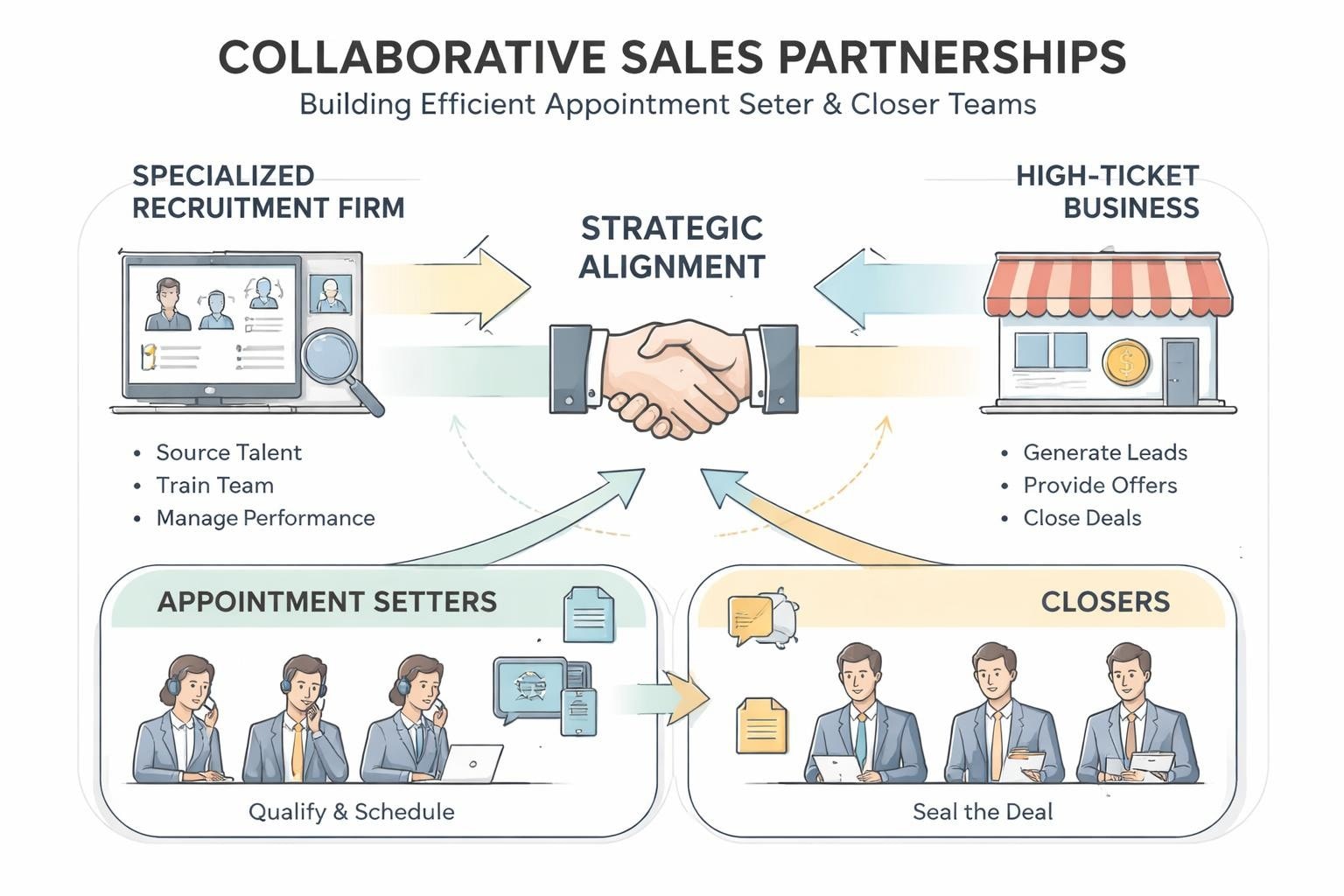
A sales co represents a collaborative approach to sales operations where businesses partner with specialized entities to achieve mutual goals. Co-selling has emerged as a strategic framework where companies combine resources, expertise, and networks to accelerate sales processes and deliver enhanced value to shared customer bases.
The traditional definition of sales encompasses activities involved in selling products or services, as noted by Merriam-Webster. However, the sales co model extends beyond individual transactions to create systematic partnerships that drive sustainable growth.
Types of Sales Co Arrangements
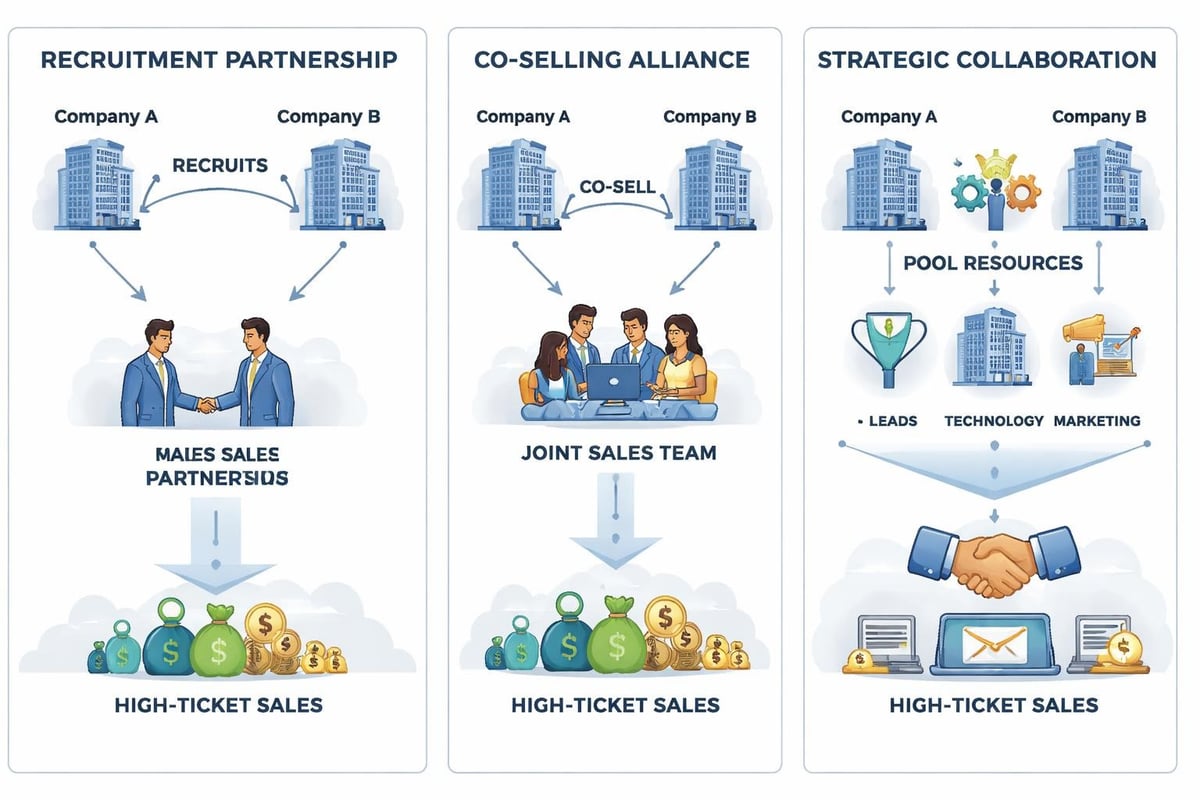
Different businesses leverage various sales co structures depending on their needs and market positioning. High-ticket companies typically encounter these primary models:
Recruitment partnerships where specialized firms act as a sales co by sourcing and placing talent
Co-selling alliances between complementary service providers
Strategic partnerships for market expansion and customer acquisition
Technology integrations that combine sales tools and platforms
Each arrangement serves distinct purposes, but all share common principles of collaboration, shared objectives, and mutual benefit.
The Role of a Sales Co in Team Building
For businesses selling high-ticket offerings through Zoom or Google Meet calls, building an effective sales team represents one of the most critical challenges. A sales co specializing in recruitment becomes an extension of your organization, understanding your unique needs and delivering talent that aligns with your culture and goals.
Traditional hiring processes consume substantial time and resources. According to research from the Society for Human Resource Management, the average cost per hire across industries reached $4,700 in 2023, with sales positions often exceeding this benchmark. When you factor in time-to-productivity, the investment multiplies significantly.
How Specialized Sales Co Partners Streamline Recruitment
A specialized recruitment sales co operates differently than general staffing agencies. These partners focus exclusively on sales talent, particularly appointment setters and closers who excel in high-ticket environments.
Key advantages include:
Pre-vetted candidate pools with proven track records
Industry-specific expertise in sales methodologies
Faster placement timelines reducing vacancy costs
Reduced risk through replacement guarantees
Sales Match exemplifies this specialized approach, focusing specifically on high-ticket businesses that operate digitally. This narrow focus allows for deeper expertise and better candidate-company matching.
Traditional Hiring | Sales Co Partnership |
|---|---|
45-60 day average time-to-hire | 7-14 day placement timelines |
Limited candidate vetting | Comprehensive screening processes |
General recruitment knowledge | Specialized sales expertise |
No replacement guarantees | Performance-based assurances |
Co-Selling as a Sales Co Strategy
Beyond recruitment, co-selling represents a powerful collaborative approach where businesses combine their sales forces to drive mutual growth. This sales co model works exceptionally well for complementary service providers in the high-ticket space.
Marketing agencies might partner with sales training companies, creating a sales co arrangement where each refers clients needing the other's services. Both parties benefit from expanded reach without the overhead of building internal capabilities in areas outside their core competencies.
Implementing Effective Co-Selling Partnerships
Successful co-selling requires strategic alignment and clear communication frameworks. Partners must share compatible values, target similar customer profiles, and offer genuinely complementary solutions.
The definition of co-selling emphasizes active collaboration between salespeople across different companies to influence and accelerate sales processes. This differs from simple referral arrangements, requiring deeper integration between partner organizations.
Essential elements of co-selling success:
Establish shared revenue models and compensation structures
Create joint value propositions that benefit customers
Develop coordinated sales processes and handoff protocols
Implement regular communication and feedback loops
Track partnership metrics and optimize continuously
High-ticket businesses benefit particularly from co-selling because the longer sales cycles and higher customer lifetime values justify the investment in partnership development.
Building Your In-House Sales Department with a Sales Co
Many high-ticket businesses reach a critical decision point: build an internal sales department or continue outsourcing. A recruitment sales co enables a hybrid approach, providing the talent needed to internalize sales while avoiding prolonged hiring struggles.
The comprehensive overview of sales on Wikipedia highlights how sales functions have professionalized over decades, requiring increasingly specialized skills. For appointment setting and closing in high-ticket environments, this specialization becomes even more pronounced.
Structuring Your High-Ticket Sales Team
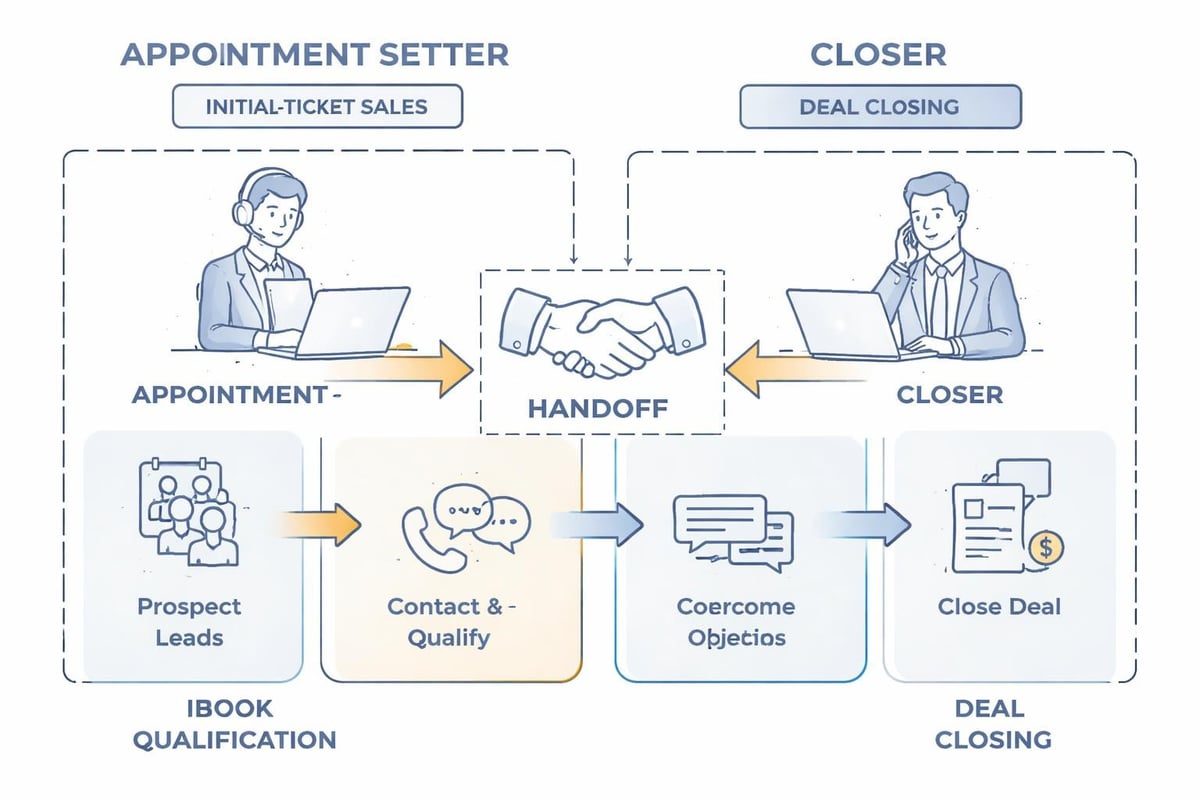
Effective high-ticket sales organizations typically separate appointment setting from closing functions. This division allows for role specialization and creates clearer career progression pathways.
Appointment setters focus on:
Lead qualification and initial discovery
Scheduling qualified prospects with closers
Maintaining consistent pipeline flow
Database management and follow-up systems
Closers concentrate on:
Conducting in-depth needs analysis
Presenting tailored solutions
Negotiating terms and handling objections
Converting qualified prospects into clients
When working with a sales co for recruitment, clearly defining these roles ensures candidates match specific position requirements. The vetting process becomes more effective when role expectations are precisely articulated.
Sales Enablement Through Sales Co Partnerships
Sales enablement best practices emphasize providing sales teams with the resources, training, and support needed to engage buyers effectively. A sales co partner can contribute significantly to enablement efforts.
Specialized recruitment partners bring insights from placing talent across multiple organizations, observing what separates top performers from average ones. This accumulated knowledge informs training recommendations, process improvements, and performance benchmarks.
Critical Success Factors for High-Ticket Sales Teams
Research consistently identifies several factors that distinguish successful high-ticket sales professionals. Understanding these characteristics helps both in recruitment and in developing existing team members.
Top performers demonstrate:
Consultative selling skills that prioritize customer needs over product features
Emotional intelligence for reading prospects and adapting communication styles
Persistence and resilience to navigate longer sales cycles without discouragement
Technical competency with video conferencing platforms and CRM systems
Time management abilities for maintaining consistent activity levels
When evaluating vetted candidates, these competencies should form the assessment framework. A quality sales co partner evaluates for these attributes systematically rather than relying solely on resume credentials.
Remote Sales Co Considerations for 2026
The shift toward remote high-ticket sales has accelerated dramatically, with most high-ticket transactions now occurring entirely through digital channels. This evolution affects how businesses approach sales co partnerships and team building.
Remote sales environments require different support structures than traditional office-based teams. Technology infrastructure, communication protocols, and performance monitoring all adapt to distributed workforce realities.
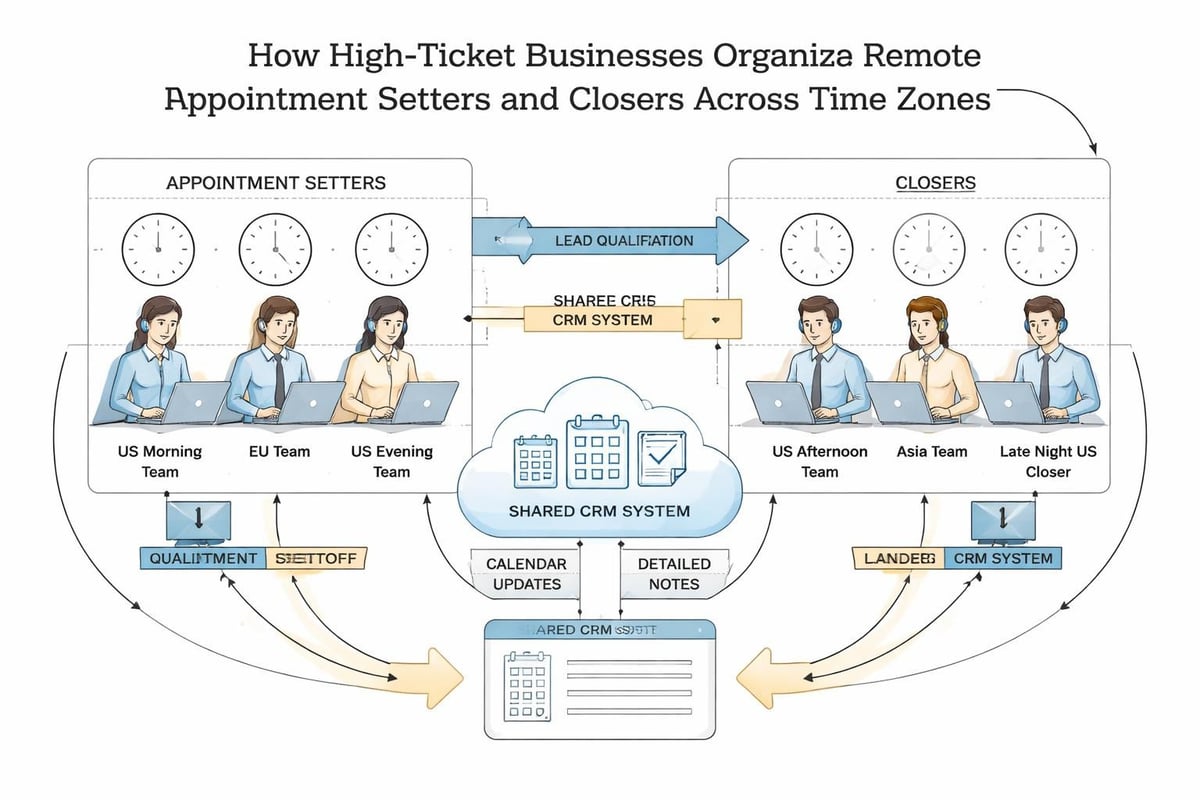
Managing Distributed Sales Teams
Successful remote sales operations balance autonomy with accountability. Team members need freedom to manage their schedules while maintaining clear performance expectations and regular touchpoints.
Challenge | Solution |
|---|---|
Communication gaps | Structured daily standups and weekly reviews |
Performance visibility | CRM-based activity tracking and reporting |
Culture building | Virtual team events and peer recognition |
Training delivery | Video-based onboarding and ongoing development |
Technology access | Standardized tools and technical support |
A recruitment sales co familiar with remote placements understands these dynamics and can identify candidates who thrive in distributed environments. The ability to work independently while maintaining team connectivity represents a crucial screening criterion.
Evaluating Sales Co Partners
Selecting the right sales co partner significantly impacts your team-building success. Whether pursuing co-selling arrangements or recruitment partnerships, due diligence separates productive relationships from disappointing ones.
High-ticket businesses should assess potential partners across multiple dimensions:
Industry expertise and market understanding
Track record and verifiable references
Process transparency and communication standards
Alignment with company values and culture
Flexibility and responsiveness to evolving needs
For recruitment-focused sales co relationships, understanding the replacement policy becomes essential. Quality partners stand behind their placements with performance guarantees that protect your investment.
Red Flags When Selecting a Sales Co
Certain warning signs indicate potential partnership problems:
Overly aggressive promises without substantiation
Lack of specialization or focus on too many industries
Poor communication during initial conversations
Unwillingness to provide references or case details
Misalignment on ideal customer profiles or values
Trust your instincts when evaluating potential partners. A sales co relationship requires ongoing collaboration, so compatibility matters as much as capability.
Integration Strategies for Sales Co Success
Successfully incorporating a sales co into your business operations requires intentional integration strategies. Whether onboarding new sales talent or launching co-selling partnerships, smooth integration accelerates value realization.
Onboarding new sales team members from recruitment partners:
Provide comprehensive product and service training
Clarify expectations through documented performance metrics
Assign mentors or buddies from existing team members
Schedule regular check-ins during the first 90 days
Solicit feedback on the onboarding experience
Sales professionals perform best when they understand not just what to do, but why it matters. Context about customer problems, competitive differentiators, and company mission deepens engagement and improves performance.
Technology Stack Considerations
Modern sales operations depend on integrated technology platforms. When working with a sales co for recruitment, ensure new hires receive proper training on your specific tools.
Essential technologies for high-ticket remote sales include:
CRM systems for pipeline and relationship management
Video conferencing platforms for customer interactions
Scheduling tools for appointment coordination
Email automation for follow-up sequences
Analytics dashboards for performance tracking
Standardizing on proven platforms reduces training time and improves collaboration across team members.
Scaling Strategies with Sales Co Support
Growth-focused high-ticket businesses eventually face scaling challenges. A sales co partner specializing in recruitment enables faster team expansion without proportional increases in hiring burden.
Planning for growth requires forecasting hiring needs based on pipeline projections and conversion metrics. If your average closer handles 15-20 qualified appointments monthly and you anticipate 100 appointments, you need 5-7 closers to maintain service levels.
Building Scalable Sales Processes
Sustainable growth depends on documented, repeatable processes that new team members can learn quickly. Process documentation becomes increasingly valuable as teams expand.
Core processes to document:
Lead qualification criteria and scoring
Discovery call frameworks and question libraries
Presentation templates and customization guidelines
Objection handling scripts and responses
Follow-up sequences and timing protocols
When these processes exist in written form with supporting training materials, a recruitment sales co can better assess candidate fit and new hires ramp faster.
Compensation Structures in Sales Co Environments
Whether structuring internal teams or establishing co-selling partnerships, compensation design significantly impacts motivation and results. High-ticket sales environments support creative commission structures that align individual incentives with business objectives.
Common compensation models include:
Base salary plus commission on closed deals
Draw against commission arrangements
Tiered commission rates based on volume
Team-based bonuses for collective performance
Profit-sharing for senior contributors
For co-selling partnerships, revenue sharing agreements must balance fairness with simplicity. Overly complex arrangements create friction and administrative burden that undermines partnership value.
Market Rates for High-Ticket Sales Talent
Competitive compensation attracts and retains top performers. Market rates vary by geography, industry, and role specificity, but high-ticket appointment setters and closers command premium compensation reflecting their revenue impact.
Businesses working with a recruitment sales co benefit from current market intelligence about competitive compensation packages. This knowledge ensures offers attract quality candidates without overpaying relative to market standards.
Quality Assurance in Sales Co Relationships
Maintaining quality standards protects your brand and customer relationships. When working with sales co partners for recruitment, establish clear performance expectations and monitoring processes.
Regular performance reviews create accountability and identify coaching opportunities early. Rather than waiting for quarterly reviews, implement weekly or bi-weekly check-ins that track leading indicators of success.
Key performance indicators for high-ticket sales:
Role | Primary Metrics | Secondary Metrics |
|---|---|---|
Appointment Setter | Appointments scheduled, Show rate | Talk time, Lead response speed |
Closer | Close rate, Average deal size | Sales cycle length, Pipeline value |
Both | Revenue generated, Customer satisfaction | Activity levels, CRM compliance |
When performance falls below standards, quality sales co partners work collaboratively to address issues, whether through additional training, role adjustments, or replacements when necessary.
Future Trends in Sales Co Evolution
The sales co model continues evolving as technology, buyer behavior, and workforce preferences shift. Staying informed about emerging trends positions businesses to adapt strategies proactively.
Video sales technologies are becoming more sophisticated, with platforms incorporating analytics that track engagement signals during calls. These insights help sales professionals adjust presentations in real-time and provide coaching data for continuous improvement.
Buyer expectations continue rising, with high-ticket prospects demanding more personalized, consultative experiences. The days of generic pitches delivered to mass audiences have passed. Modern sales co partnerships must prioritize quality over quantity in every interaction.
Remote work preferences among sales talent show no signs of reversing. Businesses that embrace distributed teams access broader talent pools and often achieve better retention than those requiring office attendance. A sales co specializing in remote recruiting understands these dynamics and sources candidates accordingly.
Building a high-performance sales team for high-ticket offerings requires strategic partnerships and specialized expertise. Understanding how sales co models work, whether through co-selling arrangements or recruitment partnerships, enables faster growth with less friction. Sales Match provides pre-vetted appointment setters and closers specifically for businesses selling premium products and services through digital channels, eliminating the hiring hassles that slow team building and revenue growth.