
Selling Companies: The Ultimate Pre-Exit Guide for 2026
Explore critical factors when selling companies in 2026: valuation timing, legal prep, sales team continuity, and exit planning strategies.
published
TL;DR: Selling companies requires 2-5 years of preparation to maximize valuation and minimize tax liability. Success depends on maintaining sales team performance, organizing financial documentation, and understanding legal structures before engaging buyers. Early planning creates competitive advantages and better outcomes.
The decision to exit your business ranks among the most significant financial choices you'll ever make. Whether you've built a thriving marketing agency, consulting firm, or B2B service company, the process of selling companies demands strategic foresight and meticulous preparation. The difference between an optimal exit and a disappointing outcome often comes down to how early you begin planning and how effectively you position your most valuable asset-your sales operation.
What Makes the Perfect Timing for Selling Companies?
Begin preparing 2-5 years before your target exit date. According to Kiplinger's business exit planning guide, this extended timeline allows you to optimize tax strategies, align personal financial goals, and strengthen the areas buyers scrutinize most carefully.
Early preparation transforms your bargaining position fundamentally. You gain the luxury of waiting for the right buyer rather than accepting the first offer. You can address operational weaknesses systematically instead of scrambling during due diligence. Most importantly, you can build documented systems that prove your business operates independently of your daily involvement.
Revenue Stability Creates Buyer Confidence
Acquirers pay premium multiples for predictable revenue streams. For online service businesses selling high-ticket offerings above $2,500, this means demonstrating:
Consistent monthly recurring revenue over 18-24 months
Diversified client base with no single customer exceeding 15% of revenue
Documented sales processes that new ownership can replicate
Performance metrics tracked across every stage of your funnel
Service businesses generating $35,000+ monthly with stable growth trajectories attract serious buyers willing to negotiate favorable terms. The key lies in proving that your revenue engine continues running smoothly regardless of who owns the company.

How Should Sales Teams Factor Into Exit Planning?
Your sales organization represents the primary value driver for service-based businesses. Buyers acquire your company to access future cash flows, and those cash flows depend entirely on your ability to close deals after ownership transfers.
This reality creates a paradox during the sale process. You need your top performers delivering results to justify your asking price, yet uncertainty about their future can trigger exactly the performance decline you're trying to avoid. Strategic owners address this challenge through transparent communication and retention incentives.
Preventing Sales Team Disruption
Consider these proven approaches to maintaining sales momentum:
Selective disclosure timing - Share exit plans with key revenue generators only after serious buyer interest emerges
Retention bonuses - Structure payments that vest 6-12 months post-transaction to keep top talent engaged
Role clarity - Negotiate employment terms with buyers before announcing the sale to your team
Documentation focus - Capture your sales methodologies in writing so institutional knowledge transfers smoothly
For businesses relying on specialized sales talent-high-ticket closers, appointment setters, or sales development representatives-the quality of your recruiting and vetting processes becomes a tangible asset. Buyers pay more when they can see exactly how you identify, hire, and onboard revenue generators.
Sales Team Factor | Impact on Valuation | Mitigation Strategy |
|---|---|---|
Key person dependency | Reduces multiple by 1-2x | Document playbooks and cross-train |
High turnover rates | Signals operational issues | Improve retention 12+ months pre-sale |
Performance inconsistency | Creates buyer uncertainty | Implement tracking and accountability systems |
Unclear comp structures | Complicates transition | Standardize commission plans and document them |
What Legal Structures Optimize Sale Outcomes?
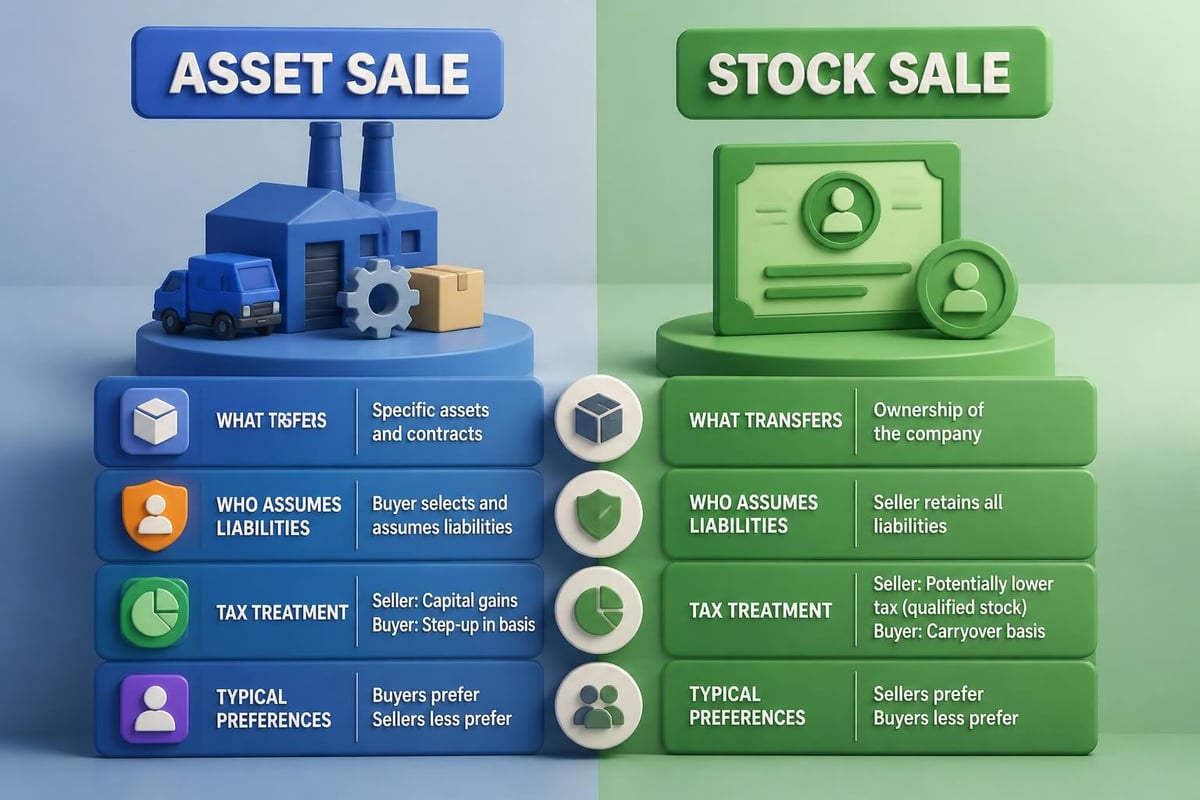
Understanding asset sales versus stock sales fundamentally affects your tax liability and transaction complexity. These two primary structures for selling companies create dramatically different outcomes for sellers and buyers.
In an asset sale, the buyer purchases specific company assets-client lists, intellectual property, equipment, and contracts-while leaving liabilities behind. Sellers typically face higher tax burdens because asset sales often trigger ordinary income rates on certain assets. However, buyers prefer this structure because they can select exactly what they're acquiring and often receive favorable tax treatment through depreciation.
Stock sales transfer ownership of the entire entity, including all assets and liabilities. Sellers usually benefit from preferential capital gains treatment on their proceeds. Buyers assume more risk because they inherit all company obligations, known and unknown.
Critical Legal Preparation Steps
According to Forbes' comprehensive M&A considerations guide, business owners should address these legal elements well before listing their companies:
Corporate governance cleanup - Ensure bylaws, shareholder agreements, and board minutes are current and complete
Contract review - Identify agreements with change-of-control provisions that could complicate transfers
IP protection - Verify that trademarks, patents, and proprietary processes are properly registered and owned by the company
Employment documentation - Confirm all team members have signed agreements covering confidentiality, non-compete clauses, and IP assignment
The legal considerations when selling your business extend beyond paperwork. Smart sellers conduct internal due diligence months before buyers request it, identifying and resolving potential red flags that could derail negotiations or reduce purchase prices.
How Do Valuation Multiples Work for Service Businesses?
Online service companies typically sell for 2-6x their Seller's Discretionary Earnings (SDE), depending on growth trajectory, market position, and operational maturity. This metric combines net profit plus owner compensation, benefits, and discretionary expenses, providing a clearer picture of actual cash flow than standard profit calculations.
Several factors push service businesses toward the higher end of valuation ranges. Recurring revenue models command premium multiples compared to project-based billing. Businesses with documented systems and processes that reduce owner involvement sell for more than those dependent on founder expertise. Companies serving multiple industries face less valuation discount than those concentrated in a single vertical.
Maximizing Your Valuation Multiple
Strategic sellers focus on these value drivers 18-24 months before engaging buyers:
Financial clarity matters tremendously. Clean books with GAAP-compliant accounting, reconciled statements, and organized tax returns signal professionalism. According to Business.com's selling considerations guide, buyers reduce offers or walk away entirely when faced with disorganized financials that make due diligence difficult.
Growth trajectory influences multiples. A company growing 40% annually commands significantly higher multiples than one with flat or declining revenue, even if current earnings are similar. Demonstrating consistent month-over-month growth through documented sales metrics strengthens your negotiating position substantially.
Customer concentration creates risk. If your top three clients represent more than 30% of revenue, expect valuation pressure. Buyers see concentrated customer bases as vulnerable to sudden revenue loss. Diversifying your client roster before selling protects your multiple.
Operational independence drives value. Can your business operate for 30 days without your involvement? Buyers pay premiums for companies where systems, not personalities, drive results. This includes everything from sales recruiting and placement processes to customer onboarding workflows.
What Financial Documentation Do Buyers Require?
Expect buyers to request 3-5 years of complete financial records during due diligence. This encompasses far more than tax returns and profit-and-loss statements. Sophisticated acquirers examine the operational details that reveal your business's true health and sustainability.
Your documentation package should include detailed revenue breakdowns showing:
Monthly recurring versus one-time revenue
Revenue by product or service line
Customer acquisition costs and lifetime value calculations
Gross margins by offering
Churn rates and retention metrics
Expense documentation proves equally important. Buyers scrutinize whether reported expenses represent normal operations or whether you've artificially inflated profitability by deferring maintenance, underinvesting in marketing, or cutting essential positions. They'll ask for vendor contracts, subscription agreements, and payroll records to verify your expense claims.
Building Your Documentation Timeline
Timeline | Documentation Tasks | Purpose |
|---|---|---|
24 months before sale | Implement consistent monthly close processes | Establish reliable financial rhythms |
18 months before sale | Begin tracking detailed KPIs and metrics | Create data-driven valuation support |
12 months before sale | Conduct internal due diligence review | Identify and fix documentation gaps |
6 months before sale | Engage quality of earnings analysis | Validate financials through third-party review |
3 months before sale | Prepare comprehensive data room | Enable efficient buyer due diligence |
Many sellers underestimate how legal and tax implications affect their final proceeds. Capital gains treatment versus ordinary income can create six-figure differences in after-tax proceeds on the same purchase price. Engaging tax advisors early in your planning process creates opportunities for legitimate tax optimization that becomes impossible once you've signed a letter of intent.
How Does the Sales Process Impact Business Continuity?
Maintaining normal operations while selling companies tests every owner's management capabilities. The sale process consumes enormous time and mental energy precisely when your business needs consistent leadership most.
Due diligence alone typically requires 60-90 days of intensive documentation gathering, question answering, and buyer meetings. During this period, your core business must continue performing at the levels that justified your asking price. Sales teams need support, clients require attention, and operational issues demand resolution.
Creating Operational Buffers
Smart sellers build capacity before entering the market. This might mean:
Promoting a second-in-command who can handle day-to-day decisions
Strengthening your sales team with additional vetted talent who can maintain momentum
Documenting standard operating procedures so teams can self-direct effectively
Scheduling regular business review meetings that continue regardless of sale activities
The challenges of maintaining operations during sale processes become particularly acute for service businesses where client relationships drive value. Any perception that service quality is declining can trigger client departures that reduce your valuation or even kill deals altogether.

What Role Do Sales Metrics Play in Buyer Confidence?
Documented sales performance data transforms subjective claims into objective proof. When selling companies that depend on consultative sales processes, your ability to show exactly how leads convert into clients becomes a decisive competitive advantage.
Buyers want granular visibility into your sales operation. They're purchasing your future revenue stream, so they need confidence that stream continues flowing after ownership changes. This means providing detailed metrics across your entire sales funnel:
Lead source breakdown with cost per lead by channel
Conversion rates at each funnel stage
Average sales cycle length from first contact to close
Win rates by sales representative
Average deal size and variance
Objection patterns and successful handling techniques
For businesses selling high-ticket services via Zoom or Google Meet-marketing agencies, coaching programs, consulting services-these metrics prove your sales success stems from repeatable systems rather than founder charisma alone.
Systematizing Sales for Transfer
The transition from founder-led sales to systematic sales operations requires deliberate effort. Consider how your approach changes when you know someone else will eventually run your sales team:
Document your sales methodology completely. Record your discovery call frameworks, presentation structures, objection handling scripts, and closing techniques. What exists only in your head has zero transferable value.
Track activity metrics religiously. Buyers need to see that your sales results correlate predictably with specific activities-calls made, demos delivered, proposals sent. This proves new ownership can replicate your success by maintaining those same activity levels.
Build redundancy into critical roles. If one closer generates 60% of your revenue, you've created a massive risk that buyers will either refuse to purchase or discount heavily. Building a deeper bench of sales talent before selling protects your valuation.
Create onboarding systems that work. Can you bring a new sales professional up to productivity in a defined timeframe using documented training? This capability has concrete value in M&A negotiations.
How Should Owners Prepare Personally for Exits?
Your personal readiness matters as much as business preparation when selling companies. The psychological, financial, and lifestyle implications of exiting a business you've built often catch owners unprepared, creating regret even when transactions succeed financially.
Financial planning extends beyond calculating after-tax proceeds. Consider how sale proceeds integrate into your broader wealth strategy. Will you reinvest in another venture? Retire completely? Transition to advisory work? Each path requires different financial structures and tax planning approaches.
The identity shift from business owner to former owner challenges many entrepreneurs emotionally. Your business has likely defined your professional identity for years or decades. Having concrete plans for how you'll spend your time and energy post-exit reduces the emptiness many sellers experience after closing.
Aligning Stakeholder Expectations
Sale processes affect more than owners. Partners, key employees, and family members all have stakes in the outcome. Transparent communication about your intentions, timeline, and expected outcomes prevents misunderstandings that can derail transactions.
For businesses with multiple owners, ensuring everyone agrees on timing, valuation expectations, and post-sale plans before engaging buyers prevents conflicts during negotiations. Few things kill deals faster than seller disagreements that emerge during due diligence.
What Common Mistakes Reduce Sale Success?
Waiting until you're burned out to sell typically reduces your proceeds by 20-40%. Exhausted owners telegraph desperation that sophisticated buyers exploit through lower offers and unfavorable terms. Strategic sellers exit from positions of strength, not necessity.
Overvaluing your business based on emotional attachment rather than market data creates extended time-on-market that ultimately forces price reductions. Working with experienced M&A advisors who provide objective valuation analysis prevents this costly mistake. The market determines value, not the effort you've invested building your company.
Neglecting to prepare your sales organization creates the single largest risk to service business exits. Buyers acquire your ability to generate future revenue. If your sales team is unstable, underdocumented, or overly dependent on you personally, expect significant valuation discounts or outright buyer disinterest.
Poor financial record-keeping costs sellers money in multiple ways. First, it extends due diligence timelines, creating more opportunities for deals to fall apart. Second, it introduces doubt about your reported performance, pushing buyers toward lower offers. Third, it prevents you from maximizing legitimate tax advantages that require documented substantiation.
Failing to understand key legal and structural considerations before engaging buyers puts you at a disadvantage during negotiations. Buyers and their advisors will structure deals to optimize their outcomes. Without equivalent expertise on your side, you'll likely accept terms that favor the buyer unnecessarily.
Successfully selling companies requires years of strategic preparation focused on financial clarity, operational independence, and sales team systematization. The businesses that command premium multiples prove their revenue engines run predictably regardless of ownership, supported by documented processes and strong talent. If you're building a high-ticket service business with growth aspirations or preparing for an eventual exit, having the right sales team in place creates measurable value that buyers recognize and reward. Sales Match specializes in recruiting pre-vetted closers, appointment setters, and sales managers for online service businesses, delivering ready-to-perform talent that strengthens your sales operation today while building transferable value for tomorrow.
About the Author
Craig Emslie is the Founder of Sales Match, a sales recruitment firm based in Saint Petersburg, FL. Since establishing the company, Craig has focused on connecting online service businesses with pre-vetted sales professionals who drive revenue growth. His expertise spans sales operations, talent acquisition, and helping service-based companies build scalable revenue systems. Craig works with marketing agencies, coaches, consultants, and B2B service providers generating $35,000+ monthly who need specialized sales talent for high-ticket offerings.
