
We Hire Remotely: Sales Recruitment in the Remote Era
Discover how "we hire remotely" transforms sales recruitment. Expert strategies for building high-performing remote sales teams in 2026.
published
TL;DR: Remote hiring has revolutionized sales recruitment, enabling businesses to access global talent pools while reducing overhead costs. Companies that implement structured remote hiring best practices and partner with specialized recruitment firms can build world-class sales teams without geographical limitations. This comprehensive guide explores proven strategies for hiring remote sales professionals effectively.
The phrase "we hire remotely" has transformed from a competitive advantage to a fundamental business practice in 2026. For companies selling high-ticket products and services through digital channels, the ability to recruit sales professionals from anywhere has eliminated traditional geographical constraints. This shift has created unprecedented opportunities for businesses to access top-tier sales talent while maintaining operational efficiency and controlling costs.
What Is Remote Hiring and Why Does It Matter for Sales Teams?
Remote hiring refers to the complete recruitment process conducted virtually, from initial candidate sourcing through onboarding, for positions that operate outside traditional office environments. Unlike temporary remote work arrangements, this approach treats distributed teams as the default organizational structure.
For businesses operating in the high-ticket sales space, this model offers distinct advantages. Companies can now access specialized sales professionals with expertise in specific industries or sales methodologies, regardless of their physical location. When we hire remotely, the talent pool expands exponentially beyond local markets.
The Data Behind Remote Sales Hiring
Current trends validate the permanence of this shift. According to comprehensive remote hiring statistics, remote work opportunities have increased significantly across all sectors, with sales roles showing particularly strong adoption rates. This growth reflects both employer preferences and candidate expectations in the current marketplace.
The implications extend beyond simple convenience. Research on remote work and career mobility demonstrates that remote-eligible positions expand pathways to upward career mobility, with measurable impacts on job transitions and compensation growth. Sales professionals increasingly prioritize remote opportunities when evaluating career moves.

How Do You Identify Top Remote Sales Talent?
Identifying exceptional remote sales professionals requires different evaluation criteria than traditional in-office hiring. The most successful organizations develop comprehensive frameworks that assess both sales competencies and remote work capabilities simultaneously.
Core competencies for remote sales professionals include:
Self-motivation and discipline: Ability to maintain productivity without direct supervision
Digital communication mastery: Proficiency across video conferencing, email, and collaboration platforms
Results orientation: Track record of meeting or exceeding quotas in performance-based environments
Technical adaptability: Comfort with CRM systems, sales enablement tools, and virtual presentation software
Time management excellence: Capacity to manage multiple prospects and deals across different time zones
The evaluation process should incorporate scenario-based assessments that simulate actual remote sales situations. Role-playing exercises conducted via video call can reveal how candidates handle objections, build rapport virtually, and navigate technical challenges during live conversations.
Leveraging Specialized Recruitment Partners
Many high-ticket businesses choose to work with specialized sales recruitment firms rather than managing the entire process internally. This approach offers several strategic advantages, particularly for companies without extensive HR infrastructure.
Professional recruitment partners maintain extensive networks of pre-vetted sales talent who have already demonstrated remote work competencies. These firms conduct comprehensive screenings that evaluate both technical sales skills and remote-specific capabilities, significantly reducing time-to-hire and improving placement quality.
What Remote Hiring Best Practices Should You Implement?
Successfully building remote sales teams requires systematic approaches that address unique challenges of distributed work environments. Organizations that we hire remotely must establish clear processes for every stage of the recruitment lifecycle.
Structuring the Virtual Interview Process
The interview sequence should progress through multiple stages, each designed to evaluate different competencies:
Initial screening call (15-20 minutes): Assess basic qualifications, communication style, and remote work experience
Skills assessment (30-45 minutes): Evaluate sales methodology, objection handling, and product knowledge capacity
Behavioral interview (45-60 minutes): Explore past performance, cultural alignment, and remote work habits
Final presentation (60 minutes): Request candidate to deliver a mock sales presentation to multiple stakeholders
Reference verification: Confirm past remote work performance and sales results
According to remote hiring best practices research, companies that implement structured, multi-stage processes report significantly higher retention rates and performance outcomes compared to those using abbreviated evaluation methods.
Technology Infrastructure Requirements
Infrastructure Element | Purpose | Implementation Priority |
|---|---|---|
Video conferencing platform | Conduct interviews and daily operations | Critical |
Applicant tracking system | Manage candidate pipeline efficiently | High |
Skills assessment tools | Evaluate sales competencies objectively | High |
Background verification service | Confirm credentials and employment history | Critical |
Collaboration software | Enable team coordination and communication | Medium |
The selection of appropriate technology creates the foundation for successful remote operations. Platforms should integrate seamlessly to create efficient workflows for both recruiters and candidates.

How Can You Assess Remote Work Capabilities Effectively?
Beyond traditional sales skills, evaluating a candidate's capacity to thrive in remote environments requires specific assessment techniques. These capabilities often determine long-term success more than basic sales experience.
Key assessment areas include:
Communication clarity: How effectively does the candidate articulate complex ideas through digital channels?
Home office setup: Does the candidate maintain a professional, distraction-free workspace with reliable technology?
Previous remote experience: What specific examples can they provide of overcoming remote work challenges?
Proactive problem-solving: How do they handle technical issues or communication barriers independently?
Schedule flexibility: Can they accommodate client meetings across different time zones when necessary?
During interviews, ask candidates to demonstrate their remote workspace via video call. This simple exercise reveals volumes about their professionalism, technical setup, and preparation. Candidates who maintain organized, professional environments typically demonstrate similar discipline in their sales activities.
Security Considerations in Remote Recruitment
The remote hiring landscape has introduced new security vulnerabilities that responsible organizations must address. As highlighted in recent security research, malicious actors have exploited remote hiring processes to infiltrate companies.
Implement verification protocols that confirm candidate identities, validate employment histories, and protect sensitive company information throughout the recruitment process. This includes secure document sharing, encrypted communication channels, and comprehensive background checks before granting system access.
What Challenges Should You Anticipate When Hiring Remotely?
Organizations that transition to remote hiring models encounter predictable challenges that require proactive solutions. Understanding these obstacles enables better preparation and faster resolution when issues arise.
Time Zone Coordination
Building sales teams across multiple time zones creates scheduling complexity for both recruitment and ongoing operations. When we hire remotely, establishing core collaboration hours where all team members are available becomes essential.
Consider creating regional hiring clusters that minimize time zone spread while still accessing diverse talent pools. For example, grouping team members within 3-4 hour time zone ranges enables reasonable overlap for team meetings and training sessions.
Cultural Integration and Team Cohesion
Remote environments can make cultural assimilation more challenging for new hires. Without organic hallway conversations and spontaneous interactions, companies must deliberately create opportunities for relationship building and cultural transmission.
Successful organizations implement structured onboarding programs that extend beyond job training to include cultural immersion activities. Virtual coffee meetings, team-building exercises, and mentor assignments help new remote sales professionals integrate into company culture effectively.
Challenge | Impact | Solution Strategy |
|---|---|---|
Limited face-to-face interaction | Slower relationship building | Scheduled video check-ins, virtual team events |
Communication delays | Reduced responsiveness | Clear communication protocols, async tools |
Performance monitoring | Difficulty assessing productivity | Output-based metrics, regular 1-on-1s |
Technical inconsistencies | Varied candidate experiences | Standardized technology requirements |
Onboarding complexity | Longer ramp-up periods | Comprehensive digital training programs |
How Do You Build Effective Remote Onboarding Programs?
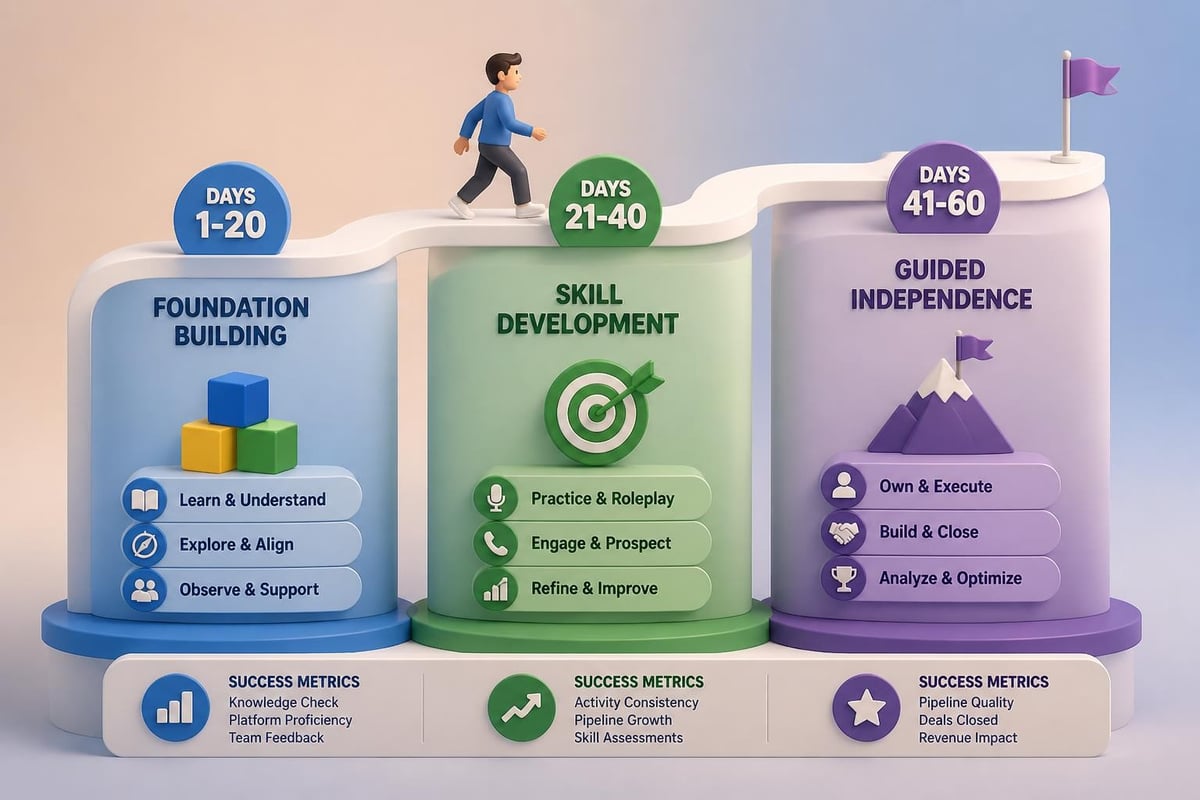
The onboarding phase determines whether remote sales hires achieve productivity quickly or struggle to find their footing. Companies that we hire remotely must invest significantly more effort in structured onboarding compared to traditional office environments.
An effective remote onboarding program spans 60-90 days and includes multiple components:
Week 1-2: Foundation Building
Company history, values, and culture orientation
Technology setup and platform training
Introduction to team members and key stakeholders
Product knowledge deep dive
Sales process and methodology training
Week 3-4: Skill Development
CRM system mastery and pipeline management
Sales script and messaging refinement
Objection handling practice and role-playing
Shadowing experienced team members on calls
Initial prospect engagement under supervision
Week 5-8: Guided Independence
Managing full sales cycle with mentor oversight
Regular performance feedback and coaching
Gradual quota ramp-up progression
Ongoing product and market training
Integration into team rhythms and meetings
Measuring Onboarding Success
Track specific metrics that indicate onboarding effectiveness rather than relying on subjective assessments. Key performance indicators include time-to-first-deal, ramp-to-quota timeline, activity levels compared to tenured representatives, and early retention rates.
Organizations offering services like Sales Match's replacement policy understand that comprehensive onboarding reduces early turnover and protects both employer and placement investment.
What Compensation Structures Work Best for Remote Sales Teams?
Compensation design significantly impacts your ability to attract and retain top remote sales talent. When we hire remotely, traditional salary structures may require adjustment to reflect geographic cost-of-living variations while maintaining internal equity.
Several compensation approaches have emerged as effective for distributed sales teams:
Location-adjusted base salaries account for cost-of-living differences while maintaining consistent commission structures. This approach recognizes that $80,000 annual base salary represents different purchasing power in various markets while ensuring all representatives earn commissions using identical calculations.
Performance-weighted compensation emphasizes variable pay over base salary, creating location-agnostic earning potential based purely on results. High-ticket sales roles particularly suit this model, where commission structures can generate substantial income for top performers regardless of geography.
Tiered commission accelerators reward representatives who exceed quota with increasing commission rates, creating powerful incentive alignment. Representatives earning 10% commission on deals up to quota might earn 15% on revenue between 100-125% of quota and 20% on revenue exceeding 125% of quota.
Benefits and Perks for Remote Teams
Beyond cash compensation, remote sales professionals value specific benefits that support distributed work:
Home office stipends for equipment and furniture
Internet and phone reimbursement
Professional development and training budgets
Flexible scheduling within core hours
Annual team meetups or retreats
Health and wellness programs adapted for remote participation
How Does Remote Hiring Impact Sales Team Performance?
Evidence increasingly demonstrates that well-managed remote sales teams match or exceed the performance of traditional office-based teams. Analysis of remote work hiring trends in 2026 reveals that companies implementing structured remote work programs report positive performance outcomes across multiple metrics.
The performance advantages stem from several factors. Remote sales professionals often report higher job satisfaction due to improved work-life balance and elimination of commute time. This satisfaction translates to lower turnover rates and more consistent performance.
Additionally, when we hire remotely, companies access specialized talent that might not relocate for positions. A business selling high-ticket coaching programs can recruit a sales professional with 10 years of experience in that specific niche, regardless of where that person chooses to live.
Performance Monitoring and Coaching
Remote environments require different performance management approaches than traditional office settings. Rather than observing activity levels through physical presence, managers must focus on objective output metrics and results.
Effective performance monitoring for remote sales teams includes:
Weekly pipeline reviews examining deal progression and stage velocity
Call recording analysis to evaluate technique and messaging
Activity tracking through CRM systems (calls made, emails sent, meetings scheduled)
Monthly quota attainment analysis with variance investigation
Customer feedback collection and satisfaction scoring
Regular coaching sessions conducted via video call should focus on specific, actionable improvements rather than general discussions. Reviewing recorded sales calls together allows managers to provide detailed feedback on specific moments where different approaches might improve outcomes.
What Role Do Recruitment Partners Play in Remote Hiring?
Many businesses partner with specialized firms rather than managing remote recruitment entirely in-house. This decision often reflects resource constraints, expertise gaps, or the desire to accelerate hiring timelines.
Professional sales recruitment services provide several distinct advantages in remote hiring contexts. These firms maintain extensive networks of remote-capable sales professionals who have demonstrated success in distributed environments. Their screening processes evaluate both fundamental sales competencies and remote-specific capabilities, delivering candidates who can succeed from day one.
The vetting process employed by specialized recruiters typically includes multiple assessment layers that individual companies struggle to replicate efficiently. This comprehensive evaluation reduces hiring mistakes and improves overall placement quality.
The Value of Replacement Guarantees
When we hire remotely, the risks associated with poor placements multiply due to reduced ability to observe and correct performance issues in real-time. Forward-thinking recruitment partners address this concern through performance guarantees that protect employer investments.
These guarantees typically stipulate that if a placed candidate fails to meet performance expectations within a defined period, the recruitment firm will source and place a replacement at no additional cost. This arrangement aligns incentives between employer and recruiter, ensuring both parties focus on long-term placement success rather than simply filling positions quickly.
How Should You Structure Remote Sales Team Operations?
Operational structure significantly impacts remote sales team effectiveness. Organizations must establish clear frameworks that enable coordination, accountability, and continuous improvement across distributed team members.
Core operational elements include:
Standardized sales processes: Document each step of the sales cycle with clear expectations and deliverables
Communication protocols: Define which channels to use for different communication types and expected response times
Meeting rhythms: Establish consistent schedules for team calls, one-on-ones, and training sessions
Documentation standards: Create centralized repositories for sales collateral, customer information, and process documentation
Technology requirements: Specify mandatory platforms and proficiency standards for all team members
Many successful remote sales organizations adopt "async-first" communication practices, defaulting to recorded video messages, detailed written updates, and shared documents rather than requiring real-time attendance for all information sharing. This approach respects time zone differences while maintaining information accessibility.
Creating Accountability Without Micromanagement
The challenge of remote management centers on creating accountability systems that ensure performance without creating oppressive micromanagement that drives away top talent. The solution lies in establishing clear output expectations while allowing process flexibility.
Focus accountability on measurable outcomes rather than input activities. Instead of requiring representatives to make exactly 50 calls per day, set expectations around meetings scheduled, opportunities created, and revenue generated. This outcome orientation empowers sales professionals to optimize their own processes while maintaining clear performance standards.
What Technology Stack Supports Remote Sales Teams Best?
The technology infrastructure supporting remote sales operations extends beyond video conferencing and CRM systems. Comprehensive stacks integrate multiple platforms that enable prospecting, communication, collaboration, and performance management.
Essential platform categories include:
Platform Type | Primary Function | Representative Options |
|---|---|---|
CRM System | Customer data and pipeline management | Salesforce, HubSpot, Pipedrive |
Video Conferencing | Client meetings and team calls | Zoom, Google Meet, Microsoft Teams |
Sales Engagement | Prospecting automation and tracking | Outreach, SalesLoft, Apollo |
Communication | Team messaging and collaboration | Slack, Microsoft Teams, Discord |
Document Management | Proposal and contract handling | DocuSign, PandaDoc, Proposify |
Call Recording | Quality assurance and training | Gong, Chorus, Wingman |
Integration between platforms determines overall system effectiveness. Representatives should access all necessary information without constantly switching contexts or manually transferring data between systems. Evaluate integration capabilities carefully when selecting technology vendors.
Security and Compliance Considerations
Remote sales operations create data security challenges that require proactive management. Sales professionals access sensitive customer information, financial data, and proprietary company materials from personal networks and devices.
Implement security protocols that protect information without creating excessive friction in daily workflows. This includes virtual private networks (VPNs), multi-factor authentication, encrypted communication channels, and clear data handling policies. Regular security training ensures team members understand their responsibilities in protecting company and customer information.
How Do You Scale Remote Sales Teams Effectively?
Scaling from initial remote sales hires to full-fledged teams requires systematic approaches that maintain quality while increasing headcount. Organizations that we hire remotely must balance growth velocity with cultural preservation and performance standards.
The most successful scaling strategies progress through defined stages rather than attempting massive expansion simultaneously. Begin with a small core team that establishes processes, proves the remote model, and creates the foundation for future growth. These initial hires become cultural ambassadors who help integrate subsequent team members.
Scaling progression typically follows this pattern:
Stage 1 (Months 1-3): Hire 2-3 initial representatives, establish processes, validate remote model
Stage 2 (Months 4-6): Add 3-5 additional representatives, refine onboarding, document best practices
Stage 3 (Months 7-12): Implement structured hiring cadence, add team leadership, create specialization
Stage 4 (Year 2+): Scale systematically based on pipeline capacity and market opportunity
This measured approach enables course correction and process refinement before scaling challenges compound. Organizations can identify what works, document successful approaches, and create replicable systems that support rapid expansion while maintaining quality.
Building Leadership Capacity
As remote teams grow beyond 8-10 representatives, individual contributor management becomes unsustainable. Developing remote-capable sales leaders who can manage distributed teams represents a critical scaling requirement.
Some organizations promote top performers into management roles, while others recruit experienced remote sales managers externally. Both approaches carry advantages, but require different support systems. Internal promotions preserve cultural knowledge but may need extensive management training, while external hires bring leadership experience but require deeper cultural integration.
What Are the Long-Term Benefits of Remote Sales Hiring?
Beyond immediate access to broader talent pools, remote hiring creates strategic advantages that compound over time. Organizations that embrace distributed models position themselves for sustained competitive advantage in talent acquisition and retention.
The cost structure improvements alone justify consideration. Eliminating office space for sales teams reduces real estate, utilities, and equipment expenses significantly. These savings can redirect toward higher compensation packages that attract premium talent or increased profit margins that strengthen business fundamentals.
Retention typically improves in remote environments when companies implement strong management practices. Sales professionals value the flexibility and autonomy that remote work provides, creating powerful retention incentives beyond pure compensation. According to research from remote hiring practitioners, companies offering permanent remote options report measurably lower voluntary turnover compared to office-required positions.
The talent pool expansion creates perhaps the most significant strategic advantage. Rather than limiting searches to candidates within commuting distance of physical offices, organizations can recruit the absolute best person for each role regardless of location. For specialized positions like high-ticket sales closers, this geographic flexibility often makes the difference between landing exceptional talent and settling for available local candidates.
Future-Proofing Your Sales Organization
Market conditions and candidate expectations continue evolving toward remote-first models. Organizations that develop remote hiring capabilities now position themselves advantageously for future talent competition. Building institutional knowledge around remote recruitment, management, and operations creates competitive moats that traditional office-bound competitors struggle to overcome.
The infrastructure investments required for remote success extend beyond immediate hiring needs. Companies develop systems, processes, and cultural norms that enable distributed collaboration across all functions, not just sales. These capabilities create organizational resilience and flexibility that prove valuable across multiple business scenarios.
Building high-performing remote sales teams requires systematic approaches that address the unique challenges of distributed work while capitalizing on unprecedented access to global talent pools. When organizations implement structured processes, leverage appropriate technology, and partner with specialized recruiters, they can assemble world-class sales capabilities that drive sustainable growth. Sales Match specializes in connecting high-ticket businesses with pre-vetted remote sales professionals who excel in distributed environments, offering comprehensive placement services with performance guarantees that eliminate hiring risk and ensure long-term team success.
About the Author
Jennifer Morrison is a sales recruitment strategist with 12 years of experience building distributed sales teams for high-ticket B2B organizations. She specializes in remote hiring methodologies and has placed over 300 sales professionals in remote roles across coaching, consulting, and service-based businesses. Jennifer holds a Master's degree in Organizational Psychology and regularly contributes to industry publications on remote workforce development.
