
Commission Based Pay: A Complete Guide for 2026
Discover how commission based compensation works, including different models, pros and cons, and best practices for high-ticket sales teams in 2026.
published
Commission based compensation structures have transformed how businesses motivate and reward sales teams, particularly in high-ticket industries where deal sizes justify performance-linked pay. For companies selling products or services above $2,500 through digital channels like Zoom or Google Meet, understanding commission based models is essential for building effective sales organizations. This comprehensive guide explores the mechanics, benefits, challenges, and strategic considerations of implementing commission based pay structures in 2026.
Understanding Commission Based Compensation Models
A commission based compensation system ties a salesperson's earnings directly to their performance, typically measured by revenue generated, deals closed, or other measurable outcomes. Unlike traditional salary structures, this approach creates a direct correlation between individual effort and financial reward.
The Core Structure Types
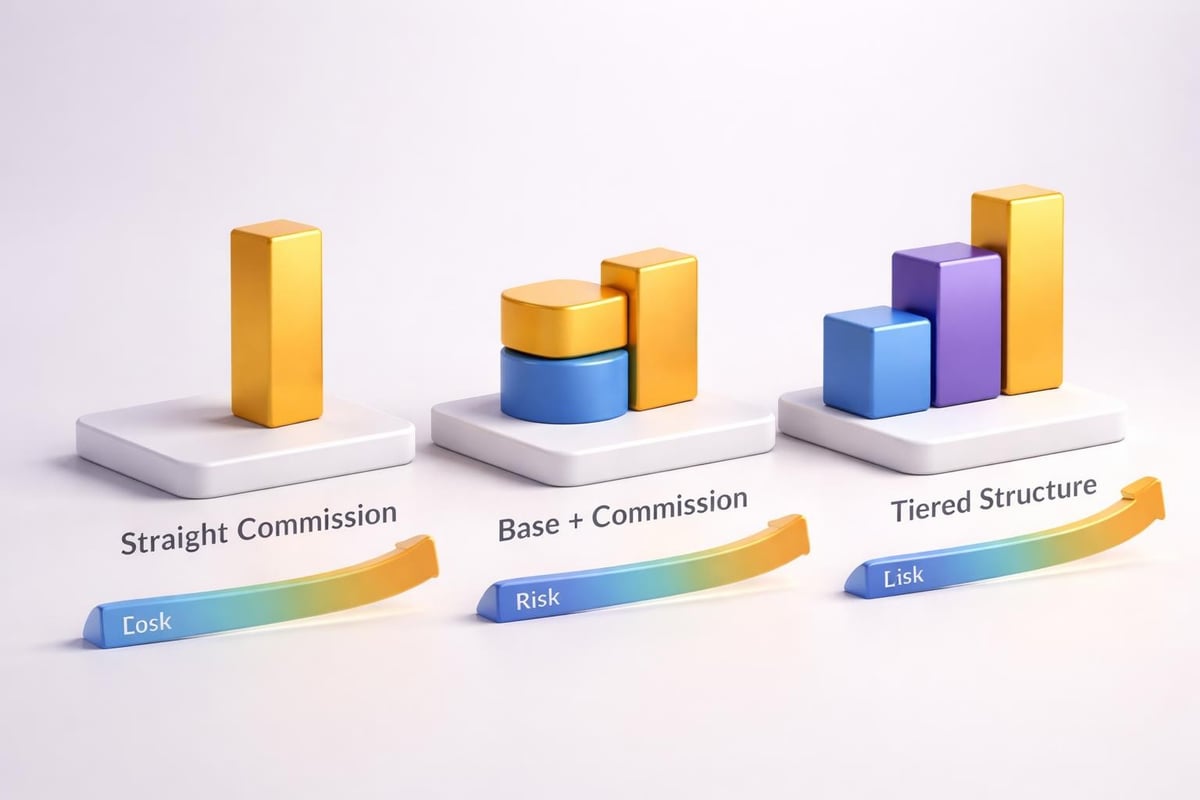
Several distinct commission based models dominate the sales landscape today. Straight commission represents the purest form, where salespeople earn exclusively from their sales with no base salary. This model attracts self-motivated professionals but carries higher risk for both parties.
Base plus commission combines a fixed salary with performance bonuses, offering stability while maintaining incentive alignment. According to research on commission-based pay structures, this hybrid approach has become increasingly popular in high-ticket sales environments where deal cycles extend beyond a single month.
Tiered commission structures increase the percentage earned as salespeople hit specific thresholds. For example, a salesperson might earn 10% on the first $50,000 in monthly sales, then 15% on everything above that threshold. This progressive model encourages sustained high performance.
Model Type | Base Salary | Commission Rate | Risk Level | Best For |
|---|---|---|---|---|
Straight Commission | None | High (15-30%) | Highest | Experienced sellers |
Base + Commission | Moderate | Medium (5-15%) | Balanced | Most organizations |
Tiered Commission | Varies | Progressive | Moderate | Growth-focused teams |
Draw Against Commission | Temporary | Variable | High | New market entry |
The Benefits of Commission Based Pay Structures
Performance-based compensation offers compelling advantages for businesses operating in competitive markets. Direct alignment between individual success and company revenue creates a powerful motivational force that salary-only structures cannot match.
When implementing a commission structure, businesses often experience increased productivity from their sales teams. Salespeople working under commission based systems typically demonstrate higher levels of self-motivation, requiring less direct management oversight.
Financial Flexibility and Scalability
Commission based models provide businesses with built-in cost control. During slower periods, compensation expenses automatically decrease in proportion to revenue. This financial flexibility proves particularly valuable for growing businesses that need to manage cash flow carefully.
Lower fixed costs reduce financial risk during market fluctuations
Scalability allows rapid team expansion without proportional overhead increases
Variable expenses align directly with revenue generation
Performance-based budgeting simplifies financial forecasting
The scalability factor becomes especially important when businesses look to hire a sales team quickly. Organizations can onboard multiple salespeople simultaneously without the same financial commitment required by purely salary-based structures.
Attracting Top Talent
High-performing sales professionals often prefer commission based arrangements because they remove earning ceilings. According to Salesonomics research on commission-based pay, top performers in high-ticket sales environments can significantly exceed traditional salary ranges through performance incentives.
This appeal helps businesses compete for sales professionals who have proven track records and confidence in their abilities. The best closers seek environments where their skills translate directly into financial rewards.
Challenges and Considerations
Despite the advantages, commission based compensation introduces complexities that require careful management. Income volatility represents the primary concern for salespeople, particularly those new to the profession or industry.
Managing Team Dynamics
Commission based environments can inadvertently create competitive dynamics that undermine collaboration. When salespeople compete for the same leads or accounts, territorial disputes often emerge.
Successful organizations address this challenge through:
Clear territory definitions and lead assignment protocols
Team-based bonuses that reward collective achievement
Transparent commission calculation processes
Regular performance reviews that emphasize collaboration
Shared resources that support all team members equally
The pros and cons of commission-based roles extend beyond individual compensation to impact overall team culture. Organizations must actively cultivate environments where healthy competition coexists with collaborative problem-solving.
Legal and Compliance Requirements
Commission based pay structures carry specific legal obligations that vary by jurisdiction. Businesses must ensure compliance with minimum wage requirements, proper classification of employees versus independent contractors, and accurate record-keeping.

According to analysis of legal implications, commission structures must clearly define earning periods, payment timelines, and circumstances affecting commission eligibility. Written agreements should specify how commissions are calculated, when they're earned versus paid, and what happens with pending commissions if employment ends.
Designing Effective Commission Structures
Creating a commission based system that drives desired behaviors requires strategic planning. The structure must balance company profitability goals with salesperson earning potential while remaining simple enough to understand and administer.
Key Design Principles
Simplicity stands as the foundation of effective commission plans. Complex formulas with multiple variables confuse salespeople and reduce motivational impact. A comprehensive guide to commission-based pay models emphasizes that salespeople should be able to calculate their expected earnings quickly.
Achievability ensures that targets remain within reach for competent performers. Setting thresholds too high demotivates teams, while excessively low bars fail to challenge salespeople or protect profit margins.
Predictability allows salespeople to forecast their earnings based on pipeline activity. When commission structures change frequently or calculations remain opaque, trust erodes and retention suffers.
Design Element | Poor Implementation | Strong Implementation |
|---|---|---|
Calculation | Multi-variable formula with exceptions | Single percentage or clear tier system |
Payment Timing | Irregular or delayed | Consistent monthly schedule |
Target Setting | Arbitrary or impossible goals | Data-driven, achievable benchmarks |
Documentation | Verbal agreements | Written, signed commission plans |
Industry-Specific Considerations
High-ticket sales environments present unique challenges for commission based compensation. Extended sales cycles mean salespeople may work leads for months before closing, requiring payment structures that sustain motivation throughout the journey.
Many successful high-ticket businesses implement milestone-based commissions that reward progress through the sales funnel. A salesperson might earn a smaller percentage when securing a qualified discovery call, additional commission at proposal acceptance, and the primary payout upon contract signature.
For businesses engaged in high-ticket sales, this approach maintains engagement during lengthy evaluation periods while recognizing that not all deals close despite significant effort invested.
Implementation Best Practices
Transitioning to or optimizing a commission based pay structure requires thoughtful change management. Existing team members accustomed to different compensation models may resist changes that introduce uncertainty.
Communication and Transparency
Successful implementations begin with clear communication about the rationale, mechanics, and expected outcomes of commission based structures. Organizations should provide detailed documentation that explains:
Exactly how commissions are calculated
When earnings are credited versus paid
How different scenarios (refunds, cancellations, payment plans) affect commissions
The process for resolving disputes or calculation errors
Historical performance data showing realistic achievement levels
Transparency builds trust and reduces anxiety associated with performance-based pay. When sales recruitment specialists evaluate candidates, they consistently find that professionals value clarity about compensation more than any other single factor.
Training and Support Systems
Commission based success requires more than motivation. Salespeople need robust training, quality leads, effective tools, and ongoing support to perform at their highest levels.
Comprehensive onboarding that teaches product knowledge, sales methodology, and commission mechanics
Lead generation support that ensures consistent pipeline flow
CRM and tracking tools that provide visibility into performance metrics
Regular coaching that addresses skill gaps and strategic challenges
Performance analytics that help salespeople identify improvement opportunities
Organizations offering services to build sales teams recognize that compensation structure alone doesn't guarantee success without these supporting elements.

Optimizing Commission Rates and Thresholds
Determining appropriate commission percentages requires analysis of multiple factors including product margins, market conditions, competitive compensation levels, and desired profit retention.
Margin-Based Calculations
Commission based rates should preserve healthy profit margins while rewarding salespeople appropriately. A common approach calculates commissions as a percentage of gross profit rather than revenue, ensuring that discounting or cost variations don't erode business profitability.
For high-ticket offerings with substantial margins, commission rates between 10-20% of revenue often prove sustainable. Lower-margin products may require smaller percentages or tiered structures that reward volume over individual deal value.
Competitive Benchmarking
Understanding market rates prevents losing vetted candidates to competitors offering more attractive compensation. Research indicates that commission based structures in software and professional services industries typically fall within predictable ranges based on deal size and complexity.
However, total compensation potential matters more than commission rate alone. A 10% commission on $10,000 average deals provides less earning potential than 5% on $50,000 transactions, assuming similar close rates and cycle times.
Addressing Common Commission Based Challenges
Even well-designed commission structures encounter predictable challenges that require proactive management. Understanding these issues helps organizations develop solutions before problems undermine team performance.
Deal Attribution Conflicts
When multiple team members contribute to sales, attribution becomes complex. Should the closer receive full commission, or should credit split between appointment setters, closers, and account managers?
Different businesses resolve this differently based on their sales processes. Some organizations designate specific roles as commission-eligible while others implement split arrangements. The key lies in establishing clear rules before conflicts emerge and documenting them in writing.
For companies utilizing remote sales closer specialists alongside appointment setters, defining these parameters prevents internal friction that damages team cohesion.
Performance Measurement Accuracy
Commission based systems depend on accurate performance tracking. Errors in attribution, calculation, or reporting destroy trust and motivation more quickly than almost any other management failure.
Implement automated tracking systems that reduce manual errors
Conduct regular audits of commission calculations
Provide salespeople with real-time dashboards showing current performance
Establish clear dispute resolution processes
Document all commission-related decisions and adjustments
Managing Underperformance
Not every salesperson succeeds under commission based structures. Organizations need clear performance standards and procedures for addressing consistent underperformance.
According to analysis of different commission models, businesses should establish minimum performance thresholds that trigger performance improvement plans or role reassessment. This protects both the organization and the salesperson from extended unsuccessful periods.
When working with recruitment partners who understand the importance of the right fit, businesses can reduce mismatches between commission based roles and candidate capabilities through thorough vetting processes.
Alternative Hybrid Models
Pure commission structures don't suit every situation or every salesperson. Several hybrid approaches combine elements of commission based pay with other compensation components.
Residual Commission Structures
For businesses with recurring revenue models, residual commissions reward salespeople for the lifetime value of accounts they acquire. This approach particularly suits subscription-based or retainer services where client relationships extend across years.
Residual models typically pay reduced percentages compared to upfront commissions but continue payments as long as clients remain active. This creates alignment around customer success rather than simply closing deals.
Team-Based Incentives
Combining individual commission based pay with team performance bonuses encourages collaboration while maintaining personal accountability. A salesperson might earn commission on their deals plus quarterly bonuses based on departmental achievement.
This hybrid approach works well for organizations where sales departments must coordinate across multiple functions or where individual contributions to complex sales are difficult to isolate precisely.
Draw Against Commission
Draw arrangements provide salespeople with consistent income that's later reconciled against earned commissions. Recoverable draws function as loans that must be repaid from future commissions, while non-recoverable draws act as guaranteed minimums.
These structures help salespeople manage income volatility during onboarding periods or seasonal fluctuations. However, they introduce administrative complexity and potential conflicts if draws consistently exceed earned commissions.
Technology and Commission Management
Modern commission based systems leverage technology to automate calculations, provide transparency, and reduce administrative burden. Manual tracking in spreadsheets becomes unsustainable as teams grow or commission structures increase in complexity.
Specialized commission management platforms integrate with CRM systems to automatically track deals, calculate earnings, and generate reports. These tools reduce errors, save administrative time, and provide salespeople with real-time visibility into their performance and earnings.
For organizations building remote sales teams across distributed locations, technology becomes essential for maintaining consistency and fairness in commission administration.
Commission based compensation structures offer powerful tools for aligning sales team motivation with business objectives, particularly in high-ticket digital sales environments. Understanding the various models, implementation challenges, and best practices enables organizations to design systems that attract top performers while maintaining profitability. When you're ready to build a world-class sales team operating under effective compensation structures, Sales Match provides pre-vetted sales talent specifically experienced in high-ticket environments, eliminating lengthy hiring processes while ensuring you find professionals who thrive under performance-based compensation models.