Interview Booking: A Complete Guide for Sales Teams
Master interview booking for sales recruitment. Learn proven strategies, scheduling best practices, and tools to streamline your hiring process.
published
Interview booking represents one of the most critical yet often underestimated components of successful sales recruitment. For businesses selling high-ticket products and services over the internet, the efficiency of your interview scheduling process directly impacts your ability to secure top sales talent before competitors do. A streamlined approach to interview booking can reduce time-to-hire by weeks, prevent candidate drop-off, and ensure your organization maintains momentum throughout the hiring process. When recruitment teams struggle with scheduling inefficiencies, qualified candidates often accept competing offers while waiting for interview confirmations.
The Strategic Importance of Efficient Interview Booking
Every hour of delay in interview booking creates opportunity for candidate disengagement. According to LinkedIn's Global Talent Trends report, 83% of candidates say a negative interview experience can change their mind about a role they once liked. The booking process itself contributes significantly to that experience, starting from the very first scheduling interaction.
The cost of poor interview booking extends beyond candidate experience. Hiring managers waste valuable time coordinating schedules manually, sending multiple email threads, and managing calendar conflicts. For sales organizations specifically, this represents a double loss-not only does the hiring process drag on, but sales leaders who should be closing deals or coaching existing team members instead spend hours playing calendar coordinator.
For companies utilizing pre-vetted sales talent, the interview booking stage becomes even more critical. These candidates typically have multiple opportunities in play simultaneously, making speed and professionalism in scheduling absolutely essential.
Understanding Candidate Psychology in the Booking Process
Top sales professionals evaluate companies throughout every touchpoint, including how efficiently you handle interview booking. A disorganized scheduling process signals potential organizational dysfunction, causing candidates to question whether they want to work for your company.
Research from Talent Board's Candidate Experience Research indicates that candidates who rate their interview scheduling experience positively are 38% more likely to accept a job offer. Conversely, those who experience scheduling difficulties often withdraw from consideration entirely, even when genuinely interested in the role.
Essential Interview Booking Components
Effective interview booking requires several interconnected elements working together seamlessly. Understanding each component helps recruitment teams identify where breakdowns occur and how to optimize the entire process.
Calendar Coordination and Time Zone Management
For remote sales positions, which represent the majority of high-ticket sales roles in 2026, time zone coordination becomes paramount. Booking interviews across multiple time zones without clear systems leads to missed appointments, frustrated candidates, and wasted interviewer availability.
Best practices for calendar coordination include:
Displaying all interview times in the candidate's local time zone
Confirming time zones explicitly in all communication
Building buffer time between back-to-back interviews
Reserving specific interview blocks on hiring manager calendars
Implementing automated calendar holds to prevent double-booking
The most efficient recruitment teams establish dedicated interview booking windows rather than attempting to find availability ad-hoc for each candidate. This approach, recommended by Cornell University's HR department, significantly reduces the back-and-forth typically associated with scheduling.
Communication Protocols That Work
Interview booking communication should follow a standardized yet personalized approach. Candidates need clear information delivered promptly, while hiring teams require systems that don't create communication bottlenecks.
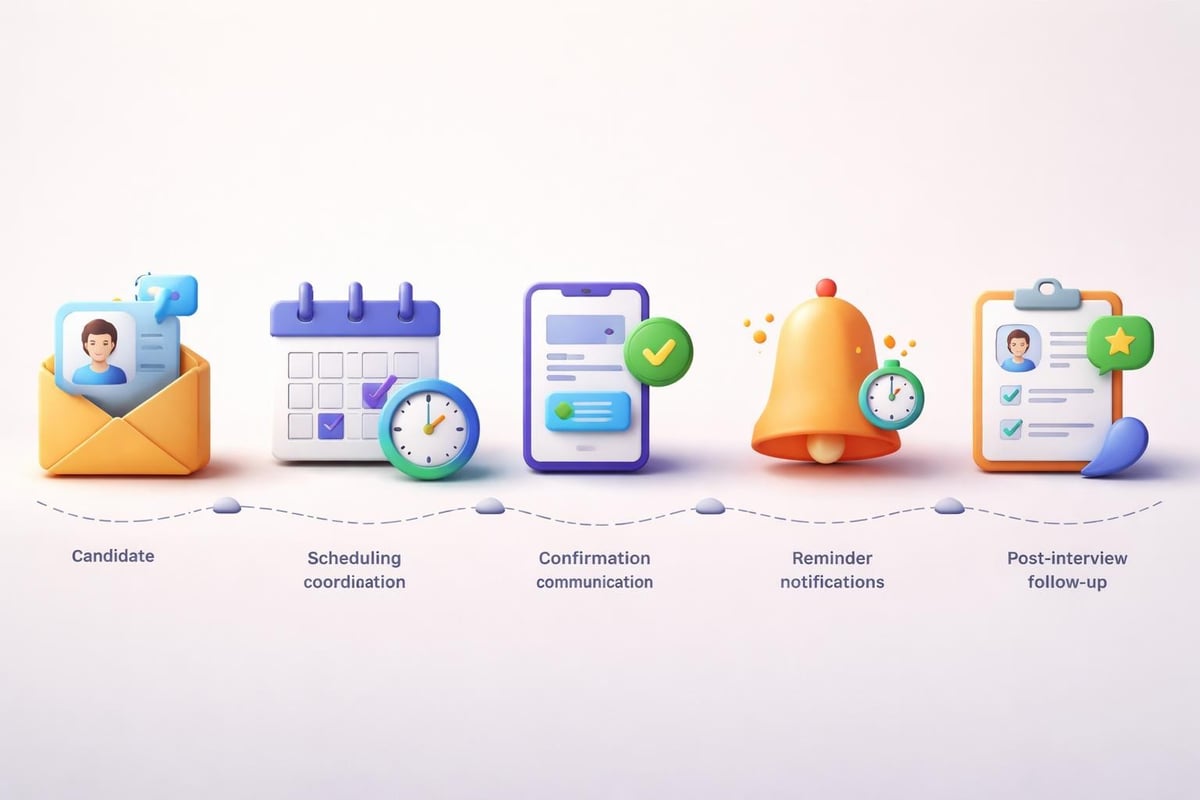
Communication Element | Timing | Key Information Required |
|---|---|---|
Initial booking outreach | Within 24 hours of screening | Available time slots, interview format, duration |
Confirmation message | Immediately upon scheduling | Date, time, time zone, platform/location, interviewer names |
Reminder notification | 24 hours before interview | Same details as confirmation plus preparation materials |
Follow-up communication | Within 48 hours post-interview | Timeline for decision, next steps |
According to Crosschq's scheduling research, candidates who receive interview confirmations within one hour of scheduling show 47% higher attendance rates than those who wait more than 24 hours for confirmation.
Technology Solutions for Interview Booking
Modern interview booking demands technology that eliminates manual coordination while maintaining the personal touch candidates expect. The right tools transform scheduling from a time-consuming administrative task into a seamless automated process.
Scheduling Platform Categories
Several categories of scheduling tools serve different interview booking needs. Understanding which type aligns with your recruitment volume and complexity helps optimize your technology stack.
Calendar scheduling tools like Calendly and Chili Piper allow candidates to self-schedule based on predefined availability. These platforms integrate with existing calendar systems, automatically update when slots are booked, and send confirmation emails without recruiter involvement.
Applicant tracking systems often include native scheduling functionality, though capabilities vary widely. More sophisticated systems offer coordinated scheduling for panel interviews, automatic time zone conversion, and integrated video conferencing links.
Specialized interview scheduling platforms provide enterprise-grade features including interview kit distribution, candidate self-rescheduling, automated reminder sequences, and analytics on scheduling efficiency. According to TechRadar's review of scheduling apps, these specialized platforms reduce scheduling time by up to 75% compared to manual coordination.
For organizations focused on building sales teams, the investment in proper scheduling technology pays dividends through faster hiring cycles and improved candidate conversion rates.

Integration and Automation Considerations
The most effective interview booking systems don't operate in isolation. They integrate with your broader recruitment technology ecosystem to create seamless workflows from candidate sourcing through final offer.
Integration points to prioritize include:
Applicant tracking system synchronization to ensure candidate data flows automatically without manual data entry
Calendar platform connectivity with Google Calendar, Microsoft Outlook, or other enterprise calendar systems
Video conferencing tool integration to automatically generate and distribute meeting links
Communication platform connections for sending scheduling messages through your preferred channels
CRM integration for sales-specific recruitment workflows that track candidates through multiple touchpoints
When evaluating scheduling technology, consider whether the platform supports your specific interview formats. Panel interviews, multi-stage processes, and skills assessments each require different scheduling capabilities. As noted in Candidate.fyi's scheduling best practices guide, standardizing your interview process makes automation significantly more effective.
Interview Booking Process Optimization
Even with excellent technology, interview booking requires thoughtful process design to maximize efficiency and candidate experience. The following optimization strategies represent proven approaches from high-performing recruitment teams.
Standardizing Without Sacrificing Personalization
Standardization accelerates interview booking while maintaining consistency, but candidates still expect personalized communication. The key lies in standardizing processes and templates while customizing specific details for each candidate.
Create template libraries for common interview booking scenarios:
Initial scheduling outreach after phone screening
Panel interview coordination for final-stage candidates
Rescheduling requests when conflicts arise
Interview preparation materials specific to role and stage
Post-interview next steps communication
Each template should include placeholders for personalized elements like candidate name, specific role details, interviewer names, and customized preparation instructions. This approach, highlighted in Timify's interview scheduling strategies, maintains efficiency while preserving the personal touch that candidates value.
Speed Benchmarks and Response Standards
In competitive talent markets, interview booking speed directly correlates with candidate conversion rates. Establishing clear response time standards ensures your team operates with appropriate urgency.
Recommended interview booking timeframes:
Initial scheduling outreach: Within 24 hours of phone screening completion
Candidate response to scheduling options: 48-hour window for selection
Confirmation delivery: Within 1 hour of candidate time selection
Interview scheduling from initial contact: Within 5 business days maximum
Rescheduling requests: Addressed within 4 hours during business hours
For high-ticket sales positions, where candidates often field multiple offers simultaneously, these timeframes become even more critical. Every day of delay increases the likelihood that your ideal candidate accepts a competing offer.
Common Interview Booking Challenges and Solutions
Despite best intentions, most recruitment teams encounter recurring challenges in their interview booking processes. Identifying these obstacles and implementing targeted solutions prevents them from undermining your hiring effectiveness.
Panel Interview Coordination Complexity
Scheduling interviews with multiple stakeholders represents one of the most time-consuming aspects of interview booking. When three, four, or five people need to align calendars, the coordination complexity increases exponentially.
Challenge | Impact | Solution |
|---|---|---|
Competing calendar availability | Delayed interviews, frustrated candidates | Establish dedicated interview blocks for all panel members |
Last-minute cancellations | Rescheduling disruption, poor candidate experience | Implement backup interviewer protocols |
Time zone confusion in remote panels | Missed interviews, wasted time | Use scheduling tools with automatic time zone detection |
Unclear interviewer responsibilities | Duplicated questions, poor assessment | Create interview guides specifying each panelist's focus area |
Research from Willo Video's scheduling best practices shows that teams using coordinated scheduling tools for panel interviews reduce scheduling time by 60% while improving candidate satisfaction scores.
Candidate No-Shows and Last-Minute Cancellations
No-shows waste interviewer time and disrupt hiring momentum. While some cancellations are unavoidable, many result from insufficient communication or unclear expectations during the interview booking process.
Reducing no-show rates requires:
Multiple confirmation touchpoints including initial confirmation, 24-hour reminder, and 1-hour reminder
Clear calendar invitations with video links, dial-in numbers, and backup contact information
Easy rescheduling mechanisms that allow candidates to modify appointments without embarrassment
Preparation materials sent in advance to increase candidate investment in the interview
Explicit communication about interview format, duration, and what to expect
The vetting process for sales candidates should include assessment of professionalism and communication, with interview attendance serving as an early indicator of these qualities.

Interview Booking for Different Sales Role Types
Different sales positions require customized interview booking approaches. Understanding these distinctions ensures your scheduling process aligns with role-specific requirements and candidate expectations.
High-Touch Versus High-Volume Recruitment
For appointment setter positions and entry-level sales roles, organizations often conduct high-volume recruitment with streamlined interview processes. Interview booking in these scenarios prioritizes speed and efficiency, often utilizing group interviews or brief one-on-one conversations.
Conversely, high-ticket closer roles demand more sophisticated interview booking approaches. These positions justify multi-stage processes with extensive stakeholder involvement, requiring careful coordination and white-glove candidate communication.
Remote Sales Position Considerations
Remote sales interviews introduce specific interview booking considerations not present in traditional hiring. Video conferencing platform selection, technology testing protocols, and virtual interview environment preparation all factor into successful scheduling.
Remote interview booking checklist:
Confirm candidate has reliable internet connection and appropriate technology
Send video platform tutorial or test link for candidates unfamiliar with the system
Provide backup communication method (phone number) in case of technical difficulties
Schedule 5-minute buffer before official start time for technology troubleshooting
Record interviews (with permission) to share with team members across time zones
Establish clear protocol for technical failures during the interview
Organizations specializing in remote sales recruitment should develop standardized remote interview booking processes that address these unique considerations systematically.
Measuring Interview Booking Performance
What gets measured gets improved. Tracking key metrics around your interview booking process identifies bottlenecks, quantifies improvement efforts, and ensures your scheduling approach continues evolving with candidate expectations.
Critical Interview Booking Metrics
Metric | Target Benchmark | What It Measures |
|---|---|---|
Time from screening to interview scheduled | Under 3 business days | Scheduling responsiveness |
Time from initial outreach to candidate selection of time slot | Under 48 hours | Candidate engagement and process clarity |
Interview no-show rate | Under 5% | Communication effectiveness and candidate commitment |
Candidate satisfaction with scheduling process | Above 4.5/5 | Overall scheduling experience quality |
Interviewer calendar utilization | 70-85% of reserved slots | Efficiency of dedicated interview blocks |
Rescheduling request rate | Under 15% | Initial scheduling accuracy and flexibility |
According to Metaview's scheduling resources, organizations that actively track these metrics reduce time-to-hire by an average of 22% within six months of implementation.
Continuous Improvement Frameworks
Interview booking optimization is not a one-time project but an ongoing refinement process. Establishing regular review cadences ensures your scheduling approach evolves with changing candidate expectations and organizational needs.
Monthly review activities should include analysis of scheduling metrics, candidate feedback collection, and interviewer input on scheduling efficiency. Quarterly reviews offer opportunities for larger process changes, technology evaluation, and benchmark comparisons with industry standards.
For companies working with recruitment partners, ensure your interview booking standards and metrics align with their processes to maintain consistency throughout the candidate journey.
Building Candidate-Centric Interview Booking Experiences
The most effective interview booking processes prioritize candidate convenience and experience while maintaining organizational efficiency. This candidate-centric approach recognizes that top sales talent has choices and evaluates companies based on every interaction.
Flexibility and Accommodation
Offering diverse scheduling options demonstrates respect for candidate circumstances and increases booking completion rates. This includes:
Extended availability windows including early morning, evening, and weekend slots for employed candidates
Multiple scheduling format options such as self-scheduling links versus coordinator-assisted booking
Accommodation for special circumstances like candidates in different time zones or those with scheduling constraints
Easy rescheduling mechanisms that don't penalize candidates for legitimate conflicts
Research from Getraha's interview scheduling guide indicates that candidates offered 10+ time slot options convert at 34% higher rates than those presented with only 2-3 options.
Transparent Communication Throughout
Candidates appreciate knowing exactly what to expect from the interview booking process and beyond. Transparency reduces anxiety, increases preparation quality, and improves overall interview performance.
Elements of transparent interview booking communication:
Clear explanation of total interview stages and timeline
Specific preparation instructions for each interview round
Names, titles, and backgrounds of interviewers
Explicit interview format details (structured, conversational, presentation-based)
Technology requirements and platform instructions
Parking, building access, or virtual meeting access details
Expected decision timeline and next steps
This level of detail particularly matters when recruiting for sales positions where communication skills and preparation abilities are core competencies being evaluated.
Interview Booking as Competitive Advantage
Organizations that excel at interview booking gain significant competitive advantages in talent acquisition. In markets where demand for qualified sales professionals exceeds supply, scheduling excellence differentiates employers and accelerates hiring cycles.
Speed-to-Interview as a Differentiator
The fastest companies to schedule interviews often win the best candidates. When a talented sales professional completes phone screenings with three companies on Monday, the organization that books their final interview for Tuesday or Wednesday typically secures the hire over competitors scheduling for the following week.
This speed advantage compounds throughout the hiring process. Companies that complete interview booking efficiently also tend to move quickly through offer generation, negotiation, and onboarding, creating momentum that keeps candidates engaged and committed.
Employer Brand Implications
Every candidate who goes through your interview booking process-whether hired or not-forms lasting impressions of your organization. Positive scheduling experiences generate referrals, strengthen employer brand, and create networks of potential future candidates.
Conversely, poor interview booking experiences get shared publicly on employer review sites and within professional networks. In the sales community specifically, where professionals are highly connected and regularly discuss employment opportunities, your scheduling reputation directly impacts your ability to attract top talent.
Organizations serious about building world-class sales teams recognize that interview booking excellence serves as both operational necessity and strategic differentiator. The companies that invest in optimizing this process consistently outperform competitors in talent acquisition speed, candidate quality, and hiring decision confidence.
Mastering interview booking transforms your sales recruitment from a reactive, administrative burden into a strategic capability that attracts and secures top talent efficiently. When you're ready to eliminate scheduling headaches entirely while accessing pre-vetted sales professionals who can drive revenue from day one, Sales Match provides the complete solution with world-class sales talent and an unlimited replacement guarantee that ensures your team always performs at the highest level.