Remote Sales: Building High-Performance Teams in 2026
Discover how remote sales transforms high-ticket businesses through virtual selling strategies, team management, and talent acquisition in 2026.
published
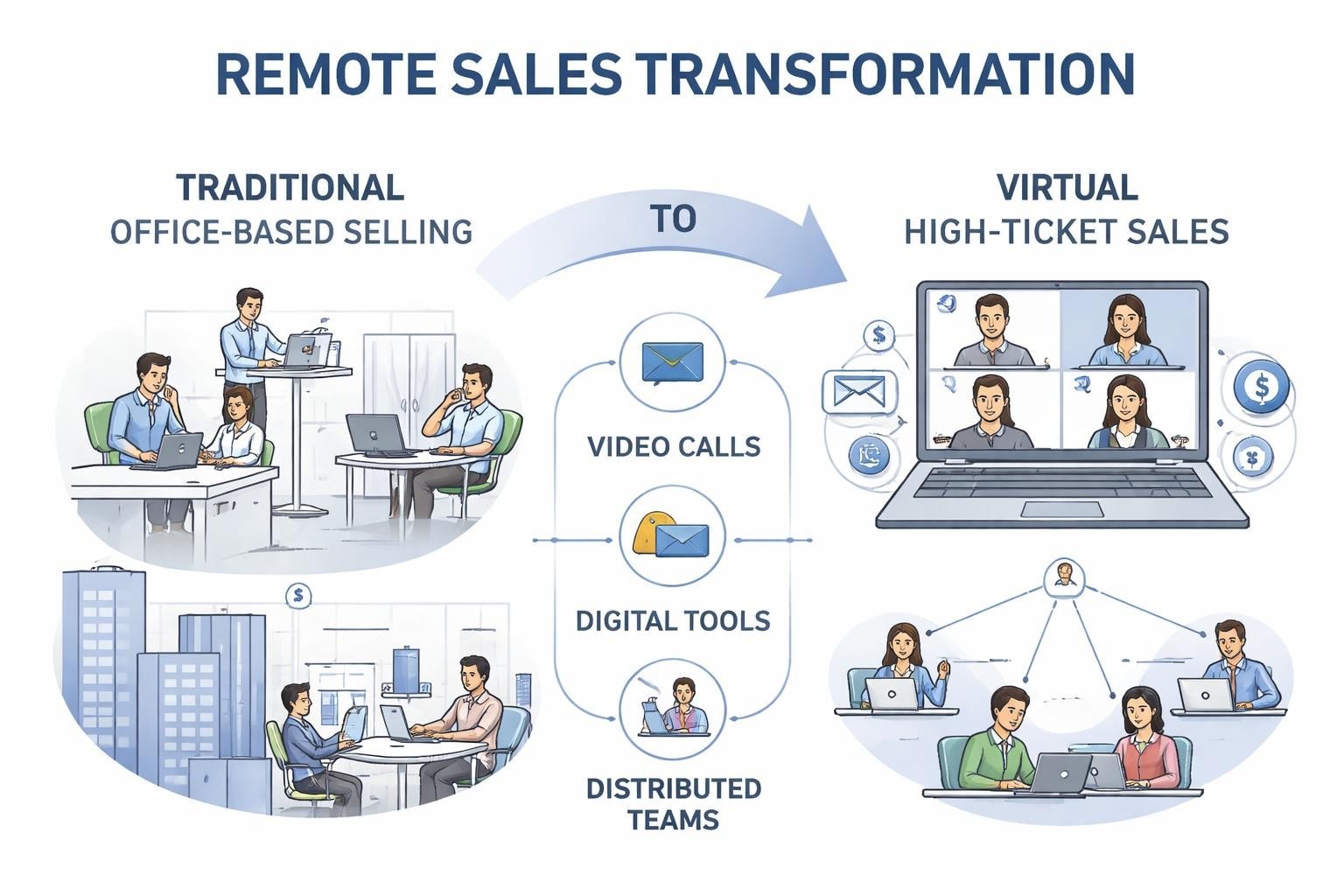
The landscape of professional selling has undergone a permanent transformation. Businesses selling high-ticket products and services now operate entirely through virtual channels, connecting with prospects via Zoom calls and Google Meet without ever meeting face-to-face. This shift has created unprecedented opportunities for companies willing to embrace remote sales as their primary growth engine. For marketing agencies, coaches, consultants, and service-based businesses, mastering virtual selling isn't optional-it's essential for survival and scalability in 2026.
The Remote Sales Revolution for High-Ticket Businesses
Remote sales has fundamentally changed how businesses approach revenue generation. According to comprehensive sales statistics, remote sellers are 34% more likely to close deals compared to their in-office counterparts. This productivity boost stems from reduced commute times, increased flexibility, and the ability to conduct more conversations per day.
The virtual selling model offers distinct advantages for businesses operating in the high-ticket space. Geographic limitations vanish when your sales team can connect with prospects anywhere in the world. A consultant based in Austin can seamlessly close a deal with a client in Singapore during the same workday they speak with prospects in New York and Los Angeles.
Why High-Ticket Sales Thrive Remotely
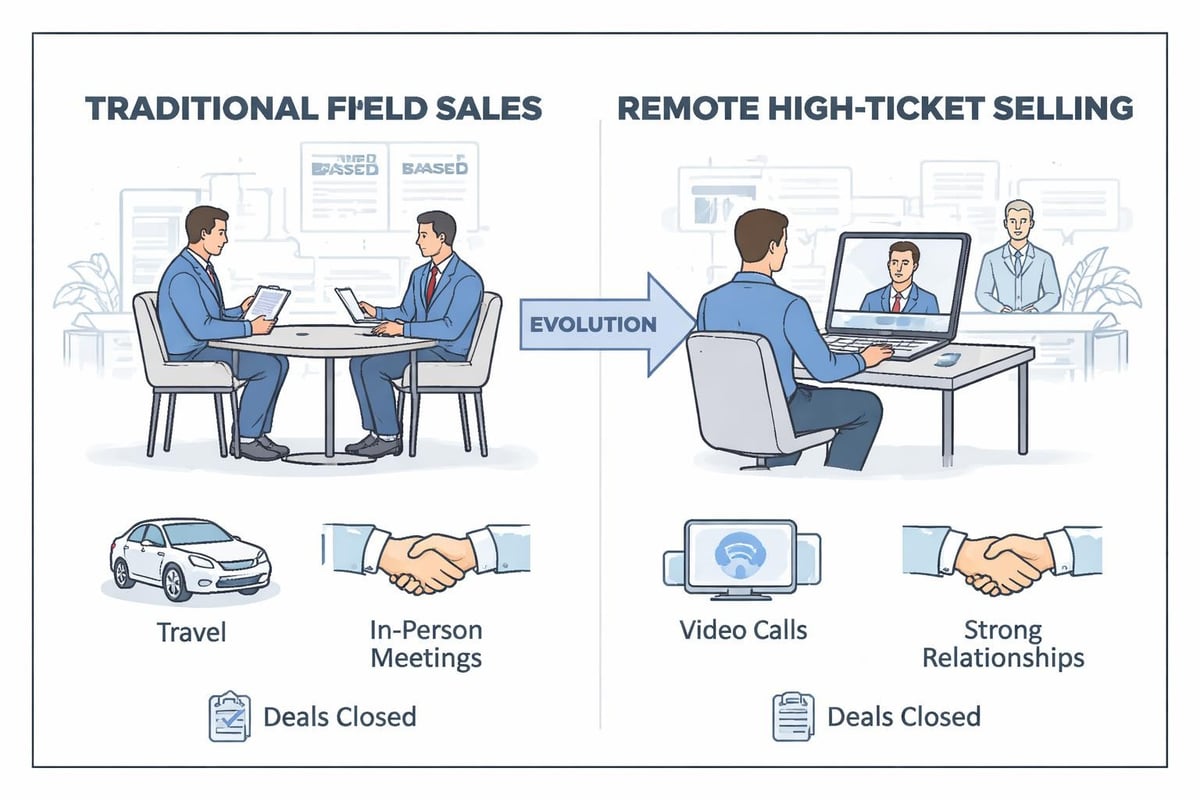
High-ticket transactions require relationship-building, trust establishment, and value demonstration-all achievable through video conferencing platforms. The intimacy of a well-executed video call often surpasses the formality of traditional office meetings. Prospects feel comfortable in their own environment, leading to more authentic conversations and faster rapport development.
Key advantages include:
Elimination of travel expenses and time waste
Access to global talent pools for team building
Increased daily conversation capacity
Enhanced work-life integration for sales professionals
Scalable infrastructure without physical office constraints
The data supports this shift. Remote work statistics for 2026 indicate that 74% of professionals expect remote work to become standard practice, with sales roles leading this transformation.
Building Your Remote Sales Infrastructure
Creating a successful virtual selling operation requires more than simply handing your team laptops and video conferencing software. The infrastructure must support seamless communication, comprehensive training, and consistent performance tracking.
Technology serves as the foundation for remote sales operations. Your stack should include a robust CRM system, reliable video conferencing platforms, screen sharing capabilities, digital signature tools, and integrated communication channels. These tools must work together cohesively rather than creating friction in the sales process.
Essential Technology Components
Tool Category | Purpose | Impact on Performance |
|---|---|---|
CRM Platform | Track prospects, manage pipeline, forecast revenue | Provides visibility and accountability |
Video Conferencing | Conduct discovery calls, demos, closes | Enables face-to-face connection virtually |
Communication Suite | Email, messaging, collaboration | Maintains team cohesion and client relationships |
Analytics Dashboard | Monitor metrics, identify trends, optimize process | Drives data-informed decision making |
Training Platform | Onboard reps, share best practices, role-play | Accelerates skill development and consistency |
The human element remains equally important. Remote sales coaching best practices emphasize integrating coaching into weekly routines rather than treating it as a quarterly event. Regular feedback sessions, call reviews, and skill development workshops keep teams sharp and motivated.
Documentation becomes critical in distributed environments. Your sales playbook should outline messaging frameworks, objection handling scripts, qualification criteria, and closing techniques. This standardization ensures consistency regardless of which team member speaks with a prospect.
Recruiting and Placing Remote Sales Talent
The quality of your sales team directly determines your revenue outcomes. Finding vetted candidates who excel in virtual environments requires a different evaluation approach than traditional hiring.
Top remote sellers possess specific characteristics beyond fundamental sales skills. They demonstrate self-discipline, communication clarity, technical proficiency, and intrinsic motivation. Without the structure of an office environment, these traits become non-negotiable.
Evaluating Remote Sales Candidates
The vetting process should assess both selling capabilities and remote work aptitude. Role-playing exercises conducted via video call reveal how candidates perform in their actual working environment. Their comfort level with technology, ability to build rapport through a screen, and presentation skills become immediately apparent.
Critical evaluation areas:
Track record with complex sales cycles - High-ticket transactions require patience and persistence
Virtual communication effectiveness - Clear articulation and active listening translate through digital channels
Self-management capabilities - Remote work demands proactive time management and goal orientation
Technical adaptability - Comfort with multiple platforms and quick troubleshooting abilities
Cultural alignment - Shared values and work ethic despite physical distance
The hiring decision for remote roles carries higher stakes because course-correcting poor fits proves more challenging in distributed teams. Thorough upfront assessment prevents costly mistakes and accelerates time-to-productivity for new hires.
For businesses lacking internal recruitment expertise, partnering with specialists who understand the nuances of remote high-ticket sales accelerates team building. Pre-vetted talent pools eliminate months of trial-and-error hiring.
Managing Distributed Sales Teams Effectively
Leadership challenges multiply when your team operates from different locations, time zones, and home offices. Strategies for managing remote sales teams emphasize clarity, communication, and culture-building.
Setting explicit expectations forms the management foundation. Every team member should understand their daily activity targets, weekly meeting schedules, response time requirements, and performance metrics. Ambiguity breeds inconsistency in remote environments.
Daily Operating Rhythms
Successful remote sales organizations establish predictable cadences. Morning huddles align the team on priorities and create accountability. Mid-day check-ins address obstacles before they derail productivity. End-of-day wrap-ups celebrate wins and set the next day's agenda.
These touchpoints prevent isolation while maintaining focus. They create natural opportunities for peer learning, competitive motivation, and managerial support without micromanagement.
Communication frequency increases in virtual settings compared to traditional offices. While this might seem counterintuitive, brief regular interactions replace the ambient awareness that naturally occurs when teams share physical space. A quick Slack message or three-minute video call resolves questions that might otherwise linger for hours.
Management Practice | Implementation Method | Frequency |
|---|---|---|
Team Standups | Video conference with entire team | Daily (15 min) |
One-on-Ones | Individual coaching sessions | Weekly (30 min) |
Pipeline Reviews | Detailed opportunity analysis | Weekly (60 min) |
Training Sessions | Skills development and role-play | Bi-weekly (90 min) |
All-Hands Meetings | Company updates and recognition | Monthly (60 min) |
Performance tracking requires visibility without surveillance. Dashboard access to key metrics-calls completed, appointments set, proposals sent, deals closed-enables both managers and reps to identify trends and adjust tactics. This transparency builds trust rather than eroding it when implemented properly.
Optimizing the Remote Sales Process
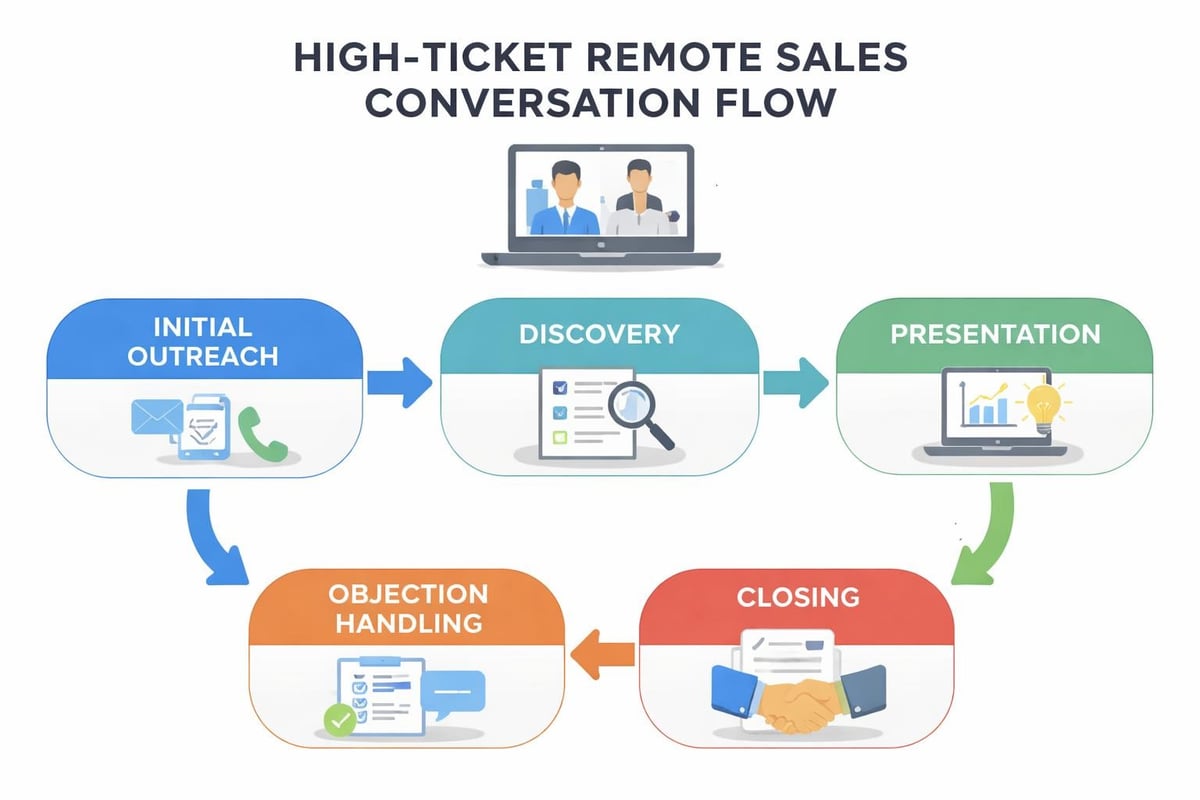
The virtual selling methodology differs from traditional approaches in subtle but significant ways. Best practices for remote selling highlight the importance of preparation, engagement tactics, and follow-through specific to digital environments.
Pre-call research intensifies when you cannot rely on reading physical body language or environmental cues. Understanding a prospect's business model, recent company news, LinkedIn activity, and competitive landscape becomes essential preparation work. This knowledge compensates for the reduced information bandwidth inherent in video conversations.
Mastering Virtual Discovery Calls
Discovery calls via Zoom or Google Meet require heightened active listening skills. According to research on mastering remote selling, top performers maintain a 43:57 talk-to-listen ratio, ensuring prospects do most of the talking. This becomes more challenging when managing screen distractions and technical considerations simultaneously.
Camera usage significantly impacts trust-building. The same research indicates that using webcams increases close rates substantially compared to voice-only calls. Prospects need to see facial expressions, enthusiasm, and sincerity to develop confidence in high-ticket purchases.
Virtual discovery best practices:
Test technology fifteen minutes before every call
Ensure proper lighting and professional background
Maintain eye contact by looking at the camera, not the screen
Use screen sharing strategically to illustrate concepts
Take notes visibly to demonstrate engagement
Eliminate notification distractions during conversations
Follow up immediately with recap emails and next steps
The presentation phase adapts to screen-based delivery. Slides must be simpler and more visual than in-person decks. Text density decreases while imagery, charts, and white space increase. The presenter controls pacing more deliberately, checking for comprehension frequently.
Objection handling evolves in remote contexts. Without the ability to read subtle physical cues, sales professionals must explicitly ask for concerns and create space for prospects to voice hesitations. Silence becomes a powerful tool-pausing after asking questions gives prospects time to formulate thoughts without the pressure of face-to-face interaction.
Scaling Remote Sales Operations
Growth creates different challenges than startup operations. As your remote sales team expands beyond five or ten people, systems and structure become essential for maintaining quality and consistency.
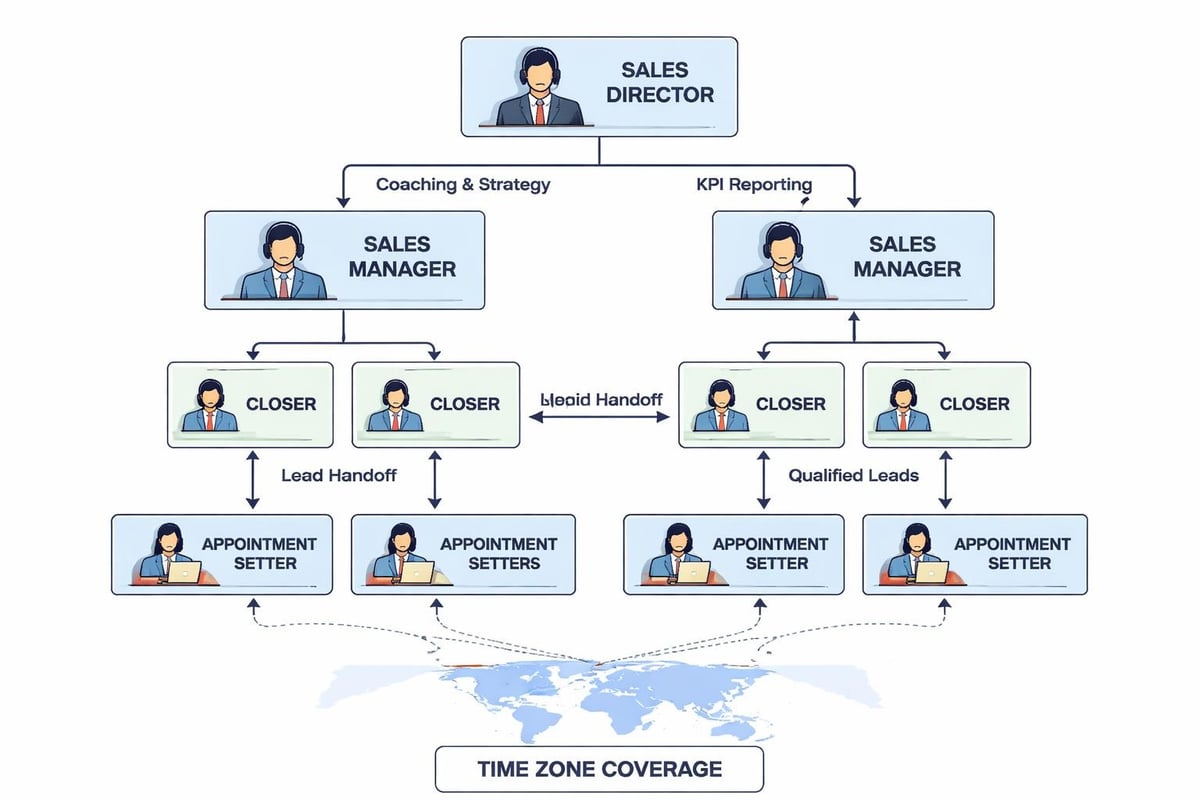
Specialization emerges as a scaling strategy. Dividing responsibilities between appointment setters and closers increases efficiency and allows for role-specific skill development. Setters focus exclusively on prospecting, qualification, and calendar booking. Closers concentrate on demonstrations, proposal presentations, and deal finalization.
This division of labor creates a multiplier effect. One skilled closer can work with multiple setters, each feeding qualified opportunities into the pipeline. The closer maximizes time spent on high-value activities while setters develop the top-of-funnel volume necessary for consistent revenue.
Building Repeatable Systems
Documentation intensity increases with team size. Your sales playbook evolves from a simple guide into a comprehensive knowledge base covering every scenario, objection, and process variation. New hires accelerate their ramp-up time by accessing this institutional knowledge rather than learning through trial and error.
Training programs formalize as you scale. Initial onboarding might span two to three weeks, combining product education, sales methodology instruction, CRM training, and supervised practice calls. Ongoing development continues through weekly coaching sessions, monthly workshops, and quarterly strategy updates.
Quality assurance mechanisms protect standards as hiring accelerates. Call recording and review becomes systematic rather than occasional. Managers should listen to representative samples from each team member weekly, providing specific feedback on technique, messaging, and prospect engagement.
Scaling infrastructure checklist:
Documented sales process with stage-specific actions
Role-based compensation structures aligned with activities
Automated lead distribution and routing systems
Standardized reporting templates and KPI definitions
Onboarding curriculum with certification requirements
Regular calibration sessions to align team on qualification criteria
Career development pathways for advancement opportunities
The commission structure must balance motivation with business economics. High-ticket sales typically warrant commission rates between 5-15% depending on price point, sales cycle length, and support requirements. Tiered structures that increase percentage rates at higher volume levels drive performance while rewarding top achievers.
Maintaining Culture in Virtual Environments
Remote sales teams face the constant challenge of building camaraderie and shared identity without water cooler conversations or team lunches. Intentional culture-building prevents the isolation and disconnection that erodes performance over time.
Virtual team-building activities must feel authentic rather than forced. Brief morning check-ins that include personal updates, not just business metrics, create human connection. Celebrating wins publicly through team channels recognizes achievement and motivates others. Sharing challenges transparently builds psychological safety that encourages risk-taking and innovation.
Recognition programs adapt to remote contexts. Digital badges, public Slack announcements, and video shout-outs during all-hands meetings provide the acknowledgment that drives continued effort. Monthly awards for top performer, most improved, and best team player create healthy competition while honoring different contribution types.
Professional development opportunities demonstrate investment in team members beyond immediate productivity. Access to sales training courses, industry conference attendance (virtual or in-person), and skill development budgets signal long-term commitment. This investment reduces turnover while increasing capabilities.
Communication norms establish boundaries that prevent burnout. Clear expectations about response times, availability windows, and after-hours contact protect work-life integration. While flexibility represents a key remote work benefit, unlimited accessibility creates unsustainable pressure that degrades performance and retention.
Technology Integration and Automation
Modern remote sales operations leverage technology strategically to eliminate friction and enhance productivity. The goal involves automating repetitive tasks while preserving the human elements that close high-ticket deals.
CRM systems serve as the central nervous system for distributed teams. Every prospect interaction, whether email, call, or video meeting, gets logged automatically through integrations. This creates shared visibility that enables seamless handoffs, manager oversight, and accurate forecasting without manual data entry.
Email sequencing tools maintain consistent follow-up without requiring sales reps to remember every touchpoint. Prospects receive timely, relevant messages triggered by specific actions or timeline intervals. This automation ensures no opportunity falls through cracks due to oversight while freeing reps to focus on live conversations.
Calendar scheduling eliminates the back-and-forth typically required to book meetings. Prospects select convenient times from a rep's availability, automatically creating calendar events and sending confirmations. This simple automation removes friction from the buying process while projecting professionalism.
Proposal generation tools pull relevant information from the CRM to create customized documents in minutes rather than hours. Templates maintain brand consistency while dynamic fields personalize each proposal. Electronic signature integration accelerates deal closure by removing printing, scanning, and mailing delays.
Analytics platforms aggregate data from multiple sources to provide comprehensive performance visibility. Managers identify trends, spot coaching opportunities, and forecast accurately based on real-time pipeline movement. Reps access personal dashboards showing progress toward goals and areas requiring attention.
Remote sales has evolved from emergency contingency to competitive advantage for high-ticket businesses in 2026. The companies thriving in this environment combine robust technology infrastructure, specialized talent, systematic processes, and intentional culture-building. Success requires both strategic vision and operational excellence in team building, process optimization, and performance management. When you're ready to hire a sales team equipped to excel in virtual environments, Sales Match provides pre-vetted appointment setters and closers specifically trained for high-ticket remote sales, eliminating the lengthy trial-and-error of traditional recruitment.