
Recruitment Work: Process, Strategy & Best Practices 2026
Discover how recruitment work has evolved in 2026. Learn proven strategies, tools, and frameworks to streamline your hiring process.
published
TL;DR: Recruitment work in 2026 combines strategic planning, advanced technology, and human expertise to identify and place qualified candidates efficiently. Success requires clear role definitions, multi-step vetting processes, and performance metrics that track quality of hire beyond traditional time-to-fill measurements.
Recruitment work has fundamentally transformed from a transactional posting-and-resume-review process into a strategic business function that directly impacts revenue growth and organizational performance. For businesses selling high-value services online, the quality of your sales team determines whether prospects convert at 2% or 20%. The companies thriving in 2026 understand that recruitment work isn't an administrative task but a competitive advantage that requires systematic processes, rigorous evaluation frameworks, and continuous refinement based on performance data.
What Is Recruitment Work and Why Does It Matter?
Recruitment work encompasses the complete process of identifying, attracting, evaluating, and placing candidates into organizational roles. This includes defining position requirements, sourcing qualified prospects, conducting multi-stage assessments, managing offer negotiations, and ensuring successful onboarding.
The impact of effective recruitment work extends far beyond filling open positions. According to Bullhorn's 2026 Industry Trends Report, 67% of recruitment professionals report that quality of hire has become the primary metric by which their performance is measured, surpassing speed-to-fill for the first time in industry surveys. This shift reflects a broader recognition that placing the wrong candidate costs far more than leaving a position open temporarily.
For service-based businesses operating remotely and selling premium offerings through virtual meetings, recruitment work directly influences revenue outcomes. A skilled closer who understands consultative selling and can navigate complex objections will generate exponentially more value than someone simply going through scripted motions.
The Strategic Foundation of Recruitment Work
Successful recruitment work begins long before job postings go live. Strategic preparation includes:
Role architecture: Defining responsibilities, success metrics, and required competencies with precision
Compensation modeling: Structuring offers that attract top performers while maintaining sustainable economics
Market positioning: Understanding where your opportunity ranks against competing offers in the current landscape
Timeline planning: Building realistic schedules that balance urgency with thorough evaluation
These foundational elements determine whether your recruitment work attracts candidates who view the role as a career opportunity or simply another job listing. Businesses offering sales recruiting services invest significant effort in this preparatory phase because poorly defined roles waste everyone's time and resources.

How Has Recruitment Work Evolved in Recent Years?
The recruitment landscape has undergone substantial changes driven by remote work normalization, technological advancement, and shifting candidate expectations. StaffingHub's analysis of 2025 staffing industry trends highlights three transformational shifts: market stabilization after pandemic-era volatility, increased adoption of automation tools, and heightened client demand for specialized talent over generalist candidates.
Remote work has fundamentally altered recruitment work by expanding talent pools geographically while simultaneously increasing competition for proven performers. A marketing agency in Austin now competes with firms in Boston, Miami, and internationally for the same appointment setter. This geographic democratization means recruitment work must emphasize differentiation through opportunity quality, growth potential, and organizational culture rather than location benefits.
Technology's Growing Role in Recruitment Processes
Technology has become integral to modern recruitment work, though human judgment remains irreplaceable for final decisions. TechRadar's review of the best recruitment platforms in 2026 evaluates systems that automate initial screening, schedule interviews, and track candidate progression through hiring funnels.
Technology Category | Primary Function | Key Benefit |
|---|---|---|
Applicant Tracking Systems | Centralize candidate data and workflow | Reduces administrative burden |
Assessment Platforms | Standardize skill evaluation | Ensures objective comparison |
Video Interview Tools | Enable asynchronous screening | Increases scheduling flexibility |
Analytics Dashboards | Track hiring metrics | Identifies process bottlenecks |
The research paper "From Text to Talent: A Pipeline for Extracting Insights from Candidate Profiles" discusses machine learning approaches to analyzing candidate backgrounds, demonstrating how automation can surface patterns that human reviewers might miss when processing hundreds of applications.
However, automation serves as an enhancement tool rather than a replacement for human expertise in recruitment work. Technology excels at handling high-volume initial filtering but struggles with nuanced evaluation of soft skills, cultural alignment, and motivational fit that determine long-term success in sales roles.
What Are the Essential Stages of Effective Recruitment Work?
Professional recruitment work follows a structured progression designed to systematically reduce candidate pools while increasing evaluation depth at each stage. This multi-gate approach ensures that time investment scales appropriately with candidate quality.
Stage One: Role Definition and Market Research
Before engaging with candidates, thorough recruitment work requires comprehensive role documentation. This includes compensation ranges, performance expectations, daily responsibilities, required experience levels, and success metrics for the first 30, 60, and 90 days.
Market research informs realistic expectations about candidate availability and competitive positioning. A business seeking an SDR with three years of B2B SaaS experience who can self-generate meetings might discover this profile commands specific compensation ranges that differ from internal assumptions.
Stage Two: Sourcing and Initial Outreach
Effective recruitment work employs multiple sourcing channels rather than relying exclusively on job board postings:
Direct outreach to passive candidates currently employed but open to superior opportunities
Referral networks leveraging existing relationships with top performers
Industry communities where specialists congregate online and at events
Strategic job postings on platforms where target candidates actively search
The academic study "Skills or Degree? The Rise of Skill-Based Hiring for AI and Green Jobs" examines how recruitment work increasingly emphasizes demonstrated competencies over formal credentials, particularly relevant when hiring for sales positions where track records matter more than degrees.
Stage Three: Multi-Step Vetting and Assessment
Rigorous vetting distinguishes professional recruitment work from simple resume forwarding. A comprehensive assessment process includes:
Application review: Verifying basic qualifications and identifying red flags
Screening interviews: Assessing communication skills, motivation, and role understanding
Skill evaluations: Testing specific capabilities through role-plays, mock calls, or assignments
In-depth interviews: Exploring experience details, problem-solving approaches, and cultural fit
Reference checks: Validating performance claims with previous employers
For sales positions, skill demonstrations provide far more predictive value than interview responses. Observing how a candidate handles objections during a live role-play reveals capabilities that self-reported experience cannot.

Stage Four: Offer Presentation and Negotiation
Professional recruitment work doesn't end when the ideal candidate is identified. Offer presentation requires strategic framing that emphasizes opportunity value while managing compensation expectations. Elements include:
Base compensation and variable components structured to align incentives with business outcomes. For appointment setter roles, this might involve hourly rates plus bonuses tied to qualified meetings scheduled.
Performance expectations clearly documented so candidates understand exactly how success is measured and rewarded.
Growth trajectory outlining advancement opportunities for high performers, particularly important when recruiting ambitious salespeople who view current roles as stepping stones.
Stage Five: Onboarding and Performance Monitoring
Recruitment work extends through the initial performance period to ensure successful placement integration. According to Top Echelon's 2026 State of the Recruiting Industry Report, 43% of placement failures occur within the first 90 days due to inadequate onboarding or misaligned expectations rather than capability gaps.
Structured onboarding includes product training, systems access, process documentation, and regular check-ins during the first month. Businesses offering replacement guarantees on placements build these monitoring checkpoints into their service delivery to identify and address issues before they result in termination.
What Metrics Should Guide Recruitment Work Quality?
Traditional recruitment metrics focus heavily on speed and cost, but these measurements often incentivize wrong behaviors. Optimizing for time-to-fill encourages rushing evaluations, while minimizing cost-per-hire discourages investing in thorough vetting.
Quality-Focused Recruitment Metrics
Modern recruitment work prioritizes quality indicators that predict long-term value:
Metric | Definition | Why It Matters |
|---|---|---|
Quality of Hire | Performance rating after 6-12 months | Measures actual contribution vs. expectations |
First-Year Retention | Percentage still employed after 12 months | Indicates cultural and role fit accuracy |
Hiring Manager Satisfaction | Feedback scores from direct supervisors | Captures subjective alignment factors |
Offer Acceptance Rate | Percentage of offers accepted | Reflects competitive positioning |
Time to Productivity | Days until new hire reaches baseline output | Reveals onboarding effectiveness |
These metrics shift recruitment work focus from filling positions quickly to placing candidates who deliver sustained performance. A placement that takes six weeks but remains productive for three years creates exponentially more value than a two-week placement that churns after four months.
SocialTalent's recruiting best practices emphasize defining clear success metrics before beginning recruitment work, ensuring all stakeholders agree on how effectiveness will be measured.
How Do Specialized Recruitment Models Work?
Different business contexts require customized approaches to recruitment work. Service-based businesses selling premium offerings through consultative sales processes need fundamentally different recruitment models than companies hiring order-takers for transactional sales.
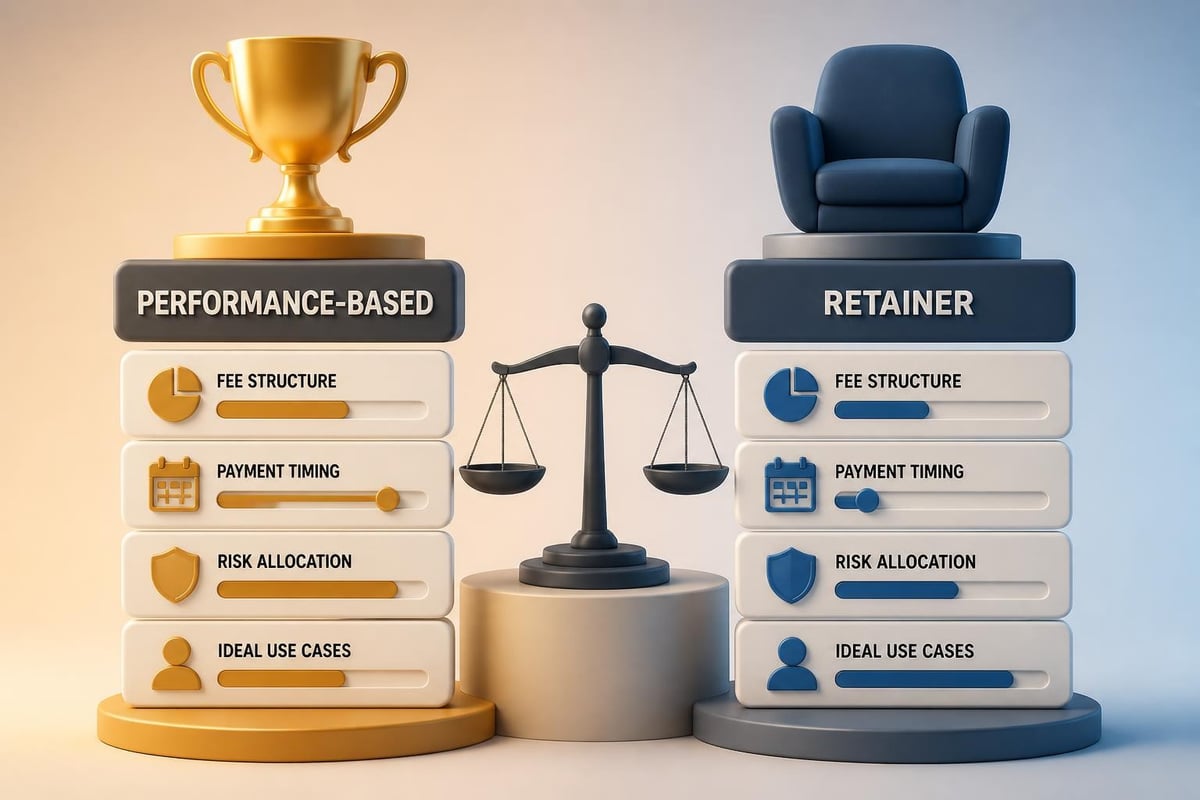
Performance-Based Recruitment Models
Performance-based structures align recruiter incentives with candidate success by tying significant compensation to placement longevity and output. This model works particularly well for high-ticket closer positions where individual performance variance is substantial.
Key characteristics include:
Reduced or eliminated upfront fees lowering initial investment risk
Success-based payments triggered by candidate performance milestones
Replacement guarantees ensuring candidates who fail are replaced without additional fees
Ongoing support throughout integration and ramp periods
This approach requires recruiters to conduct exceptionally thorough vetting since their revenue depends on placement success rather than simply filling positions.
Retainer-Based Recruitment Models
Retainer arrangements involve upfront and milestone payments throughout the recruitment work process, appropriate when hiring for roles requiring extensive search efforts or when filling multiple positions over time.
Businesses building entire sales teams often benefit from retainer relationships that provide dedicated recruiting resources across multiple hiring needs simultaneously. The predictable cost structure facilitates budget planning while ensuring recruiter availability when needs arise.
What Challenges Affect Modern Recruitment Work?
Despite technological advances and process improvements, recruitment work faces persistent challenges that require strategic solutions. Understanding these obstacles helps businesses set realistic expectations and allocate appropriate resources.
Talent Scarcity in Specialized Roles
High-performing sales professionals who combine industry knowledge, technical proficiency, and consultative selling skills remain scarce relative to demand. The research paper "RecruitScope: A Visual Analytics System for Multidimensional Recruitment Data Analysis" introduces analytical approaches to understanding talent availability patterns across different markets and specializations.
This scarcity means recruitment work must often focus on converting passive candidates rather than selecting from active applicant pools. The best performers rarely browse job boards because they receive regular unsolicited opportunities.
Remote Work Verification Challenges
With sales teams operating entirely remotely, recruitment work must verify self-management capabilities, home office setups, and communication consistency without in-person observation. Video interviews provide some insight, but assessing whether someone will maintain productivity without physical supervision requires different evaluation approaches than traditional office hiring.
Rapid Market Changes
The study "Gender of Recruiter Makes a Difference: A study into Cybersecurity Graduate Recruitment" explores how various factors influence hiring decisions, demonstrating the complexity of modern recruitment work where numerous variables affect outcomes.
Compensation expectations, role availability, and candidate preferences shift continuously. Recruitment work that relies on outdated market intelligence wastes time pursuing candidates at inappropriate compensation levels or emphasizing benefits that no longer differentiate opportunities.
How Should Businesses Evaluate Recruitment Partners?
Organizations that lack internal recruitment expertise often engage external specialists to handle hiring processes. Evaluating potential recruitment partners requires examining specific capabilities and service models rather than accepting generic marketing claims.
Critical Evaluation Criteria
When assessing firms that provide recruitment work, prioritize these factors:
Vetting process transparency: Understanding exactly how candidates are evaluated before presentation. Firms should articulate specific assessment stages, evaluation criteria, and disqualification thresholds.
Industry specialization: Experience recruiting specifically for your business model and sales motion. Generalist recruiters struggle to assess nuanced requirements for consultative sales roles selling premium services.
Replacement policies: Clear terms governing what happens when placements don't succeed, including timeframes and conditions. Unlimited replacement guarantees demonstrate confidence in candidate quality.
Performance metrics: Historical data on placement longevity, ramp times, and client satisfaction. Reputable firms track and share these indicators rather than focusing exclusively on volume metrics.
Client-recruiter communication: Responsiveness, update frequency, and feedback incorporation throughout the recruitment work process.
Businesses selling services above $2,500 per transaction should seek recruiters who understand the specific competencies required for complex, multi-touch sales cycles rather than transactional selling skills.
What Does Effective Recruitment Work Look Like in Practice?
Professional recruitment work balances systematic processes with flexible adaptation to unique business needs and candidate circumstances. While frameworks provide structure, successful outcomes require judgment that accounts for context and nuance.
The Recruitment Work Workflow
A comprehensive recruitment process follows this general progression:
Discovery consultation where recruiters learn business models, sales processes, ideal customer profiles, and team dynamics
Role documentation creating detailed position descriptions with specific success criteria
Sourcing strategy development identifying optimal channels and messaging for target candidate profiles
Candidate pipeline building through direct outreach, network activation, and strategic job postings
Initial screening via phone or video to assess basic qualifications and mutual interest
Skill assessment through role-plays, mock calls, or relevant assignments
Client presentation introducing qualified candidates with evaluation summaries
Interview coordination managing scheduling and feedback collection
Offer development structuring compensation and terms based on candidate expectations and market data
Onboarding support ensuring smooth integration during critical first weeks
Each stage includes feedback loops where recruiters refine understanding based on client responses and candidate interactions. This iterative approach improves targeting precision throughout the engagement.
Time Investment and Expectations
Thorough recruitment work requires time investment proportional to role complexity and seniority. Entry-level appointment setter positions might be filled within two to three weeks given larger candidate pools and simpler requirements. Senior sales management roles requiring specific industry experience, proven team-building capabilities, and strategic planning skills may require six to eight weeks of dedicated search effort.
Businesses should align timeline expectations with quality requirements, understanding that compressing recruitment work timelines necessitates compromising evaluation thoroughness. The pressure to fill positions quickly often results in settling for available candidates rather than optimal candidates.
Effective recruitment work requires strategic planning, rigorous vetting processes, and quality-focused metrics that prioritize long-term performance over short-term placement speed. For businesses selling premium services through consultative sales, the expertise and proven capabilities of your sales team directly determine revenue outcomes and growth trajectories. Sales Match specializes in placing pre-vetted, high-ticket sales professionals for service-based businesses, combining multi-stage evaluation processes with performance-based models and unlimited replacement guarantees to ensure you get proven talent without extended hiring timelines.
About the Author
Craig Emslie is the Founder of Sales Match, a specialized recruitment firm placing high-ticket sales professionals for online service-based businesses. Based in Saint Petersburg, FL, Craig has spent years refining vetting processes and performance models that align recruiter success with client outcomes. He focuses exclusively on sales roles for businesses selling premium services through virtual channels, understanding the unique competencies required for consultative selling in remote environments.
