
What is a Ticket Closer? Role, Skills & Hiring Guide
Discover what a ticket closer does, essential skills needed, and how to hire top talent for your high-ticket sales team in 2026.
published
TL;DR: A ticket closer is a specialized sales professional who converts pre-qualified leads into customers for high-value products and services. They focus exclusively on closing deals rather than prospecting, typically working with products priced above $2,500. Understanding this role is essential for businesses looking to scale their sales operations and maximize conversion rates.
The modern sales landscape has evolved dramatically, creating specialized roles that maximize efficiency and revenue generation. One position that has gained significant prominence in high-ticket sales environments is the ticket closer. This specialized professional serves as the final and most critical link in the sales chain, transforming qualified prospects into paying customers for premium offerings. For businesses selling high-value products or services over the internet, understanding this role becomes paramount to building a revenue-generating sales organization.
A ticket closer operates within a structured sales ecosystem where lead generation, qualification, and appointment setting have already occurred. This specialization allows them to focus their energy and expertise on what they do best: converting interested prospects into committed buyers. The role has become increasingly vital as businesses recognize that different stages of the sales process require distinct skill sets and approaches.
What Defines a Ticket Closer in Modern Sales?
A ticket closer represents a sales professional dedicated exclusively to finalizing deals with pre-qualified prospects. Unlike traditional sales representatives who handle the entire sales cycle, these specialists enter the conversation after initial contact and qualification have been completed. The closer role in sales focuses specifically on converting warm leads into customers through consultative selling and strategic relationship building.
The "ticket" component of the title typically refers to the price point of the offering. In most cases, ticket closers work with products or services valued above $2,500, though some organizations set the threshold even higher. This distinction matters because high-value sales require different techniques, longer relationship building, and more sophisticated objection handling than lower-priced offerings.
Key Responsibilities and Daily Activities
The primary responsibility of a ticket closer centers on conducting sales presentations and consultations with qualified leads. These conversations typically occur via video conferencing platforms like Zoom or Google Meet, making location irrelevant and enabling businesses to access talent globally.
Daily activities include:
Reviewing lead information and qualification notes before scheduled calls
Conducting discovery conversations to understand prospect needs and pain points
Delivering customized presentations that align solutions with specific business challenges
Handling objections and concerns with strategic responses
Negotiating terms and pricing within established parameters
Securing commitments and processing transactions
Documenting call outcomes and maintaining accurate CRM records

Performance metrics for ticket closers differ significantly from other sales roles. Rather than measuring total pipeline generated or appointments set, these professionals are evaluated on conversion rates, average deal size, and total revenue closed. A skilled ticket closer might handle 15-25 qualified appointments weekly, with conversion rates ranging from 20% to 40% depending on the industry and offer quality.
What Skills Separate Elite Ticket Closers from Average Performers?
The distinction between an adequate ticket closer and an exceptional one often determines whether a business scales successfully or struggles with revenue consistency. Elite performers possess a unique combination of soft skills, technical knowledge, and psychological awareness that enables them to connect with prospects and guide them toward confident purchasing decisions.
Skill Category | Key Competencies | Impact on Performance |
|---|---|---|
Communication | Active listening, clear articulation, storytelling | Builds trust and understanding |
Emotional Intelligence | Reading prospects, adapting approach, managing objections | Increases conversion rates |
Product Mastery | Deep feature knowledge, benefit translation, competitive positioning | Establishes credibility |
Process Discipline | CRM management, follow-up consistency, time management | Maximizes opportunity value |
Active listening stands as perhaps the most undervalued yet critical skill. Exceptional ticket closers understand that closing begins with comprehensive understanding, not persuasive talking. They ask probing questions, allow prospects to fully express concerns, and identify underlying motivations that generic sales scripts never address.
Adaptability enables top performers to adjust their approach based on prospect personality, communication style, and decision-making preferences. Some buyers respond to data and logic, while others prioritize emotional connection and vision. The ability to recognize these patterns and shift strategy mid-conversation separates elite closers from rigid script-followers.
Technical Proficiency Requirements
Modern ticket closers operate in a technology-driven environment that demands comfort with various platforms and tools. Video conferencing software serves as their primary workplace, requiring professional presentation skills and technical troubleshooting abilities. CRM platforms like HubSpot, Salesforce, or custom solutions must become second nature for tracking conversations and managing follow-ups.
Payment processing knowledge ensures smooth transaction completion once verbal commitments are secured. Understanding different payment structures, financing options, and contract terms allows closers to address financial logistics without losing momentum or creating friction during the final stages of the sale.
How Does the Ticket Closer Role Fit Within Sales Team Structure?
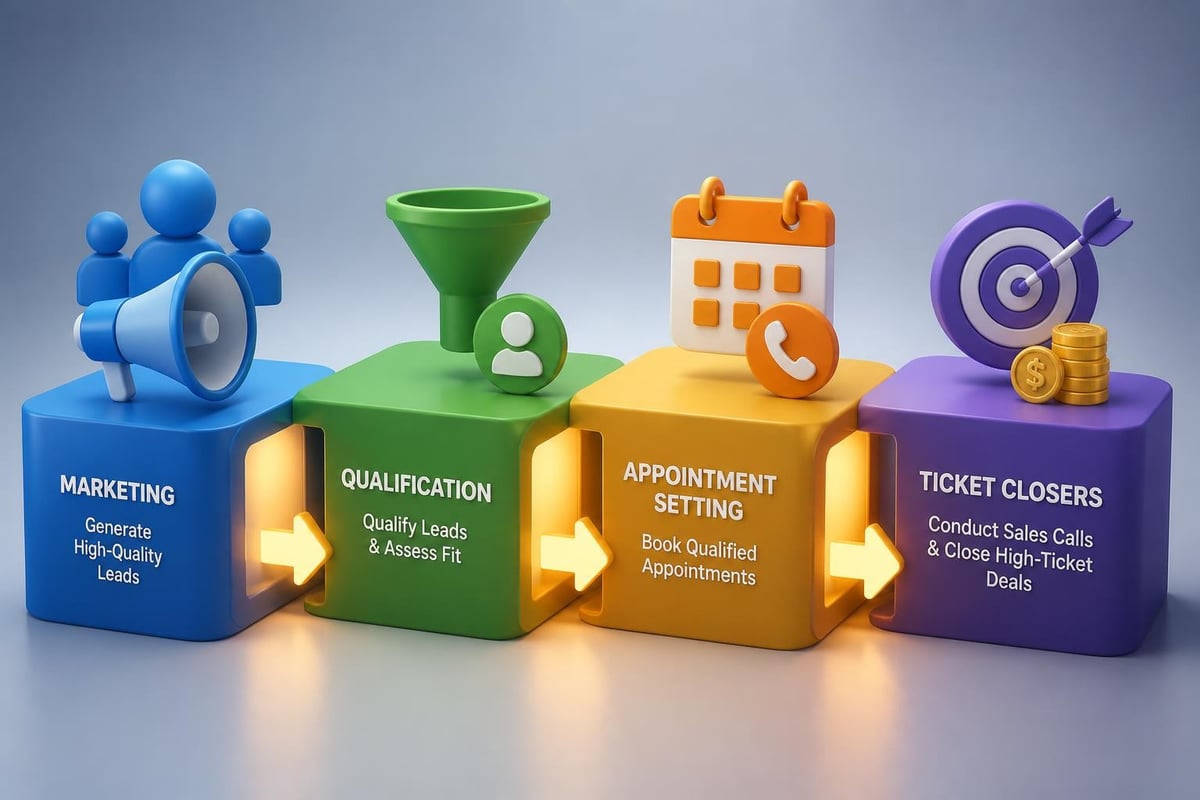
High-ticket sales operations function most efficiently when structured as a specialized assembly line where each team member focuses on their area of expertise. The ticket closer occupies the revenue-critical position at the end of this assembly line, receiving qualified opportunities from appointment setters or sales development representatives.
In a typical high-ticket sales organization, the structure flows sequentially:
Marketing generates interest through content, advertising, and outreach campaigns
Lead qualifiers assess fit based on budget, need, and decision-making authority
Appointment setters schedule qualified prospects onto closer calendars
Ticket closers conduct sales consultations and convert prospects into customers
Account managers ensure successful onboarding and customer satisfaction
This segmentation allows each role to develop deep expertise in their specific function. A ticket closer who once spent 60% of their time prospecting can now dedicate 100% of their energy to conversion optimization, dramatically improving both individual performance and organizational revenue.
Compensation and Performance Incentives
Ticket closer compensation typically combines base salary with performance-based commissions. High-ticket closer positions often feature base salaries ranging from $40,000 to $70,000 annually, with commission structures adding substantial earning potential based on closed revenue.
Commission structures vary widely based on industry, product pricing, and organizational philosophy. Some companies offer 5-10% of closed revenue, while others provide tiered structures that increase percentage rates as closers exceed quota thresholds. This performance alignment ensures that ticket closers remain motivated to maximize both conversion rates and deal sizes.
What Challenges Do Businesses Face When Hiring Ticket Closers?
Identifying and securing exceptional ticket closer talent represents one of the most significant obstacles businesses encounter when scaling sales operations. The specialized nature of the role, combined with high demand across industries, creates a competitive hiring landscape where top performers have numerous options and command premium compensation packages.
Vetting challenges arise because traditional interview processes rarely reveal true closing ability. A candidate might interview exceptionally well, demonstrating confidence and communication skills, yet struggle to convert prospects under pressure. Role-playing exercises and trial periods provide better assessment mechanisms, but these extend the hiring timeline and increase resource investment.
Many businesses discover that their hiring decision processes lack the sophistication needed to evaluate ticket closer candidates effectively. Generic sales experience doesn't automatically translate to high-ticket closing proficiency. The consultative approach, extended sales cycles, and sophisticated objection handling required for premium offerings demand specialized experience that standard sales backgrounds don't always provide.
Common Hiring Mistakes and Their Consequences
Organizations frequently make critical errors when building their closer teams:
Prioritizing charisma over competence: Engaging personalities don't guarantee conversion ability
Overlooking industry alignment: Experience matters, and transferable skills have limits
Rushing the hiring process: Desperation leads to poor fits and expensive turnover
Ignoring cultural fit: Skills without alignment create team dysfunction
Underestimating training needs: Even experienced closers require product and process education
The financial impact of these mistakes compounds quickly. A poor hire occupies calendar spots that could generate revenue, requires management attention and training resources, and ultimately must be replaced. The complete cost of a failed ticket closer hire often exceeds $50,000 when accounting for lost opportunity, training investment, and recruitment expenses.
How Can Businesses Build Effective Ticket Closer Teams?
Constructing a high-performing ticket closer team requires strategic planning that extends beyond simply filling positions. Successful organizations approach team building as a comprehensive initiative that addresses recruitment, training, performance management, and retention simultaneously.
Recruitment strategy begins with clearly defining the ideal candidate profile. Rather than generic sales experience requirements, effective job descriptions specify high-ticket closing experience, industry familiarity, technology proficiency, and measurable past performance. Remote high-ticket closer positions expand the talent pool significantly, allowing businesses to access qualified candidates regardless of geographic location.
Team Building Phase | Critical Actions | Success Metrics |
|---|---|---|
Recruitment | Define profile, source candidates, assess rigorously | Time to hire, candidate quality |
Onboarding | Product training, process education, shadowing | Time to first close, ramp speed |
Development | Ongoing coaching, skill refinement, performance review | Conversion improvement, deal size growth |
Retention | Competitive compensation, career path, recognition | Tenure length, team stability |
Partnering with specialized recruitment firms that understand the nuances of high-ticket sales can dramatically improve hiring outcomes. Sales recruiting services that pre-vet candidates based on proven performance in similar roles reduce the risk inherent in hiring decisions and accelerate team building timelines.
Training and Performance Development
Even experienced ticket closers require comprehensive onboarding when joining a new organization. Product knowledge forms the foundation, but understanding positioning, competitive advantages, ideal customer profiles, and common objection responses proves equally critical. Structured training programs that combine information delivery with practical application through role-playing and shadowing create faster ramps to productivity.
Ongoing development separates organizations that maintain performance from those that experience closer burnout and declining conversion rates. Regular coaching sessions that review recorded calls, analyze lost opportunities, and refine approaches keep skills sharp and prevent complacency. Top performers appreciate investment in their development and view it as organizational commitment to their success.
Performance tracking systems provide the data necessary for effective coaching and accountability. Beyond simple conversion rates, sophisticated organizations monitor metrics like average talk time, objection frequency, discount requests, and payment plan adoption. These indicators reveal performance patterns and improvement opportunities that aggregate conversion rates might mask.

What Industries and Business Models Benefit Most from Ticket Closers?
While ticket closers create value across various sectors, certain industries and business models experience disproportionate benefits from this specialized role. Businesses selling complex, high-consideration offerings where buyer education and relationship building influence purchasing decisions see the strongest return on investment from dedicated closers.
Coaching and consulting businesses represent ideal environments for ticket closer specialization. These services involve significant financial commitment, require trust in the provider's expertise, and demand customized solutions aligned with specific client situations. A skilled ticket closer can articulate value propositions, demonstrate understanding of unique challenges, and position programs as strategic investments rather than expenses.
Marketing agencies selling comprehensive service packages benefit substantially from dedicated ticket closers. Agency services often involve ongoing relationships, strategic partnership elements, and measurable business impact. Communicating these components effectively requires consultative selling skills and the ability to connect marketing activities to revenue outcomes, strengths that characterize elite ticket closers.
Service-Based Business Applications
Software-as-a-service companies, particularly those serving business markets with products priced above $2,500 annually, increasingly adopt specialized closer models. The subscription nature of SaaS creates unique closing dynamics where initial contract value matters less than lifetime customer value, requiring closers who understand long-term relationship dynamics and can communicate ongoing value delivery.
Educational product companies offering premium training programs, certifications, or courses leverage ticket closers to convert interested learners into enrolled students. These sales often involve overcoming financial objections, addressing time commitment concerns, and helping prospects envision their transformation, all areas where skilled closers excel.
Professional service firms including legal, financial planning, and business advisory practices increasingly recognize that business development and service delivery require different skill sets. Bringing ticket closers into the client acquisition process allows subject matter experts to focus on delivery while dedicated professionals handle conversion conversations.
What Metrics Indicate Ticket Closer Success and Team Health?
Measuring ticket closer performance extends beyond simple revenue tracking to encompass indicators that predict sustainable success and reveal improvement opportunities. Organizations that monitor comprehensive metric suites gain insights enabling proactive management and strategic optimization.
Conversion rate stands as the primary performance indicator, measuring the percentage of scheduled appointments that result in closed deals. Industry benchmarks vary significantly based on price point, sales cycle length, and lead quality. High-ticket sales closer conversion rates typically range from 20% to 40%, with exceptional performers occasionally exceeding 50% when working with highly qualified leads.
Average deal size reveals whether closers maximize revenue potential within each opportunity. Tickets closers should consistently achieve deal sizes near the company average, with top performers exceeding it through effective upselling and premium package positioning. Significant deviations below average suggest training needs or misalignment between closer capabilities and offer complexity.
Show rate percentage: Measures how many scheduled appointments actually occur
Follow-up close rate: Tracks conversions requiring multiple touchpoints beyond the initial call
Objection patterns: Identifies recurring concerns that might indicate product, pricing, or positioning issues
Call duration averages: Reveals whether closers invest appropriate time in discovery and relationship building
Pipeline velocity: Measures time from first appointment to closed deal
Leading Indicators of Performance Trends
While lagging indicators like monthly revenue reveal past performance, leading indicators enable predictive management and early intervention. Call volume trends indicate capacity utilization and potential burnout risks. A ticket closer handling excessive appointments might maintain short-term numbers while experiencing quality degradation that eventually impacts conversion rates.
Qualification feedback frequency measures how often closers identify misaligned prospects that shouldn't have reached their calendar. Occasional misalignment is normal, but consistent patterns suggest problems with upstream qualification processes. Addressing these issues improves closer efficiency and reduces frustration from unproductive appointments.
Objection diversity in lost deals provides insight into whether losses stem from a few recurring issues or varied factors. Concentrated objection patterns suggest addressable problems with positioning, pricing, or product-market fit. Distributed objection patterns might indicate closer skill gaps or fundamental offer weaknesses requiring strategic attention.
How Does Remote Work Impact Ticket Closer Effectiveness?
The shift toward remote sales operations has transformed ticket closer roles, creating both opportunities and challenges that organizations must address strategically. The ability to conduct high-ticket sales entirely through digital channels has democratized access to talent while introducing new performance considerations.
Geographic flexibility represents the most significant advantage of remote ticket closer models. Businesses are no longer constrained to talent pools within commuting distance of physical offices. This expanded access enables organizations to identify and recruit top performers regardless of location, increasing competition for quality candidates while simultaneously improving hiring outcomes for companies willing to embrace remote structures.
Technology dependence introduces vulnerabilities that didn't exist in traditional sales environments. Internet connectivity issues, platform malfunctions, and technical difficulties can derail critical sales conversations at pivotal moments. Successful remote ticket closers develop contingency protocols, maintain backup communication channels, and demonstrate technical troubleshooting abilities that minimize disruption impact.
Virtual relationship building requires different skills than in-person sales. Without physical presence, body language, and environmental control, ticket closers must leverage vocal tonality, active listening, and strategic questioning more effectively. Top remote performers master the art of creating connection through screens, using names frequently, maintaining strong eye contact with cameras, and demonstrating genuine interest through their engagement style.
Building a high-performing ticket closer team requires strategic recruitment, comprehensive training, and ongoing performance management. The specialized nature of this role means that hiring mistakes create expensive setbacks while exceptional hires drive exponential revenue growth. Sales Match eliminates the guesswork from ticket closer recruitment by providing pre-vetted, high-performing sales professionals ready to convert your qualified leads into revenue. With specialized expertise in high-ticket sales recruitment and a comprehensive replacement guarantee, you can build your ideal closer team without the traditional hiring risks and delays.
FAQs
How do I find a ticket closer who can actually close, not just interview well?
Traditional interviews rarely reveal closing ability. Sales Match runs every closer through an 8-step process with live call assessments and recorded call reviews, so you only see proven performers. First candidates land in 7–10 days.
How much should I pay a ticket closer?
Sales Match recommends a minimum total comp of $100K+/year to attract A-players, structured as commission, base plus commission, or salary. A bad hire can cost $50K+ in lost time, so paying for quality protects you.
What if the closer I hire doesn't perform?
You're covered. There's $0 upfront, and every placement carries the longest replacement guarantee in the industry. If a closer underperforms or leaves, you get a replacement at no extra cost.
