
Recruiting Team: Build High-Performance Sales Hiring
Build a recruiting team that finds top sales talent. Learn structures, roles, and best practices for hiring closers, setters, and SDRs.
published
TL;DR: A recruiting team specializing in sales roles requires defined structures, specialized vetting processes, and clear role delineation to place top-performing closers, setters, and SDRs. The most effective teams balance speed with quality, use data-driven evaluation methods, and align candidate placement with specific business revenue models.
Building a recruiting team capable of consistently identifying and placing exceptional sales talent requires more than posting job descriptions and conducting interviews. For online service businesses generating substantial monthly revenue, the cost of a poor sales hire extends beyond wasted salary - it impacts pipeline velocity, deal closure rates, and ultimately, growth trajectory. The difference between a generic hiring approach and a specialized recruiting team often determines whether businesses scale predictably or struggle with inconsistent revenue.
What Makes a Recruiting Team Effective for Sales Roles?
A recruiting team designed for sales placement must prioritize performance indicators over traditional hiring metrics. Unlike corporate HR departments that focus on culture fit and longevity, sales-focused teams evaluate closing ratios, objection handling, and revenue generation capacity.
The most effective structures include specialized roles rather than generalist recruiters. According to recruitment team structure best practices, specialist models outperform generalist approaches when targeting niche skill sets. For sales recruitment, this means dedicating team members to specific functions: sourcing closers versus appointment setters, evaluating SDR candidates versus sales managers.
Core Components of Sales-Focused Teams
Talent sourcing specialists identify candidates through targeted channels rather than broad job boards. They understand where high-ticket closers congregate, which communities produce appointment setters with strong conversion rates, and how to evaluate sales experience across industries.
Assessment coordinators design and execute multi-step vetting processes that simulate actual sales scenarios. Role-play exercises, objection handling drills, and discovery call simulations reveal competencies that resumes cannot capture.
Client relationship managers understand buyer psychology, deal structures, and revenue models. They match candidate strengths with specific business needs - pairing a closer experienced in high-consideration B2B sales with consulting firms rather than impulse-buy coaching programs.
Performance metrics drive accountability. Track time-to-placement, candidate retention rates beyond 90 days, and the percentage of placed salespeople who meet or exceed quota in their first quarter.

How Should You Structure Your Internal Recruiting Team?
The optimal recruiting team structure depends on hiring volume, specialization requirements, and growth velocity. Building scalable recruiting teams emphasizes matching team design to business stage and hiring needs.
For businesses hiring 1-3 salespeople quarterly, a lean structure works effectively:
Role | Responsibility | Time Allocation |
|---|---|---|
Lead Recruiter | End-to-end ownership, client relationships | 60% sourcing, 40% interviews |
Sourcing Specialist | Pipeline development, initial screening | 100% candidate identification |
Operations Coordinator | Scheduling, documentation, onboarding | Administrative support |
Organizations scaling to 5-10 sales hires monthly require expanded capacity with role specialization. Separate teams for closers versus setters prevent context-switching and develop deeper expertise in evaluating specific skill sets.
Hybrid Models for Flexibility
Many growing businesses adopt hybrid recruiting team approaches that combine internal coordination with external specialized placement. The internal team owns culture assessment and final approval while external partners handle sourcing and initial vetting.
This model proves particularly effective for businesses without full-time recruiting needs. Rather than maintaining a complete in-house recruiting team during slower periods, companies access specialized expertise precisely when scaling demands increase.
Sales recruitment services operating on performance-based or retainer models integrate into existing processes without long-term overhead commitments. Businesses maintain control over final hiring decisions while leveraging external vetting infrastructure.
What Roles Should Your Recruiting Team Include?
Defining clear role boundaries prevents duplication and ensures comprehensive coverage across the hiring lifecycle. According to recruitment team role definitions, ambiguous responsibilities create gaps where strong candidates slip through processes.
Recruitment Manager sets hiring strategy, manages client relationships, and owns placement quality metrics. For sales-specific teams, this person must understand sales methodologies, compensation structures, and the nuances between transactional and consultative selling.
Senior Recruiter handles high-complexity placements like sales managers and enterprise closers. They conduct advanced behavioral interviews, evaluate leadership capabilities, and assess candidates' ability to build and optimize sales processes.
Talent Acquisition Specialist focuses on volume roles including SDRs and appointment setters. They manage larger candidate pools, conduct initial screenings, and coordinate assessment exercises that evaluate communication skills and coachability.
Sourcing Researcher builds talent pipelines before immediate needs arise. They identify passive candidates currently employed in sales roles, maintain relationships with high performers, and track industry movement patterns.
Compensation models within the recruiting team should align with placement quality. Base salary plus performance bonuses tied to candidate retention creates accountability beyond simply filling positions quickly.
Which Best Practices Improve Recruiting Team Performance?
Implementing proven methodologies accelerates time-to-hire while maintaining quality standards. Recruiting best practices emphasize systematic approaches over ad-hoc processes.
Standardized evaluation frameworks ensure consistency across candidates. Create scorecards that rate specific competencies relevant to sales success:
Objection handling sophistication (1-10 scale)
Discovery question quality and depth (1-10 scale)
Closing confidence and assertiveness (1-10 scale)
Coachability and feedback integration (1-10 scale)
Industry knowledge and business acumen (1-10 scale)
Multiple team members should evaluate candidates using identical criteria, then compare scores to identify discrepancies requiring deeper investigation.
Data-Driven Pipeline Management
Track candidate progression through each stage to identify bottlenecks. If 60% of applicants pass initial screening but only 15% advance beyond role-play exercises, the sourcing criteria need refinement.
Managing recruiting pipelines effectively requires visibility into conversion rates at each stage. Use recruitment software to monitor:
Application-to-screen conversion rate
Screen-to-interview advancement rate
Interview-to-offer acceptance rate
Offer-to-successful-90-day-mark retention rate
For businesses hiring appointment setters, conversion rate benchmarks differ from closer placements. Setters typically have higher application volumes but require different assessment criteria focused on calendar management, rapport building, and qualification accuracy.

How Do You Scale Your Recruiting Team Efficiently?
Growth creates pressure to accelerate hiring without compromising quality. The recruiting team must expand capacity while maintaining rigorous vetting standards that protect placement success rates.
Leverage technology strategically to automate administrative tasks without removing human judgment from critical decisions. Automated scheduling, email sequences for candidate nurturing, and digital assessment tools free recruiters to focus on evaluation quality.
According to research on recruitment team structures in growing companies, startups scaling from 50 to 250 employees require recruiting team expansion that precedes rather than follows hiring surges. Building pipeline capacity before immediate needs prevents rushed placements.
Specialist Development Path
As your recruiting team grows, develop vertical expertise rather than horizontal generalization. Train recruiters to become experts in specific sales roles:
Closer specialists understand high-ticket sales psychology, deal structure complexity, and the mindset differences between $3,000 and $30,000 sales cycles
Setter specialists evaluate qualification frameworks, appointment-setting efficiency, and lead handoff quality
SDR specialists assess prospecting creativity, persistence, and email/phone conversion rates
Manager specialists evaluate coaching ability, process optimization skills, and team development capacity
This specialization allows recruiting team members to develop deeper sourcing networks, more sophisticated assessment techniques, and stronger pattern recognition for identifying top performers.
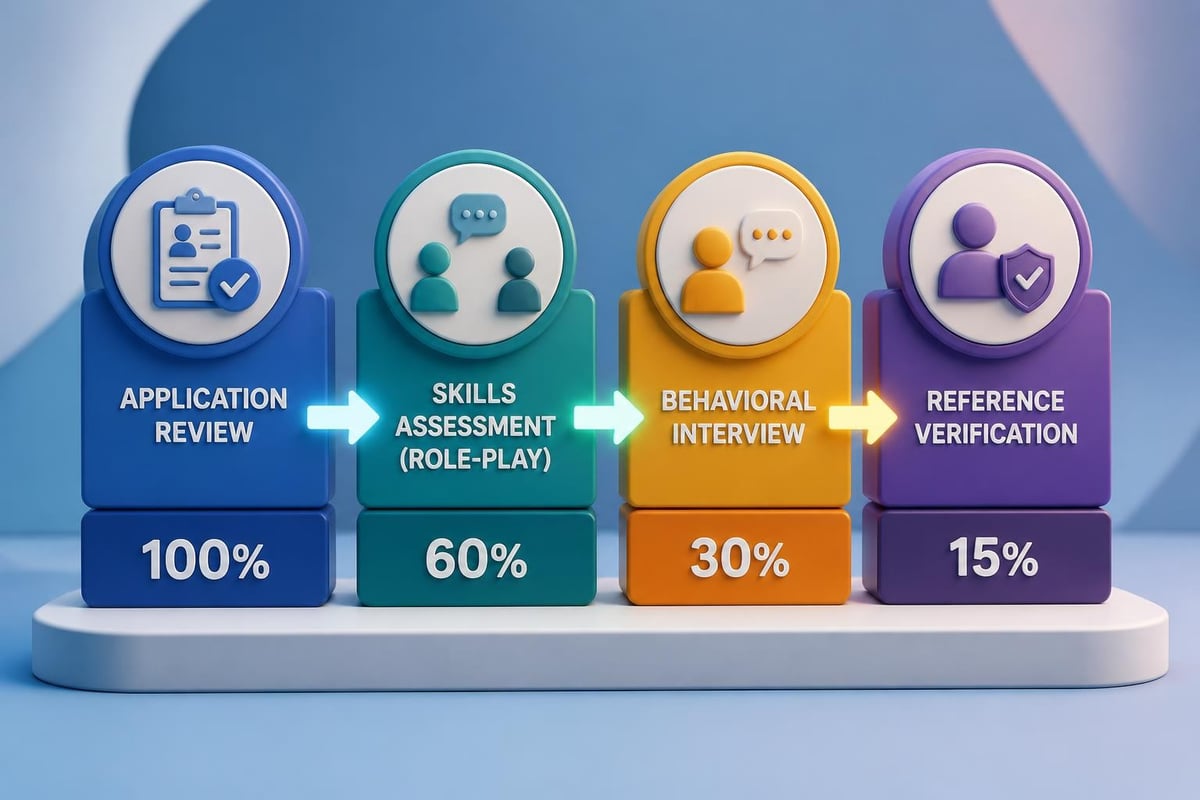
What Vetting Process Should Your Recruiting Team Use?
Multi-step evaluation separates adequate candidates from exceptional performers. A recruiting team handling sales placements must simulate real-world scenarios that reveal capabilities resumes cannot capture.
Stage 1: Application Review and Initial Screening
Review track record focusing on measurable achievements. "Exceeded quota" means little without context - exceeded by what percentage, selling what product, at what price point, with what sales cycle length?
Phone screens should last 15-20 minutes and assess:
Communication clarity and confidence
Sales experience relevance to your specific model
Compensation expectations and motivation drivers
Availability and timeline compatibility
Stage 2: Skills Assessment
Role-play exercises tailored to your actual sales scenarios. For high-ticket closers, present objections specific to your price point and sales cycle. For appointment setters, evaluate qualification questions and calendar conversion technique.
Record these sessions for detailed review by multiple recruiting team members. Assess tonality, pacing, rapport-building, and recovery from challenging moments.
Stage 3: Deep-Dive Interview
Explore situations revealing character and capability:
"Describe your most difficult close and how you navigated it"
"Walk me through your discovery process for a complex B2B sale"
"How do you respond when a prospect goes silent after initial interest?"
"What's your approach when quota seems unreachable mid-month?"
Listen for specificity, self-awareness, and evidence of continuous improvement. Top performers analyze their losses as deeply as their wins.
Vetting Stage | Time Investment | Pass-Through Rate | Key Evaluation Focus |
|---|---|---|---|
Initial Screen | 15-20 minutes | 40-50% | Basic qualification, communication |
Skills Assessment | 45-60 minutes | 25-35% | Role-play performance, objection handling |
Deep Interview | 60-90 minutes | 60-70% | Experience depth, problem-solving |
Final Evaluation | 30-45 minutes | 80-90% | Culture alignment, offer negotiation |
Stage 4: Reference Verification
Contact previous sales managers and colleagues to verify performance claims. Ask specific questions about quota attainment, ranking within team, and areas requiring development.
For high-ticket closer placements, verify closing percentages at specific price points. A closer with 35% conversion at $1,500 may perform very differently at $15,000 deals requiring different objection handling and value articulation.
How Does Your Recruiting Team Match Candidates to Business Models?
Placement success requires understanding that not all sales experience transfers across business models. The recruiting team must evaluate compatibility between candidate background and client requirements.
Sales cycle alignment proves critical. Appointment setters excelling in high-volume, low-consideration environments often struggle when qualifying for complex B2B services requiring deep discovery. Conversely, closers accustomed to 6-month enterprise sales cycles may find 2-call close models frustrating.
Price point experience matters significantly. Research from sales organizations indicates that salespeople perform best within 50% of their historical deal sizes. Someone closing $500 products can typically scale to $750 effectively but may struggle at $5,000 without additional training.
Matching Process Elements
Your recruiting team should document client requirements across multiple dimensions:
Average deal size and range
Typical sales cycle length
Decision-maker complexity (individual versus committee)
Technical complexity of offering
Objection patterns most common
Compensation structure and quota expectations
Then evaluate candidates against these specific parameters rather than generic "sales experience." Appointment setter hiring requires different evaluation criteria than closer placement despite both being sales functions.
What Technology Should Your Recruiting Team Use?
The right tools amplify recruiting team effectiveness without replacing human judgment in critical assessments. Technology should accelerate administrative tasks and provide data visibility while preserving personalized evaluation.
Applicant Tracking Systems (ATS) centralize candidate information, track pipeline progression, and automate communication sequences. For sales recruitment specifically, choose systems allowing custom fields for sales-specific metrics like quota attainment and closing percentages.
Video interviewing platforms enable asynchronous initial screenings where candidates record responses to standard questions. This allows recruiting team members to evaluate communication skills and presentation quality before investing in live conversations.
Assessment platforms deliver standardized role-play scenarios, personality evaluations, and cognitive ability tests. While valuable for baseline screening, these cannot replace live interaction for sales roles where adaptability and real-time thinking separate good from exceptional.
Reference checking automation streamlines verification without losing depth. Structured questionnaires sent to references provide consistent data while allowing follow-up for concerning responses.
Track recruiting team productivity metrics within these systems:
Candidates sourced per recruiter weekly
Time from application to first interview
Interview-to-offer ratio by recruiter
Placement retention rates by sourcing channel
For businesses managing high-volume hiring, automation becomes essential to maintain speed without sacrificing assessment quality. Batch similar tasks - conduct all initial screens on specific days, group role-play assessments together - to minimize context-switching.
How Should Compensation Work Within Your Recruiting Team?
Aligning recruiting team incentives with placement quality rather than simply filling positions creates better long-term outcomes. Poor compensation design encourages speed over candidate-client fit.
Base salary plus performance bonuses tied to specific metrics works effectively:
Placement bonus paid upon candidate start date (30% of total)
Retention bonus paid at 90-day mark (40% of total)
Performance bonus paid when placed candidate achieves quota (30% of total)
This structure incentivizes the recruiting team to prioritize placements likely to succeed rather than maximizing volume. A recruiter who places 10 candidates with 40% retention earns less than one who places 6 candidates with 100% retention.
Team-Based Incentives
Individual performance metrics create competition that may reduce knowledge sharing. Balance individual accountability with team-based bonuses when overall placement targets are met.
For specialized sales recruiting teams, consider role-specific compensation reflecting difficulty. Placing sales managers or enterprise closers requires more sophisticated evaluation than SDR placement - compensation should reflect this complexity.
Review compensation structures quarterly to ensure they drive desired behaviors. If recruiting team members rush late-month placements to hit quotas, the incentive structure needs adjustment.
What Challenges Do Recruiting Teams Face in Sales Placement?
Understanding common obstacles allows proactive mitigation rather than reactive problem-solving. Sales recruitment presents unique challenges distinct from other hiring functions.
Candidate overselling occurs frequently in sales recruitment. Salespeople naturally present themselves compellingly, potentially masking skill gaps or overstating achievements. The recruiting team must look beyond surface-level confidence to evaluate genuine capability.
Implement verification processes at each stage. Cross-reference claimed quota attainment with specific questions: "What was your team's average attainment that quarter? Where did you rank? What percentage of reps hit quota?"
Passive candidate engagement requires different approaches than active job seekers. Top-performing salespeople already earning strong commissions need compelling reasons to consider changes. Your recruiting team must articulate opportunity beyond basic job descriptions.
Client expectation management prevents misalignment. Businesses often seek "unicorns" - closers with 10 years experience, 60% close rates, and willingness to work for low base salary. The recruiting team must educate clients on market realities and compensation benchmarks.
Market Competition and Talent Scarcity
High-performing sales professionals receive multiple offers simultaneously. According to competitive recruiting practices, speed and clear value proposition differentiate successful placements from lost candidates.
Your recruiting team should maintain decision timelines under 7 days from final interview to offer. Lengthy processes cause candidate drop-off regardless of opportunity quality.
For businesses working with external partners, replacement policies provide protection against placements that don't perform as expected, reducing risk in faster hiring decisions.
How Do You Measure Recruiting Team Success?
Defining clear metrics creates accountability and identifies improvement opportunities. Track both efficiency and effectiveness measures to balance speed with quality.
Time-to-fill measures days from requisition opening to candidate acceptance. For sales roles, this should average 21-35 days for closers and 14-21 days for setters. Longer timelines suggest sourcing challenges or overly restrictive criteria.
Quality-of-hire proves more valuable than speed metrics alone. Measure:
Percentage of placements exceeding quota in first 90 days
Average tenure of placed candidates
Manager satisfaction scores for recruiting team placements
Candidate performance ratings at 6-month review
Source effectiveness reveals which channels produce strongest candidates. Track application source (referrals, job boards, social media, passive outreach) against ultimate placement success. Invest more heavily in channels producing higher-quality pipelines.
Offer acceptance rate indicates how well the recruiting team sets expectations and sells opportunities. Rates below 70% suggest misalignment between candidate expectations and actual offers.
Metric | Target Range | Below Target Indicates | Above Target Indicates |
|---|---|---|---|
Time-to-Fill | 21-35 days | Overly selective criteria | Potentially rushed evaluation |
90-Day Retention | 85-95% | Poor candidate-client matching | Effective vetting process |
Offer Accept Rate | 75-85% | Expectation misalignment | Strong candidate experience |
First-Quarter Quota Attainment | 65-75% | Skills assessment gaps | Successful capability prediction |
Monthly recruiting team reviews should analyze these metrics collectively rather than in isolation. Low retention despite fast time-to-fill suggests prioritizing speed over fit. High offer acceptance but poor performance indicates ineffective skills assessment.
What Makes Sales-Specialized Recruiting Teams Different?
Generic recruiting approaches fail in sales placement because the skill set requires behavioral assessment beyond credentials review. A recruiting team focused exclusively on sales develops pattern recognition impossible for generalist HR departments.
Understanding sales psychology allows evaluators to distinguish between genuine confidence and compensatory bravado. Top closers demonstrate quiet certainty rather than aggressive self-promotion. They ask sophisticated questions during interviews rather than simply answering yours.
Recognizing methodology compatibility prevents mismatches. SPIN selling works beautifully for complex B2B but fails in impulse-buy environments. Challenger approaches suit certain buyer types but alienate others. Your recruiting team should identify candidates' natural methodologies and match them to compatible selling environments.
Evaluating coachability predicts long-term success more accurately than current skill level. Sales methodologies evolve, industries change, and products require different approaches. Candidates who demonstrate learning agility and implement feedback outperform those with static skill sets.
Sales-specialized recruiting teams maintain networks within the profession. They attend sales conferences, participate in industry communities, and build relationships with top performers before immediate needs arise. This proactive pipeline development ensures access to talent unavailable through reactive job postings.
Understanding different sales team structures helps recruiting teams evaluate where candidates will thrive - some excel in tightly-scripted environments while others need autonomy to customize approaches.
Building an effective recruiting team for sales roles requires specialized expertise, rigorous vetting processes, and alignment between candidate capabilities and specific business models. The right structure balances speed with quality, uses data to drive continuous improvement, and maintains focus on long-term placement success rather than simply filling positions quickly. For businesses seeking pre-vetted sales talent without building internal recruiting infrastructure, partnering with specialists accelerates growth while reducing hiring risk. Sales Match provides fully-vetted high-ticket closers, appointment setters, and sales managers through a rigorous multi-step evaluation process, offering performance-based and retainer models with unlimited replacement guarantees on select placements.
Author Bio: Craig Emslie is the Founder of Sales Match, a specialized sales recruitment firm based in Saint Petersburg, FL. With extensive experience placing high-ticket closers and appointment setters for online service businesses, Craig has developed proprietary vetting processes that predict sales performance across diverse business models and price points.
