
We Place: Strategic Talent Placement for Sales Teams
Discover how we place sales talent strategically. Learn proven methods for vetting, matching, and placing high-performing salespeople in 2026.
published
TL;DR: When we place sales professionals strategically, the process involves rigorous vetting, precise role alignment, and measurable performance indicators. Successful placement requires understanding both client needs and candidate capabilities, ensuring long-term fit rather than quick hiring fixes.
The phrase "we place" represents more than a simple transaction in recruitment. It embodies a strategic commitment to matching the right sales talent with the right organizations, creating partnerships that drive revenue growth and sustainable business expansion. In 2026, as remote work continues to dominate the sales landscape and competition for top performers intensifies, how we place candidates determines whether businesses thrive or struggle to meet their revenue targets. For service-based businesses selling high-value offerings through digital channels, the placement process has evolved into a sophisticated science combining behavioral assessment, skill validation, and cultural alignment.
What Does "We Place" Actually Mean in Sales Recruitment?
When recruitment professionals say "we place" candidates, they're describing a comprehensive matching process that extends far beyond resume screening and interviews. Strategic placement involves deep analysis of both client requirements and candidate capabilities, ensuring alignment across multiple dimensions: technical skills, sales methodology, industry experience, compensation expectations, and long-term career goals.
The placement process differs fundamentally from traditional hiring. While internal HR teams often focus on filling open positions quickly, specialized sales recruiting firms prioritize quality of fit and long-term performance. This distinction matters significantly for businesses selling products or services above $2,500, where each sales hire directly impacts revenue generation.
The Evolution of Strategic Placement
Modern placement methodologies have transformed dramatically since 2020. According to research from LinkedIn's Global Talent Trends report, 87% of talent professionals say that recruitment has become more strategic and data-driven over the past five years. When we place candidates today, we leverage performance analytics, behavioral assessments, and role-specific competency frameworks that didn't exist a decade ago.

Key components of strategic placement include:
Comprehensive skills assessment beyond resume claims
Industry-specific experience validation
Sales methodology compatibility testing
Communication style evaluation for remote selling
Reference verification from previous managers and clients
Trial projects or role-play scenarios
Cultural fit analysis for long-term retention
Organizations implementing these rigorous placement standards report significantly higher retention rates. Sales recruitment specialists who follow structured methodologies help clients avoid costly mis-hires that can damage team morale and revenue projections.
How Do We Place High-Ticket Sales Professionals Effectively?
Placing high-ticket closers, appointment setters, and sales development representatives requires specialized knowledge of consultative selling environments. Unlike transactional sales roles, these positions demand professionals who can navigate complex decision-making processes, handle objections skillfully, and maintain relationships across extended sales cycles.
The placement process begins with understanding client requirements at a granular level. When we place salespeople for coaching businesses, marketing agencies, or B2B service providers, we analyze their sales process, average deal size, sales cycle length, and ideal customer profile. This foundation enables precise candidate matching.
Vetting Standards for Premium Placements
Assessment Area | Evaluation Method | Success Indicators |
|---|---|---|
Sales Experience | Work history verification | 2+ years in similar roles |
Closing Skills | Role-play scenarios | 70%+ conversion in simulations |
Communication | Video interview analysis | Clear articulation, active listening |
Technical Aptitude | CRM and tools assessment | Proficiency with core platforms |
Industry Knowledge | Vertical-specific questions | Relevant experience documented |
Professional placement firms maintain databases of pre-vetted candidates who have completed these assessments before client engagement begins. This approach dramatically reduces time-to-hire while maintaining quality standards. The sourcing-to-placement process employed by leading firms demonstrates how systematic methodologies improve outcomes.
When we place appointment setters specifically, the evaluation criteria shift to emphasize qualification skills, persistence, calendar management, and ability to handle high-volume outreach. For closers, negotiation skills, deal structuring capabilities, and revenue generation track records take priority.
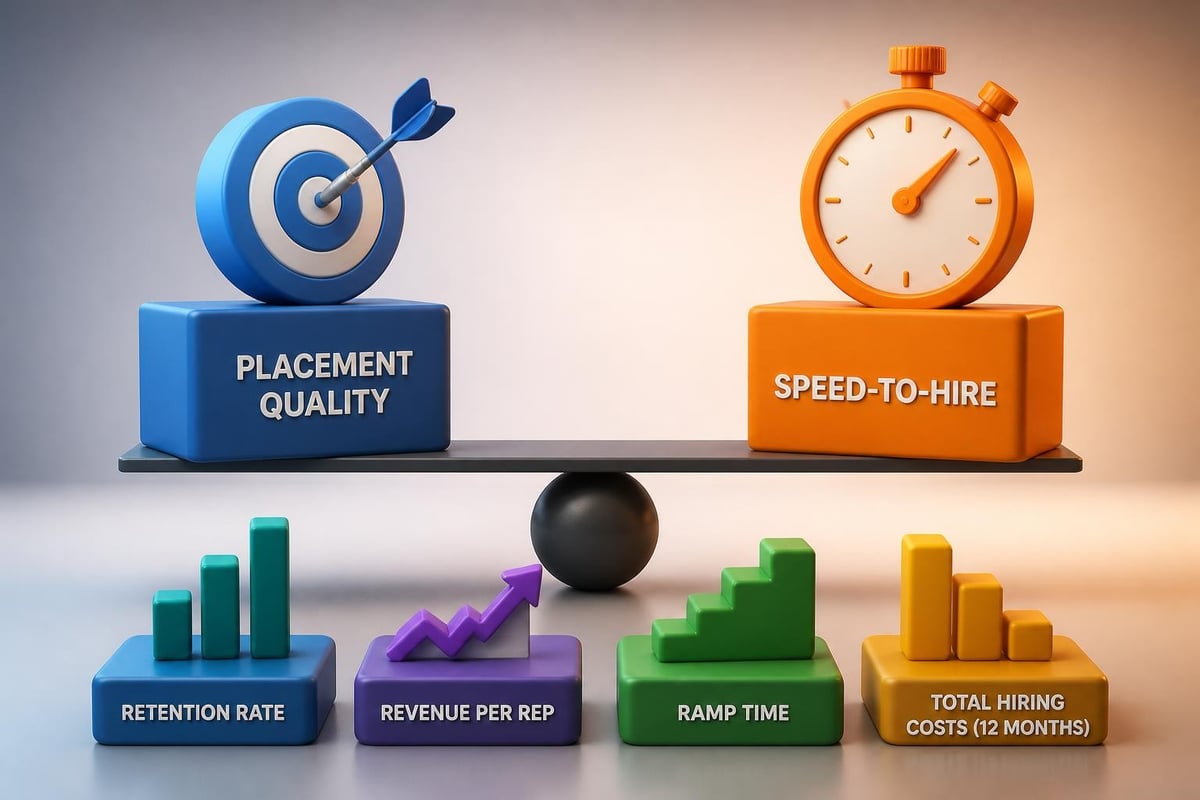
Why Does Placement Quality Matter More Than Speed?
The recruitment industry has historically emphasized speed-to-fill metrics, often at the expense of placement quality. However, data from the Society for Human Resource Management indicates that the average cost of a bad hire equals 30% of the employee's first-year earnings. For high-ticket sales roles where annual compensation can exceed $100,000, this represents substantial financial risk.
When we place candidates through accelerated processes without proper vetting, several problems emerge:
Skill mismatches become apparent only after onboarding investment
Cultural incompatibility creates team friction and productivity loss
Unrealistic expectations lead to early departures and restart costs
Training inefficiencies waste management time on unsuitable candidates
Revenue disruption occurs during search and replacement cycles
Organizations selling high-value offerings through consultative approaches cannot afford these disruptions. Each unfilled sales position or underperforming rep directly impacts monthly revenue. The replacement guarantee policies offered by quality-focused firms protect clients against placement failures.
Building Sustainable Sales Teams
Strategic placement contributes to long-term team stability and performance improvement. When we place salespeople who genuinely align with company culture, sales methodology, and growth trajectory, they integrate faster, ramp more efficiently, and remain longer with the organization.
Research from Gallup's State of the American Workplace study found that highly engaged sales teams show 21% greater profitability than disengaged counterparts. Proper placement creates the foundation for this engagement by ensuring role fit from day one.
Companies working with specialized recruitment services benefit from expertise in specific verticals and role types. This specialization ensures recruiters understand nuanced requirements that generalist HR teams might overlook.
What Separates Strategic Placement from Basic Recruiting?
The distinction between strategic placement and basic recruiting parallels the difference between consultative selling and order-taking. When we place talent strategically, we function as business advisors who understand client growth objectives, market positioning, and competitive dynamics.
Strategic placement involves:
Market intelligence sharing about compensation trends and talent availability
Process consultation to optimize hiring workflows and decision criteria
Candidate development through coaching and interview preparation
Negotiation facilitation to align expectations between clients and candidates
Onboarding support to ensure successful integration and ramp-up
Performance tracking to validate placement success and identify improvements
Basic recruiting focuses primarily on candidate sourcing and submittal. The recruiter acts as a conduit rather than a strategic partner, often resulting in misaligned expectations and placement failures.
Performance-Based Placement Models
Innovative firms have introduced performance-based compensation structures that align recruiter incentives with client outcomes. When we place closers on commission-based arrangements, for example, both the client and placement firm share risk and reward. This model ensures rigorous vetting since the recruiter's success depends on candidate performance.
Placement Model | Client Investment | Risk Distribution | Best For |
|---|---|---|---|
Performance-based | Low upfront cost | Shared between parties | Commission sales roles |
Retainer-based | Monthly fee | Client assumes risk | Salaried positions |
Contingency-based | Success fee only | Recruiter assumes risk | Standard placements |
Hybrid model | Partial retainer + success fee | Balanced risk | Complex searches |
Organizations can explore various recruiting service models to find arrangements matching their budget constraints and hiring urgency. The key consideration involves balancing cost, speed, and quality based on business priorities.
How Can Businesses Evaluate Placement Partner Quality?
Selecting the right recruitment partner significantly influences placement outcomes. When businesses evaluate how potential partners say "we place" candidates, several quality indicators separate exceptional firms from mediocre providers.
Evaluation criteria include:
Vertical specialization in relevant industries and role types
Vetting process rigor with documented assessment methodologies
Candidate pipeline depth demonstrating active sourcing capabilities
Client testimonials from similar businesses and use cases
Replacement guarantees protecting against placement failures
Time-to-placement metrics showing efficiency without sacrificing quality
Communication standards for updates, feedback, and transparency
Professional staffing firms with strong track records provide detailed process documentation and performance data. They articulate clear service level agreements and maintain consistent communication throughout engagements.
Red Flags in Placement Partnerships
Certain warning signs indicate potential problems with recruitment partners:
Promises of unrealistically fast placements without proper vetting
Lack of industry-specific knowledge or vertical expertise
Unwillingness to provide references from current clients
Absence of documented assessment processes or quality standards
High-pressure sales tactics during initial consultations
Unclear fee structures or hidden costs
No replacement guarantees or limited warranty periods
When we place candidates through reputable partners, transparency and mutual accountability characterize the relationship. Both parties share responsibility for successful outcomes.

What Role Does Geography Play When We Place Remote Sales Talent?
The shift to remote work has fundamentally changed how we place sales professionals. Geography no longer constrains talent pools, enabling businesses to access global talent markets. For companies selling through Zoom or Google Meet, physical location matters less than timezone alignment, communication skills, and self-management capabilities.
This geographic flexibility creates both opportunities and challenges. Businesses can find specialized talent regardless of local market constraints, but must implement robust remote management systems and cultural integration processes.
Remote Placement Considerations
When we place remote salespeople, additional evaluation dimensions become critical:
Home office setup and technology infrastructure
Self-motivation and autonomous work capabilities
Communication proficiency in virtual environments
Timezone compatibility with target markets and team meetings
Previous remote experience and track record
Digital tool proficiency with CRM, video conferencing, and collaboration platforms
According to FlexJobs' Annual Survey, remote workers report 24% higher job satisfaction compared to office-based counterparts, suggesting that proper remote placement can enhance retention. The global talent acquisition approach adopted by forward-thinking firms maximizes access to qualified candidates across borders.
Organizations hiring appointment setters and high-ticket closers benefit particularly from geographic flexibility, as these roles translate seamlessly to virtual environments when candidates possess strong digital communication skills.
How Do We Place Candidates While Maintaining Quality Standards?
Maintaining rigorous quality standards throughout high-volume placement requires systematic processes and disciplined execution. When we place multiple sales professionals simultaneously, workflow efficiency cannot compromise vetting thoroughness.
Quality maintenance strategies include:
Documented assessment scorecards with objective criteria
Multi-step interview processes involving various stakeholders
Standardized skill evaluations applied consistently across candidates
Reference check protocols verifying past performance claims
Trial period arrangements allowing performance validation
Continuous feedback loops between clients and placed candidates
Performance tracking systems measuring post-placement success
Leading placement firms implement quality management systems similar to those used in manufacturing, applying Six Sigma or similar methodologies to reduce variation and improve consistency. These systems ensure that when we place the tenth candidate, vetting rigor matches the first placement.
Balancing Customization and Scalability
While systematic processes ensure consistency, effective placement also requires customization for specific client needs. The challenge involves scaling personalized service without degrading quality.
Technology enables this balance through applicant tracking systems, assessment automation, and candidate relationship management platforms. However, human judgment remains essential for evaluating cultural fit, communication nuance, and intangible qualities that determine sales success.
The recruitment process outsourcing approach used by some firms combines technology efficiency with personalized service, creating scalable yet customized placement solutions.
What Happens After We Place a Candidate Successfully?
Strategic placement extends beyond offer acceptance and day-one onboarding. When we place sales professionals, comprehensive support during the integration period significantly impacts long-term success and retention.
Post-placement support includes:
Structured onboarding programs covering systems, processes, and expectations
Regular check-ins with both client and candidate during the first 90 days
Performance milestone tracking to identify issues early
Coaching resources to address skill gaps or adjustment challenges
Feedback facilitation between managers and new hires
Issue resolution when misalignments emerge
Relationship management maintaining long-term partnerships
Organizations that invest in thorough onboarding see new sales hires reach full productivity 34% faster than those with minimal integration support, according to research from the Sales Management Association.
Quality-focused recruitment partners maintain ongoing relationships after placement, functioning as extended team members rather than transactional service providers. This approach aligns incentives around candidate success and long-term client satisfaction.
How Does We Place Talent for Specialized Sales Roles?
Specialized sales positions require nuanced placement approaches. When we place sales development representatives, appointment setters, account executives, and sales managers, each role demands distinct competencies and assessment methodologies.
Role-Specific Placement Requirements
Role Type | Critical Skills | Assessment Focus | Success Metrics |
|---|---|---|---|
SDR | Prospecting, qualification | Activity volume, research quality | Meeting set rate |
Appointment Setter | Persistence, calendar management | Dial metrics, show rate | Qualified appointments |
Closer | Negotiation, deal structuring | Close rate, average deal size | Revenue generated |
Sales Manager | Leadership, coaching | Team development, process | Team quota attainment |
When we place customer success managers, the evaluation shifts toward relationship management, client retention capabilities, and expansion selling skills. These positions require different personality profiles than pure acquisition roles.
Understanding these distinctions enables precise matching between candidate strengths and role requirements. Generic assessment approaches miss critical nuances that determine performance in specialized positions.
Strategic talent placement requires balancing speed, quality, and cultural fit while maintaining rigorous vetting standards throughout the process. When businesses need to scale their sales teams with pre-vetted professionals who can deliver results immediately, partnering with specialists who understand high-ticket sales environments makes the difference between revenue growth and costly hiring mistakes. Sales Match provides access to rigorously vetted closers, appointment setters, and SDRs ready to perform in consultative selling environments, with performance-based models and replacement guarantees that protect your investment while accelerating team growth.
About the Author: Craig Emslie is the Founder of Sales Match, a specialized sales recruitment firm based in Saint Petersburg, FL. With extensive experience placing high-ticket sales professionals for service-based businesses, Craig has developed systematic vetting processes that ensure quality placements and long-term client success.
