
Sales Executive Recruiting Firms: Complete Guide 2026
Discover how sales executive recruiting firms help high-ticket businesses find top closers and appointment setters. Expert insights for 2026.
published
Finding exceptional sales talent has become increasingly challenging for businesses operating in the high-ticket space. Sales executive recruiting firms specialize in connecting companies with proven closers and appointment setters who can drive consistent performance. For businesses selling products or services over $2,500 through virtual platforms like Zoom or Google Meet, partnering with the right recruiting firm can eliminate months of trial and error while building a team capable of scaling revenue predictably.
Understanding the Sales Executive Recruiting Landscape
Sales executive recruiting firms operate differently than traditional staffing agencies. These specialized organizations focus exclusively on identifying, vetting, and placing sales professionals who can perform in high-pressure environments. The distinction matters because selling high-ticket offers requires a unique skill set that goes far beyond basic cold calling or relationship building.
According to the IBISWorld executive search industry report, the executive search and recruiting sector has evolved significantly over the past decade, with specialized firms capturing larger market share. This trend reflects growing recognition that generic hiring approaches fail when businesses need salespeople who can handle complex sales cycles and sophisticated buyer objections.
What Separates Specialized Firms from General Recruiters
The difference between a general staffing agency and sales executive recruiting firms becomes apparent when you examine their methodology. Specialized firms maintain active pipelines of candidates who have already demonstrated success in consultative selling environments. They understand the nuances of different sales roles, from appointment setters who excel at booking qualified meetings to closers who can navigate multi-call sales sequences.
Key differentiators include:
Deep industry knowledge of sales methodologies and compensation structures
Established networks within specific sales niches
Rigorous assessment processes that test actual selling skills
Understanding of remote work dynamics and virtual selling requirements
Experience matching personality types to company culture
Why High-Ticket Businesses Need Specialized Recruiting Partners
Marketing agencies, coaches, consultants, and service-based businesses face unique hiring challenges. Unlike companies selling low-ticket products where volume compensates for lower conversion rates, high-ticket sales require precision. A single underperforming salesperson can cost tens or hundreds of thousands in lost opportunities.
The stakes are particularly high when your sales process happens entirely over internet-based calls. Sales executive recruiting firms that specialize in this environment understand what separates adequate performers from exceptional closers. They recognize that remote sales roles demand self-discipline, technical proficiency, and the ability to build rapport without in-person interaction.
The True Cost of Bad Sales Hires
When you hire the wrong salesperson, the financial impact extends beyond their salary. Consider the opportunity cost of leads that were mishandled, the time invested in training someone who ultimately fails, and the potential damage to your brand reputation. Research on sales recruitment best practices shows that poor hiring decisions in sales roles create ripple effects throughout the entire organization.
Hidden Cost Category | Impact on Business |
|---|---|
Wasted lead flow | Qualified prospects burned through ineffective follow-up |
Training investment | Time and resources spent on onboarding that yields no return |
Team morale | Existing performers frustrated by carrying underperformers |
Revenue delays | Extended timeline to profitability while searching for replacement |
Brand perception | Poor sales experiences damaging market reputation |
The Modern Vetting Process for Sales Talent
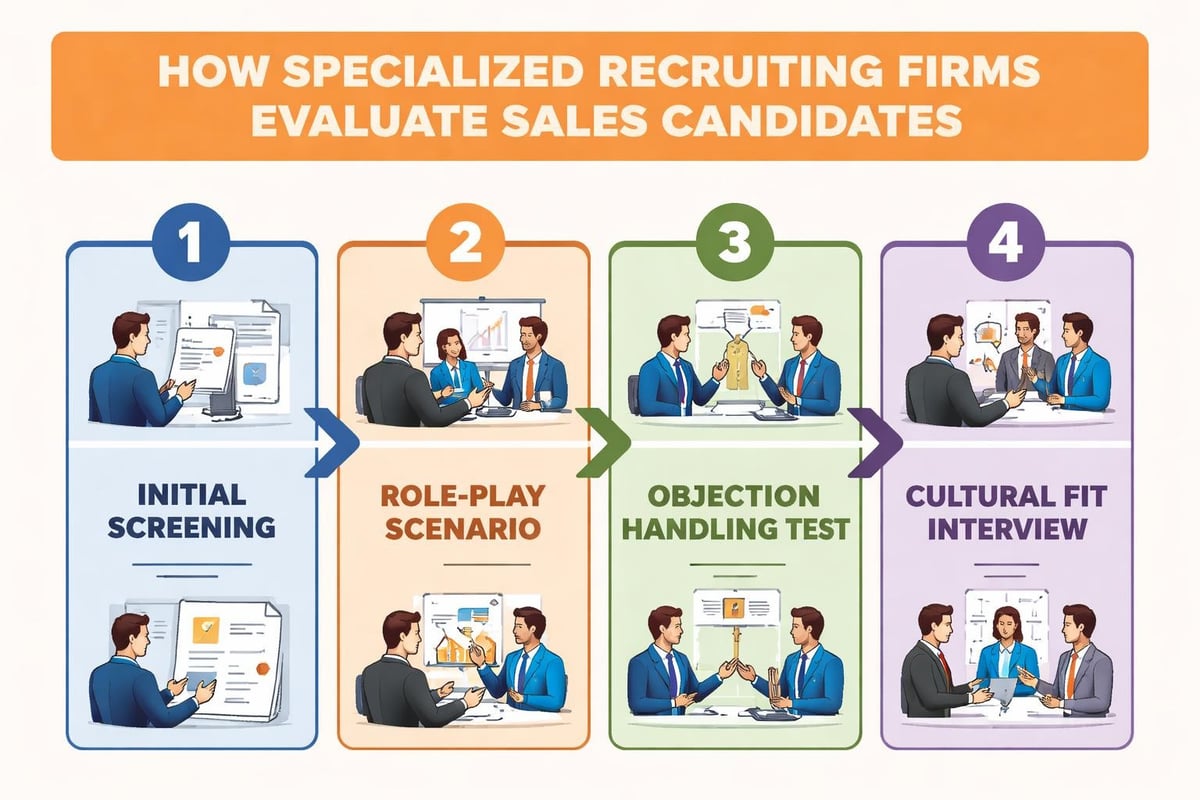
Sales executive recruiting firms have evolved their assessment methodologies to match the demands of 2026's selling environment. Traditional interviews that focus on resume credentials and conversational ability no longer suffice. Today's leading firms employ multi-stage evaluation processes that simulate real selling conditions.
At Sales Match, the focus centers on identifying candidates who have already succeeded in high-ticket environments. This approach recognizes that past performance in similar roles provides the most reliable predictor of future success. The emphasis on vetted candidates ensures businesses receive salespeople who can produce results immediately rather than requiring extensive development.
Assessment Components That Matter
Modern vetting processes incorporate both quantitative and qualitative measures. Sales executive recruiting firms test for specific competencies that correlate with high-ticket closing ability. These assessments go beyond checking references or verifying employment history.
Critical evaluation areas include:
Objection handling proficiency through recorded role-play scenarios
Technical literacy for managing CRM systems and virtual meeting platforms
Consultative selling skills measured through discovery call simulations
Resilience and rejection tolerance assessed through behavioral interviews
Communication clarity evaluated in both written and verbal formats
Cultural alignment gauged through values-based questioning
According to 2026 sales hiring trends, technical fluency has become non-negotiable. Salespeople must navigate multiple software platforms while maintaining conversational flow with prospects. This dual capability represents a significant shift from traditional sales roles where administrative tasks were handled by support staff.
Matching Sales Talent to Business Models
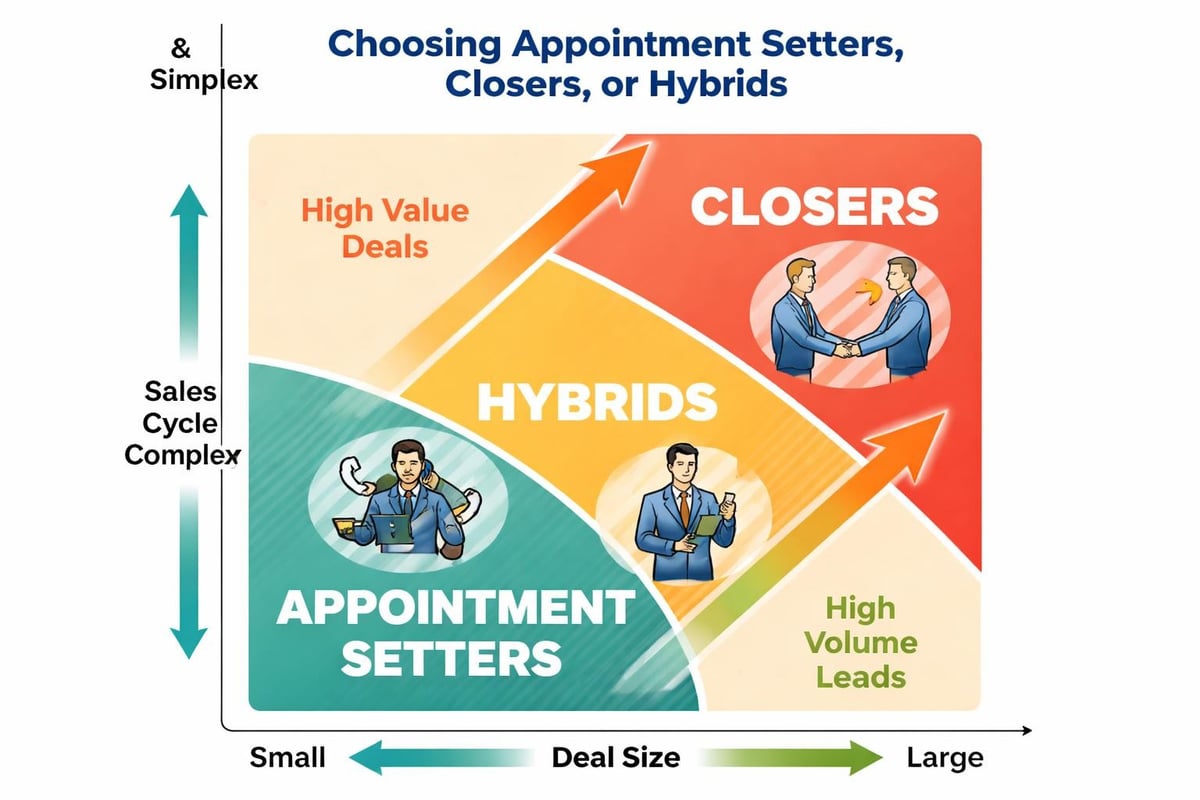
Not all sales roles are created equal, and sales executive recruiting firms must understand these distinctions. An appointment setter who excels at booking meetings for software companies might struggle in a coaching environment where emotional intelligence and lifestyle transformation discussions dominate. Similarly, a closer who thrives in single-call environments may underperform when your sales cycle requires multiple touchpoints over weeks.
The matching process requires detailed understanding of your business model, offer structure, average deal size, and sales cycle length. Firms that specialize in high-ticket remote sales understand these variables and how they impact candidate selection. They recognize that selling a $5,000 consulting package differs fundamentally from closing a $50,000 implementation project, even though both qualify as high-ticket.
The Appointment Setter vs. Closer Distinction
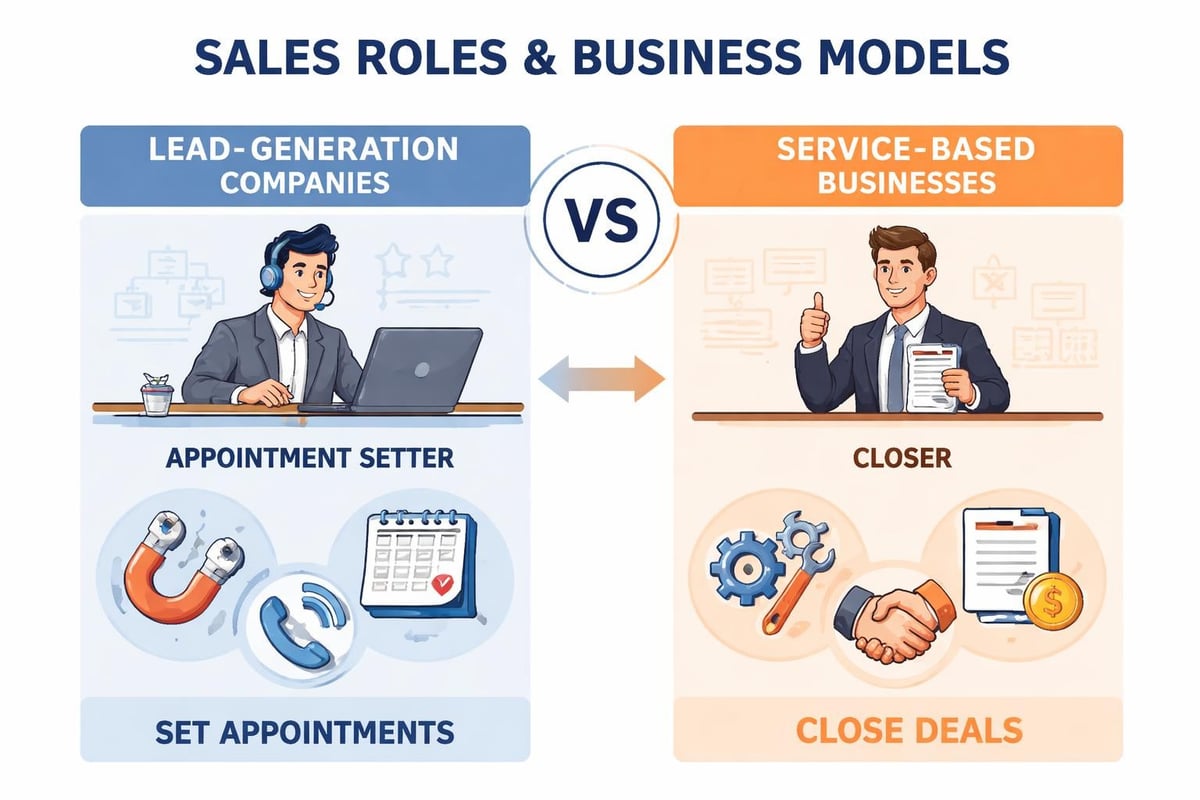
Many businesses conflate these roles, but they require different skill sets and personality types. Appointment setters focus on qualifying prospects and booking calendar slots for senior closers. They need pattern recognition to identify buying signals, persistence to work through large contact lists, and communication skills to create curiosity without overselling.
Closers, conversely, must handle objections, negotiate pricing, create urgency, and ask for the sale directly. They operate in higher-pressure environments where individual conversations can result in five or six-figure decisions. The personality traits that make someone an exceptional appointment setter don't automatically translate to closing ability.
Role Type | Primary Skills | Success Metrics | Typical Compensation |
|---|---|---|---|
Appointment Setter | Qualification, curiosity creation, calendar management | Show rate, qualified meeting percentage | Base plus performance bonuses |
Closer | Objection handling, negotiation, urgency creation | Close rate, average deal size, customer retention | Base plus commission or pure commission |
What to Look for When Selecting a Recruiting Partner
Choosing among sales executive recruiting firms requires careful evaluation. The wrong partnership wastes time and money while leaving your sales pipeline understaffed. The right relationship provides access to talent you couldn't locate independently while accelerating your path to a fully functioning sales team.
Start by examining their candidate pool and placement history. Firms that specialize in your industry or business model bring context that generalists lack. They understand the language your ideal customers speak, the objections your salespeople will encounter, and the rhythms of your typical sales cycle.
Questions to Ask Potential Recruiting Partners
Before committing to any sales executive recruiting firm, conduct thorough due diligence. Their answers reveal whether they can deliver on their promises or simply provide access to the same candidate pool available through job boards.
What is your average time-to-placement for roles similar to ours?
How do you source candidates beyond traditional job postings?
What specific assessments do you use to evaluate sales competency?
Can you describe your replacement policy if a placement doesn't work out?
How do you stay current with evolving sales methodologies and technologies?
What ongoing support do you provide after placement?
How do you handle compensation expectations and negotiations?
The importance of offering constructive feedback during hiring cannot be overstated. Top sales candidates evaluate potential employers just as critically as you evaluate them. Firms that facilitate transparent communication and rapid decision-making help you secure candidates before competitors do.
Emerging Trends Reshaping Sales Recruitment
The sales executive recruiting landscape continues evolving as technology and buyer behavior shift. Sales recruitment trends for 2026 highlight several developments that impact how businesses should approach talent acquisition. Understanding these trends helps you select recruiting partners who operate at the industry's leading edge rather than relying on outdated methods.
Skills-based hiring has gained prominence over credential-focused selection. According to research on building high-performing sales teams, companies that prioritize demonstrated abilities over educational backgrounds or previous company names access broader talent pools while improving performance outcomes.
The Rise of Pre-Vetted Talent Platforms
Traditional recruiting models required businesses to review dozens of resumes, conduct multiple interview rounds, and invest weeks vetting candidates before making offers. Modern sales executive recruiting firms have disrupted this approach by maintaining pools of pre-screened talent ready for immediate deployment.
This shift particularly benefits high-ticket businesses that can't afford extended vacancies in critical sales positions. When a closer leaves or you need to scale quickly for a product launch, accessing ready-to-hire candidates compressed from weeks to days changes your operational dynamics entirely.
Benefits of pre-vetted talent access:
Reduced time-to-productivity for new hires
Lower risk of mis-hires through proven track records
Faster scaling during growth periods
Decreased internal recruiting overhead
Access to passive candidates not actively job searching
Building Your Sales Team Strategy
Partnering with sales executive recruiting firms should align with your broader team-building strategy. Some businesses need to hire entire sales departments from scratch, while others simply need to fill specific gaps in existing structures. Your approach should reflect your growth timeline, budget constraints, and internal management capacity.
Consider whether you need full-time employees or if project-based contractors better suit your current stage. For businesses just validating high-ticket offers, committing to full-time salaries before proving product-market fit creates unnecessary financial pressure. Conversely, established companies with consistent lead flow benefit from building dedicated internal teams with strong cultural alignment.
Compensation Structures That Attract Top Performers
Sales executive recruiting firms understand that compensation packages make or break your ability to attract elite talent. Top performers have options and gravitate toward opportunities offering the best combination of base security, commission upside, and growth potential. Your commission structure communicates volumes about how you value sales contributions.
According to strategies for hiring top sales talent, competitive packages in 2026 often include performance accelerators, where commission percentages increase after hitting specific thresholds. This approach rewards exceptional performers while maintaining profitability on average deals.
Technology's Role in Modern Sales Recruiting
While technology has transformed how sales executive recruiting firms operate, the human element remains irreplaceable. Automated sourcing tools help identify candidates matching specific criteria, but evaluating sales ability still requires experienced recruiters who understand the profession's nuances. The most effective firms blend technological efficiency with human judgment.
Assessment platforms now simulate real sales scenarios with remarkable fidelity. Candidates can demonstrate their objection-handling skills, discovery question frameworks, and closing techniques through recorded exercises that hiring managers review asynchronously. This approach saves time while providing richer evaluation data than traditional interviews.
Balancing Automation with Personal Touch
The risk in over-automating recruitment processes lies in losing the personal connection that helps candidates envision themselves succeeding within your organization. Best practices for sales recruiting firms emphasize maintaining human touchpoints throughout the candidate journey, even when technology handles screening and scheduling.
Top sales professionals respond to recruiters who understand their career aspirations, can articulate growth paths, and facilitate meaningful conversations with hiring managers. The firms that win elite talent treat the recruiting process itself as a sales experience, recognizing that candidates are evaluating them just as critically.
Measuring Recruiting Success Beyond Initial Placement
The relationship with sales executive recruiting firms shouldn't end when a candidate accepts your offer. Long-term success requires measuring performance metrics that indicate whether placements are actually improving your business outcomes. Track not just hiring speed but retention rates, ramp time to productivity, and actual sales performance against expectations.
According to insights on attracting sales executives, the best recruiting partnerships include post-placement support. This might involve check-ins during the first 90 days, coaching resources for new hires, or facilitated feedback sessions that help both parties understand what's working and what needs adjustment.
Key performance indicators for recruitment success:
Time from job posting to accepted offer
Percentage of candidates who pass 90-day probation periods
Average ramp time to first closed deal
Year-one retention rate for placed candidates
Performance ranking of recruited salespeople versus existing team
Cost per successful placement versus internal recruiting expenses
Navigating Common Recruiting Challenges
Even when partnering with experienced sales executive recruiting firms, obstacles emerge. Candidate ghosting, where promising prospects disappear mid-process, wastes time and creates frustration. Misaligned expectations around compensation, work environment, or growth opportunities derail promising matches. Understanding these challenges helps you work more effectively with recruiting partners.
The vetting process helps minimize many common problems, but perfect prediction remains impossible. Human behavior introduces variables that no assessment can fully capture. This reality makes replacement guarantees and ongoing support valuable components of recruiting partnerships.
Managing the Remote Work Dynamic
For businesses operating entirely through virtual platforms, assessing whether candidates can thrive in remote environments adds another evaluation layer. Skills that predict success in office-based sales roles don't automatically transfer to remote high-ticket closing positions. Self-motivation, home office professionalism, and digital communication proficiency become critical success factors.
Sales executive recruiting firms specializing in remote placements understand these distinctions. They screen for candidates who have already proven their ability to produce results without direct supervision, manage their own schedules effectively, and maintain performance standards without the social reinforcement of office environments.
Selecting the right sales executive recruiting firms transforms your ability to build teams capable of consistent performance in high-ticket environments. By focusing on specialized expertise, rigorous vetting processes, and alignment with your specific business model, you can access talent that would otherwise remain invisible through traditional hiring channels. Sales Match provides pre-vetted appointment setters and closers specifically for businesses selling high-ticket offers over internet-based calls, eliminating the lengthy hiring processes that prevent many companies from scaling their sales operations effectively.